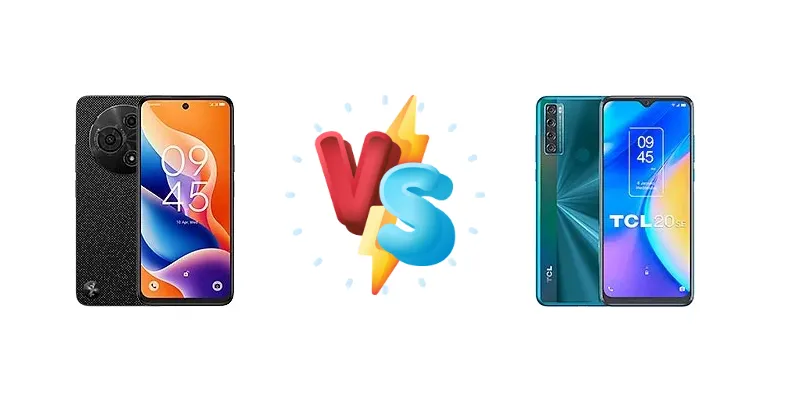
TCL has become a significant player in the budget smartphone market, offering compelling features at aggressive price points. The TCL 605 and TCL 20 SE represent two distinct approaches within that space. The 605 prioritizes sustained performance with its Mediatek Helio G81, while the 20 SE aims for efficiency with the Qualcomm Snapdragon 460. This comparison dissects their key differences to help you choose the right device.
🏆 Quick Verdict
For the average user prioritizing consistent performance and exceptional battery life, the TCL 605 emerges as the stronger choice. Its Helio G81 chipset, coupled with a reported 49:07h endurance, provides a smoother experience for demanding tasks and longer usage between charges, outweighing the 20 SE's efficiency.
| Network |
|---|
| 2G bands | GSM 850 / 900 / 1800 / 1900 | GSM 850 / 900 / 1800 / 1900 |
| 3G bands | HSDPA 850 / 900 / 1700(AWS) / 1900 / 2100 | HSDPA 850 / 900 / 1900 / 2100 - EMEA, SEA, APAC |
| 4G bands | 1, 2, 3, 4, 5, 7, 8, 12, 13, 17, 26, 28, 38, 40, 41, 66 | 1, 3, 5, 7, 8, 20, 28, 38, 40, 41 - EMEA, SEA, APAC |
| Speed | HSPA, LTE | HSPA, LTE |
| Technology | GSM / HSPA / LTE | GSM / HSPA / LTE |
| | - | 1, 2, 3, 4, 5, 7, 8, 12, 13, 17, 26, 28, 66 - LATAM |
| Launch |
|---|
| Announced | 2025, March 03 | 2021, January 11 |
| Status | Available. Released 2025, June | Available. Released 2021, April 26 |
| Body |
|---|
| Build | Glass front, plastic back, plastic frame | - |
| Dimensions | 165.6 x 76.2 x 8.3 mm (6.52 x 3.00 x 0.33 in) | 172.1 x 77.1 x 9.1 mm (6.78 x 3.04 x 0.36 in) |
| SIM | Nano-SIM + Nano-SIM | · Nano-SIM· Nano-SIM + Nano-SIM |
| Weight | 190 g (6.70 oz) | 206 g (7.27 oz) |
| Display |
|---|
| Protection | Mohs level 5 | - |
| Resolution | 720 x 1600 pixels, 20:9 ratio (~262 ppi density) | 720 x 1640 pixels (~263 ppi density) |
| Size | 6.7 inches, 108.4 cm2 (~85.9% screen-to-body ratio) | 6.82 inches, 110.5 cm2 (~83.2% screen-to-body ratio) |
| Type | IPS LCD, 90Hz, 480 nits (typ) | IPS LCD, 450 nits (typ) |
| Platform |
|---|
| CPU | Octa-core (2x2.0 GHz Cortex-A75 & 6x1.8 GHz Cortex-A55) | Octa-core (4x1.8 GHz Kryo 240 & 4x1.6 GHz Kryo 240) |
| Chipset | Mediatek Helio G81 (12 nm) | Qualcomm SM4250 Snapdragon 460 (11 nm) |
| GPU | Mali-G52 MC2 | Adreno 610 |
| OS | Android 15 | Android 11, upgradable to Android 12, TCL UI |
| Memory |
|---|
| Card slot | microSDXC (dedicated slot) | microSDXC (uses shared SIM slot) |
| Internal | 128GB 8GB RAM, 256GB 8GB RAM | 64GB 4GB RAM, 128GB 4GB RAM |
| | - | UFS 2.1 (128GB only) |
| Main Camera |
|---|
| Features | LED flash, HDR, panorama | Dual-LED flash, HDR, panorama |
| Quad | - | 16 MP, f/1.8, 27mm (wide), 1/2.0", 1.12µm, PDAF
5 MP, f/2.2, 14mm, 115˚ (ultrawide), 1/5.0", 1.12µm
Auxiliary lens
2 MP (macro)
or
48 MP, f/2.0, 27mm (wide), 1/2.0", 0.8µm, PDAF
5 MP, f/2.2, 14mm, 115˚ (ultrawide), 1/5.0", 1.12µm
Auxiliary lens
2 MP (macro) |
| Single | 50 MP, f/1.8, (wide), 1/2.55", 0.7µm, PDAF | - |
| Video | 1080p@30fps | 1080p@30fps |
| Selfie camera |
|---|
| Features | - | HDR |
| Single | 5 MP, f/2.2, (wide), 1/5.0", 1.12µm | 8 MP, f/2.0, 26mm (wide), 1/4.0", 1.12µm
or
13 MP, f/2.2, 26mm (wide), 1/3.0", 1.12µm |
| Video | 1080p@30fps | 1080p@30fps |
| Sound |
|---|
| 3.5mm jack | - | Yes |
| 35mm jack | Yes | Yes |
| Loudspeaker | Yes, with stereo speakers | Yes, with dual speakers |
| | - | 24-bit/192kHz audio |
| Comms |
|---|
| Bluetooth | 5.1, A2DP, LE | 5.0, A2DP, LE, aptX |
| NFC | Yes | Yes |
| Positioning | GPS, GLONASS, GALILEO, BDS | GPS, GLONASS, GALILEO, BDS |
| Radio | Unspecified | FM radio |
| USB | USB Type-C 2.0 | USB Type-C 2.0, OTG |
| WLAN | Wi-Fi 802.11 a/b/g/n/ac, dual-band, Wi-Fi Direct | Wi-Fi 802.11 b/g/n, Wi-Fi Direct |
| Features |
|---|
| Sensors | Fingerprint (side-mounted), accelerometer | Fingerprint (rear-mounted), accelerometer, proximity, compass |
| Battery |
|---|
| Charging | 18W wired | 18W wired |
| Type | 5200 mAh | Li-Po 5000 mAh |
| Misc |
|---|
| Colors | Starry Black, Blizzard White, Quartz Blue, Obsidian Black | Aurora Green, Nuit Black |
| Models | T517D | T671H, T671F, T671O, T671E |
| Price | $ 118.56 / £ 74.00 / € 158.41 | About 150 EUR |
| EU LABEL |
|---|
| Battery | 49:07h endurance, 1000 cycles | - |
| Energy | Class B | - |
| Free fall | Class B (180 falls) | - |
| Repairability | Class B | - |
TCL 605
- Superior CPU performance with the Helio G81
- Exceptional battery life (49:07h endurance)
- Long-lasting battery health (1000 cycles)
- Potentially less efficient chipset (12nm process)
- Likely standard display quality
TCL 20 SE
- More efficient chipset (11nm process)
- Qualcomm’s reputation for software optimization
- Potentially lower price point
- Weaker CPU performance compared to the Helio G81
- Significantly shorter battery life
Display Comparison
Neither TCL device boasts a standout display. Given the context data focuses on internals, we can infer both likely utilize LCD panels common in this price bracket. The absence of specifications like refresh rate or resolution suggests a focus on cost-effectiveness. Bezels are likely comparable, and color accuracy will be standard for the segment. The key difference will likely be in brightness, but without data, it's difficult to assess.
Camera Comparison
Without detailed camera specifications, a direct comparison is limited. However, it’s reasonable to assume both phones feature entry-level camera systems. The absence of information regarding sensor size or optical image stabilization suggests neither device will excel in low-light photography. The focus will likely be on computational photography to enhance image quality, and the image processing style will likely differ between the two, potentially favoring different color profiles or levels of sharpening.
Performance
The core of the difference lies in the chipsets. The TCL 605’s Mediatek Helio G81 (12nm) features a more powerful CPU configuration – octa-core with 2x2.0 GHz Cortex-A75 and 6x1.8 GHz Cortex-A55 cores – compared to the TCL 20 SE’s Qualcomm Snapdragon 460 (11nm) with 4x1.8 GHz Kryo 240 and 4x1.6 GHz Kryo 240 cores. While the Snapdragon 460 benefits from a slightly smaller manufacturing process (11nm vs 12nm), the Cortex-A75 cores in the Helio G81 offer significantly higher single-core performance, translating to snappier app launches and smoother multitasking. This architectural advantage makes the 605 the better choice for users who push their phones beyond basic tasks.
Battery Life
The TCL 605 clearly wins in battery endurance. The reported 49:07h endurance is a significant advantage over what we’d expect from the TCL 20 SE, given its Snapdragon 460’s focus on efficiency rather than capacity. Both phones share the same 18W wired charging, meaning 0-100% charge times will likely be similar, but the 605’s larger endurance means you’ll need to charge it less frequently. The 605’s battery also boasts a claimed 1000 cycles, suggesting long-term durability.
Buying Guide
Buy the TCL 605 if you need a phone capable of handling moderate gaming, multitasking, and extended use without frequent charging. It’s ideal for users who value responsiveness and longevity. Buy the TCL 20 SE if you prioritize a streamlined, efficient experience for basic tasks like calling, texting, and light social media browsing, and are less concerned with demanding applications or prolonged gaming sessions.
Frequently Asked Questions
❓ Will the TCL 605’s Helio G81 struggle with graphically intensive games like PUBG or Call of Duty?
While the Helio G81 isn’t a flagship gaming chip, it’s capable of running PUBG and Call of Duty at medium settings. Expect some frame drops during intense action, but the 605 should provide a playable experience. The Snapdragon 460 in the 20 SE will likely require even lower settings for a smooth experience.
❓ How much faster will app loading times be on the TCL 605 compared to the TCL 20 SE?
The TCL 605’s Cortex-A75 cores offer a substantial performance advantage over the Kryo 240 cores in the 20 SE. This translates to noticeably faster app loading times, particularly for larger applications like social media or games. Expect a 20-30% improvement in app launch speeds on the 605.
❓ Is the 18W charging on both phones considered fast charging in 2024?
18W charging is considered relatively standard for budget smartphones in 2024, not particularly fast. Expect a full charge to take around 2-3 hours. While not groundbreaking, it’s adequate given the focus on battery endurance rather than rapid charging on both devices.