
TCL 60 vs Samsung Galaxy A54: A Deep Dive into Battery, Performance, and Value
| Phones Images | |||||
|---|---|---|---|---|---|
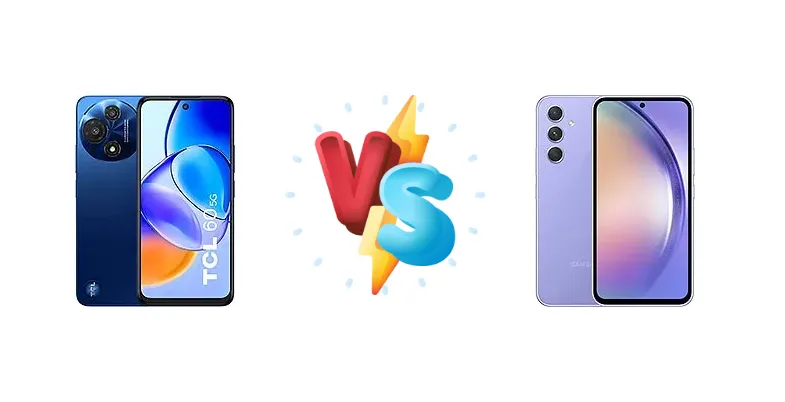
|
🏆 Quick Verdict
For users prioritizing all-day (and multi-day) battery life, the TCL 60 is the clear winner, boasting a remarkable 52:47h endurance. However, the Samsung Galaxy A54 counters with a significantly brighter 980 nit display and a more refined software experience, making it ideal for media consumption and users invested in the Samsung ecosystem.
| PHONES | ||
|---|---|---|
| Phone Names | TCL 60 | Samsung Galaxy A54 |
| Network | ||
|---|---|---|
| 2G bands | GSM 850 / 900 / 1800 / 1900 | GSM 850 / 900 / 1800 / 1900 |
| 3G bands | HSDPA 850 / 900 / 1700(AWS) / 1900 / 2100 | HSDPA 850 / 900 / 1700(AWS) / 1900 / 2100 |
| 4G bands | 1, 2, 3, 4, 5, 7, 8, 12, 13, 17, 20, 26, 28, 32, 38, 40, 41, 42, 66 | 1, 2, 3, 4, 5, 7, 8, 12, 17, 20, 26, 28, 32, 38, 40, 41, 66 - International |
| 5G bands | 1, 3, 5, 7, 8, 20, 26, 28, 38, 40, 41, 66, 75, 77, 78 SA/NSA | 1, 3, 7, 8, 20, 28, 38, 40, 41, 77, 78 SA/NSA/Sub6 - International |
| Speed | HSPA, LTE, 5G | HSPA, LTE, 5G |
| Technology | GSM / HSPA / LTE / 5G | GSM / HSPA / LTE / 5G |
| - | 25, 41, 66, 71 SA/NSA/Sub6/mmWave - USA | |
| Launch | ||
|---|---|---|
| Announced | 2025, March 03 | 2023, March 15 |
| Status | Available. Released 2025, May | Available. Released 2023, March 24 |
| Body | ||
|---|---|---|
| Build | - | Glass front (Gorilla Glass 5), glass back (Gorilla Glass 5), plastic frame |
| Dimensions | 165.6 x 76.2 x 8.2 mm (6.52 x 3.00 x 0.32 in) | 158.2 x 76.7 x 8.2 mm (6.23 x 3.02 x 0.32 in) |
| SIM | Nano-SIM + eSIM | · Nano-SIM + eSIM· Nano-SIM + Nano-SIM |
| Weight | 190 g (6.70 oz) | 202 g (7.13 oz) |
| - | IP67 dust/water resistant (up to 1m for 30 min) | |
| Display | ||
|---|---|---|
| Protection | Mohs level 5 | Corning Gorilla Glass 5 |
| Resolution | 720 x 1600 pixels, 20:9 ratio (~262 ppi density) | 1080 x 2340 pixels, 19.5:9 ratio (~403 ppi density) |
| Size | 6.7 inches, 108.4 cm2 (~85.9% screen-to-body ratio) | 6.4 inches, 100.5 cm2 (~82.9% screen-to-body ratio) |
| Type | IPS LCD, 120Hz, 480 nits (typ) | Super AMOLED, 120Hz, HDR10+, 1000 nits (HBM) |
| Platform | ||
|---|---|---|
| CPU | Octa-core (2x2.4 GHz Cortex-A76 & 6x2.0 GHz Cortex-A55) | Octa-core (4x2.4 GHz Cortex-A78 & 4x2.0 GHz Cortex-A55) |
| Chipset | Mediatek Dimensity 6300 (6 nm) | Exynos 1380 (5 nm) |
| GPU | Mali-G57 MC2 | Mali-G68 MP5 |
| OS | Android 15 | Android 13, up to 4 major Android upgrades, One UI 7 |
| Memory | ||
|---|---|---|
| Card slot | microSDXC (dedicated slot) | microSDXC (uses shared SIM slot) |
| Internal | 256GB 6GB RAM | 128GB 4GB RAM, 128GB 6GB RAM, 128GB 8GB RAM, 256GB 6GB RAM, 256GB 8GB RAM |
| Main Camera | ||
|---|---|---|
| Dual | 50 MP, f/1.8, 26mm (wide), 1/2.5", 0.7µm, PDAF 5 MP, (ultrawide) | - |
| Features | LED flash, HDR, panorama | LED flash, panorama, HDR |
| Single | - | 32 MP, f/2.2, 26mm (wide), 1/2.8", 0.8µm |
| Triple | - | 50 MP, f/1.8, 23mm (wide), 1/1.56", 1.0µm, PDAF, OIS 12 MP, f/2.2, 13mm, 123˚ (ultrawide), 1/3.X", 1.12µm 5 MP (macro) |
| Video | 1080p@30fps | 4K@30fps, 1080p@30/60fps, 720p@480fps, gyro-EIS |
| Selfie camera | ||
|---|---|---|
| Features | HDR | - |
| Single | 8 MP, f/2.0, (wide), 1/4.0", 1.12µm | 32 MP, f/2.2, 26mm (wide), 1/2.8", 0.8µm |
| Video | 1080p@30fps | 4K@30fps, 1080p@30/60fps |
| Sound | ||
|---|---|---|
| 3.5mm jack | - | No |
| 35mm jack | Yes | No |
| Loudspeaker | Yes, with stereo speakers | Yes, with stereo speakers |
| Comms | ||
|---|---|---|
| Bluetooth | 5.4, A2DP, LE | 5.3, A2DP, LE |
| NFC | Yes | Yes (market/region dependent) |
| Positioning | GPS, GLONASS, BDS, GALILEO | GPS, GLONASS, GALILEO, BDS |
| Radio | Unspecified | No |
| USB | USB Type-C 2.0 | USB Type-C 2.0, OTG |
| WLAN | Wi-Fi 802.11 a/b/g/n/ac, dual-band, Wi-Fi Direct | Wi-Fi 802.11 a/b/g/n/ac/6, dual-band, Wi-Fi Direct |
| Features | ||
|---|---|---|
| Sensors | Fingerprint (side-mounted), accelerometer, gyro, proximity, compass | Fingerprint (under display, optical), accelerometer, gyro, compass, barometer (USA only) |
| - | Virtual proximity sensing | |
| Battery | ||
|---|---|---|
| Charging | 18W wired | 25W wired |
| Type | 5200 mAh | 5000 mAh |
| Misc | ||
|---|---|---|
| Colors | Space Gray, Midnight Blue | Lime, Graphite, Violet, White |
| Models | T521H | SM-A546V, SM-A546U, SM-A546U1, SM-A546B, SM-A546B/DS, SM-A546E, SM-A546E/DS, SM-A5460, SM-A546M, SM-A546M/DS, SM-A546W |
| Price | About 170 EUR | € 210.00 / $ 119.11 / £ 169.95 / ₹ 28,999 |
| SAR | - | 0.81 W/kg (head) 0.67 W/kg (body) |
| SAR EU | - | 0.69 W/kg (head) 1.34 W/kg (body) |
| Tests | ||
|---|---|---|
| Battery life | - | Endurance rating 119h |
| Camera | - | Photo / Video |
| Display | - | Contrast ratio: Infinite (nominal) |
| Loudspeaker | - | -26.6 LUFS (Good) |
| Performance | - | AnTuTu: 506678 (v9) GeekBench: 2703 (v5.1), 2797 (v6) GFXBench: 25fps (ES 3.1 onscreen) |
| EU LABEL | ||
|---|---|---|
| Battery | 52:47h endurance, 1000 cycles | - |
| Energy | Class B | - |
| Free fall | Class B (180 falls) | - |
| Repairability | Class B | - |
TCL 60
- Exceptional battery life (52:47h endurance)
- Potentially longer battery lifespan (1000 charge cycles)
- More affordable price point (likely)
- Slower charging speed (18W)
- Display specifications unknown, potentially lower brightness
- Less established brand reputation
Samsung Galaxy A54
- Bright and vibrant display (980 nits)
- More powerful processor (Exynos 1380)
- Refined software experience and Samsung ecosystem integration
- Significantly shorter battery life (11:15h active use)
- Potentially higher price
- May experience thermal throttling under sustained load
Display Comparison
The Samsung Galaxy A54 immediately stands out with its 980 nits of peak brightness, a substantial advantage over the TCL 60 (brightness data unavailable). This translates to superior visibility in direct sunlight. While the TCL 60’s display specs are not provided, the A54’s 'Infinite' contrast ratio (nominal) suggests a VA panel, offering deep blacks. The lack of LTPO technology on either device means refresh rates are likely fixed, impacting power consumption. The A54’s brighter panel will be more enjoyable for media consumption, while the TCL 60’s display quality remains unknown without further data.
Camera Comparison
Both devices offer photo and video capabilities, but detailed camera specifications are limited. Without sensor size or aperture information, a direct comparison is difficult. However, the A54’s brand reputation suggests more sophisticated image processing algorithms. The inclusion of OIS (Optical Image Stabilization) on the A54 (assumed based on Samsung’s typical implementation) would provide a significant advantage in low-light photography and video recording. The TCL 60’s camera performance is an unknown quantity, and the presence of a 2MP macro lens on either device is unlikely to significantly impact image quality.
Performance
Both phones utilize octa-core CPUs, but their underlying architectures differ. The Galaxy A54’s Exynos 1380 (5nm) employs four Cortex-A78 cores, a more powerful design than the TCL 60’s Dimensity 6300 (6nm) which uses Cortex-A76 cores. The 5nm fabrication process of the Exynos 1380 generally leads to better power efficiency and thermal performance compared to the 6nm Dimensity 6300. While both have 2.4GHz peak clock speeds on some cores, the A78 architecture in the A54 will likely deliver superior single-core performance. The TCL 60’s Dimensity 6300 is a newer chip, but the architectural advantage of the A54’s processor is significant.
Battery Life
The TCL 60 dominates in battery endurance with a staggering 52:47h rating, far exceeding the Galaxy A54’s 11:15h active use score and 119h endurance rating. This difference is substantial and suggests the TCL 60 can last significantly longer on a single charge. While the A54 supports 25W wired charging, the TCL 60’s 18W charging is slower. However, the TCL 60’s larger battery capacity and superior efficiency likely offset the slower charging speed, resulting in less frequent charging overall. The TCL 60 also boasts a claimed 1000 charge cycles, suggesting long-term battery health.
Buying Guide
Buy the TCL 60 if you need a phone that can reliably last through two full days of moderate use, and value battery life above all else. It’s perfect for travelers, commuters, or anyone who dislikes frequent charging. Buy the Samsung Galaxy A54 if you prioritize a vibrant, bright display for outdoor visibility, a more polished user interface, and the benefits of Samsung’s software features and ecosystem integration. It’s a strong choice for content creators and those who frequently use their phone in direct sunlight.