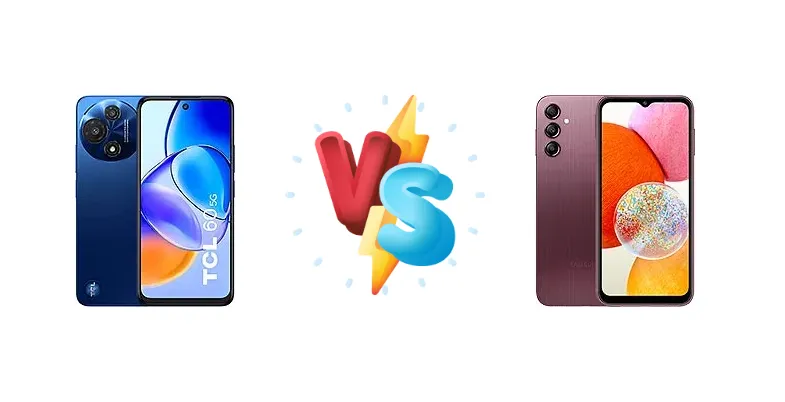
The sub-$200 smartphone market is fiercely competitive. The TCL 60 and Samsung Galaxy A14 both aim to deliver essential features at an accessible price, but they take different approaches. The TCL 60 leverages a newer Mediatek Dimensity 6300 chipset, while the Galaxy A14 offers a choice between the Helio G80 and Exynos 850, creating a complex performance landscape.
🏆 Quick Verdict
For most users, the TCL 60 emerges as the stronger contender. Its Dimensity 6300 chipset, built on a more efficient 6nm process, provides a noticeable performance advantage over both versions of the Galaxy A14, coupled with significantly superior battery endurance. While Samsung's brand recognition is a factor, the TCL 60 delivers more for your money.
| Network |
|---|
| 2G bands | GSM 850 / 900 / 1800 / 1900 | GSM 850 / 900 / 1800 / 1900 |
| 3G bands | HSDPA 850 / 900 / 1700(AWS) / 1900 / 2100 | HSDPA 850 / 900 / 2100 |
| 4G bands | 1, 2, 3, 4, 5, 7, 8, 12, 13, 17, 20, 26, 28, 32, 38, 40, 41, 42, 66 | 1, 3, 5, 7, 8, 20, 28, 38, 40, 41 |
| 5G bands | 1, 3, 5, 7, 8, 20, 26, 28, 38, 40, 41, 66, 75, 77, 78 SA/NSA | - |
| Speed | HSPA, LTE, 5G | HSPA, LTE |
| Technology | GSM / HSPA / LTE / 5G | GSM / HSPA / LTE |
| Launch |
|---|
| Announced | 2025, March 03 | 2023, February 28 |
| Status | Available. Released 2025, May | Available. Released 2023, March 27 |
| Body |
|---|
| Build | - | Glass front, plastic back, plastic frame |
| Dimensions | 165.6 x 76.2 x 8.2 mm (6.52 x 3.00 x 0.32 in) | 167.7 x 78 x 9.1 mm (6.60 x 3.07 x 0.36 in) |
| SIM | Nano-SIM + eSIM | · Nano-SIM· Nano-SIM + Nano-SIM |
| Weight | 190 g (6.70 oz) | 201 g (7.09 oz) |
| Display |
|---|
| Protection | Mohs level 5 | - |
| Resolution | 720 x 1600 pixels, 20:9 ratio (~262 ppi density) | 1080 x 2408 pixels, 20:9 ratio (~400 ppi density) |
| Size | 6.7 inches, 108.4 cm2 (~85.9% screen-to-body ratio) | 6.6 inches, 104.9 cm2 (~80.2% screen-to-body ratio) |
| Type | IPS LCD, 120Hz, 480 nits (typ) | PLS LCD |
| Platform |
|---|
| CPU | Octa-core (2x2.4 GHz Cortex-A76 & 6x2.0 GHz Cortex-A55) | Octa-core (2x2.0 GHz Cortex-A75 & 6x1.8 GHz Cortex-A55) - Version AOcta-core (4x2.0 GHz Cortex-A55 & 4x2.0 GHz Cortex-A55) - Version B |
| Chipset | Mediatek Dimensity 6300 (6 nm) | Mediatek MT6769 Helio G80 (12 nm) - Version AExynos 850 (8 nm) - Version B |
| GPU | Mali-G57 MC2 | Mali-G52 MC2 |
| OS | Android 15 | Android 13, upgradable to Android 15, One UI 7 |
| Memory |
|---|
| Card slot | microSDXC (dedicated slot) | microSDXC (dedicated slot) |
| Internal | 256GB 6GB RAM | 64GB 4GB RAM, 128GB 4GB RAM, 128GB 6GB RAM |
| Main Camera |
|---|
| Dual | 50 MP, f/1.8, 26mm (wide), 1/2.5", 0.7µm, PDAF
5 MP, (ultrawide) | - |
| Features | LED flash, HDR, panorama | LED flash, panorama, HDR |
| Single | - | 13 MP, f/2.0, (wide) |
| Triple | - | 50 MP, f/1.8, 26mm (wide), 1/2.75", 0.64µm, PDAF
5 MP, f/2.2, 17mm (ultrawide), 1/5.0", 1.12µm
2 MP (macro) |
| Video | 1080p@30fps | 1080p@30fps |
| Selfie camera |
|---|
| Features | HDR | - |
| Single | 8 MP, f/2.0, (wide), 1/4.0", 1.12µm | 13 MP, f/2.0, 26mm (wide), 1/3.1", 1.12µm |
| Video | 1080p@30fps | 1080p@30fps |
| Sound |
|---|
| 3.5mm jack | - | Yes |
| 35mm jack | Yes | Yes |
| Loudspeaker | Yes, with stereo speakers | Yes |
| Comms |
|---|
| Bluetooth | 5.4, A2DP, LE | 5.1 or 5.3, A2DP, LE |
| NFC | Yes | Yes (market/region dependent) |
| Positioning | GPS, GLONASS, BDS, GALILEO | GPS, GALILEO, GLONASS, BDS, QZSS |
| Radio | Unspecified | Unspecified |
| USB | USB Type-C 2.0 | USB Type-C 2.0 |
| WLAN | Wi-Fi 802.11 a/b/g/n/ac, dual-band, Wi-Fi Direct | Wi-Fi 802.11 a/b/g/n/ac, dual-band, Wi-Fi Direct |
| Features |
|---|
| Sensors | Fingerprint (side-mounted), accelerometer, gyro, proximity, compass | Fingerprint (side-mounted), accelerometer, proximity, compass |
| Battery |
|---|
| Charging | 18W wired | 15W wired |
| Type | 5200 mAh | Li-Po 5000 mAh |
| Misc |
|---|
| Colors | Space Gray, Midnight Blue | Black, Dark Red, Silver, Green |
| Models | T521H | SM-A145F, SM-A145F/DSN, SM-A145M, SM-A145M/DS, SM-A145P, SM-A145R |
| Price | About 170 EUR | € 85.76 / $ 147.60 / £ 79.95 |
| SAR EU | - | 0.46 W/kg (head) 1.37 W/kg (body) |
| EU LABEL |
|---|
| Battery | 52:47h endurance, 1000 cycles | - |
| Energy | Class B | - |
| Free fall | Class B (180 falls) | - |
| Repairability | Class B | - |
TCL 60
- Superior chipset performance with Dimensity 6300
- Exceptional battery life (52:47h endurance)
- More efficient 6nm fabrication process
- Brand recognition is lower than Samsung
- Display specs are unknown and potentially average
Samsung Galaxy A14
- Samsung’s One UI software experience
- Wider carrier availability
- Established brand reputation
- Less powerful chipset (Helio G80 or Exynos 850)
- Lower battery efficiency
- Potential for throttling with Helio G80
Display Comparison
Neither device boasts a standout display. Both likely utilize LCD panels, a common cost-saving measure in this segment. However, detailed display specs (resolution, brightness, color gamut) are missing. The TCL 60’s advantage lies in its potential for better power efficiency due to the more modern chipset driving the display. Samsung’s One UI software may offer more display customization options, but this doesn’t address fundamental panel quality.
Camera Comparison
Camera details are sparse, but the focus should be on the main sensor. Without specific megapixel counts or aperture information, it’s difficult to make a definitive judgment. However, the TCL 60’s more powerful ISP (Image Signal Processor) within the Dimensity 6300 chipset likely translates to better image processing, particularly in low-light conditions. The Galaxy A14’s inclusion of a 2MP macro camera is largely a marketing gimmick, offering minimal practical benefit. Image quality will likely be comparable in good lighting, but the TCL 60 should pull ahead in challenging scenarios.
Performance
The TCL 60’s Mediatek Dimensity 6300 (6nm) is the clear winner in the chipset department. Its Cortex-A76 cores, clocked at 2.4 GHz, offer a significant performance uplift compared to the Galaxy A14’s Cortex-A75 cores (2.0 GHz) in the Helio G80 version. Even against the Exynos 850 (8nm) version, the Dimensity 6300’s newer architecture and 6nm fabrication process provide better efficiency and sustained performance. The Helio G80’s 12nm process is demonstrably less efficient, leading to more heat and potential throttling. The Exynos 850, while better, still lags behind the Dimensity 6300. The TCL 60 will handle multitasking and demanding apps more smoothly.
Battery Life
The TCL 60’s 52:47h endurance rating is a standout feature. This suggests excellent power efficiency, a direct result of the Dimensity 6300’s 6nm process. While the Galaxy A14’s battery capacity is unknown, its less efficient chipsets (Helio G80 and Exynos 850) will consume more power. The TCL 60’s 18W charging is slightly faster than the Galaxy A14’s 15W, but the real advantage is the longer time between charges. The TCL 60’s stated 1000 charge cycles also suggest a longer lifespan.
Buying Guide
Buy the TCL 60 if you prioritize sustained performance for everyday tasks and longer battery life. It’s ideal for users who stream videos, browse the web, and occasionally game. Buy the Samsung Galaxy A14 if you are deeply embedded in the Samsung ecosystem, value the One UI software experience, and are looking for a reliable, if less powerful, device for basic communication and light usage. The A14’s wider availability through carriers may also be a deciding factor.
Frequently Asked Questions
❓ Does the Samsung Galaxy A14’s Exynos 850 chip overheat during extended gaming sessions?
The Exynos 850 is known to throttle under sustained load, meaning performance will decrease over time during gaming to manage heat. While it’s not a severe overheating issue, users should expect frame rate drops in demanding titles. The TCL 60’s Dimensity 6300, with its 6nm process, is better equipped to handle thermal management.
❓ Is the 2MP macro camera on the Samsung Galaxy A14 actually useful for taking detailed close-up photos?
Generally, 2MP macro cameras on budget phones produce images with limited detail and sharpness. The small sensor size and lack of optical image stabilization result in blurry and noisy photos. It’s primarily a marketing feature and won’t deliver professional-quality macro photography.
❓ Can the TCL 60 handle popular games like PUBG Mobile at high frame rates?
The TCL 60’s Dimensity 6300 should be capable of running PUBG Mobile at medium to high settings with stable frame rates. While it won’t achieve the maximum settings possible on flagship devices, it provides a playable and enjoyable gaming experience. Expect to achieve 30-60fps depending on the graphical settings.
❓ How long will it take to fully charge the TCL 60 with the included 18W charger?
While a precise 0-100% charging time isn't available, the TCL 60’s 18W charging should take approximately 2.5 to 3 hours for a full charge. The efficient chipset and optimized power management contribute to faster charging compared to the Galaxy A14’s 15W charging.