
TCL 60 vs Google Pixel 7a: A Deep Dive into Value and Performance
| Phones Images | |||||
|---|---|---|---|---|---|
|
🏆 Quick Verdict
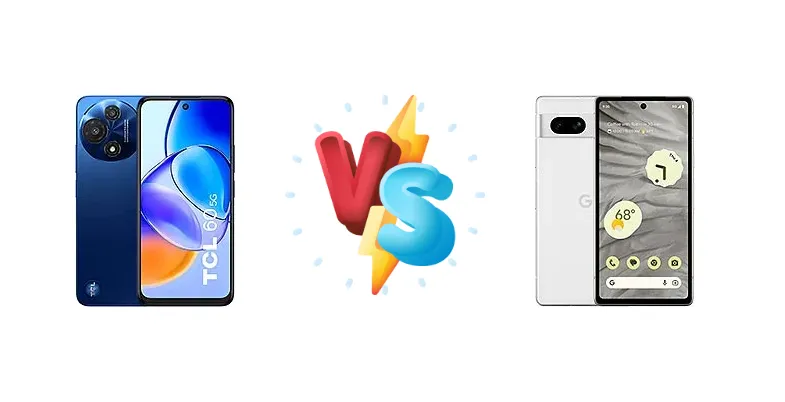
For users prioritizing all-day battery life and a budget-friendly price, the TCL 60 is the clear winner. However, the Google Pixel 7a delivers a superior camera experience and smoother performance thanks to its Tensor G2 chipset, making it ideal for photography enthusiasts and those invested in the Google ecosystem.
| PHONES | ||
|---|---|---|
| Phone Names | TCL 60 | Google Pixel 7a |
| Network | ||
|---|---|---|
| 2G bands | GSM 850 / 900 / 1800 / 1900 | GSM 850 / 900 / 1800 / 1900 |
| 3G bands | HSDPA 850 / 900 / 1700(AWS) / 1900 / 2100 | HSDPA 800 / 850 / 900 / 1700(AWS) / 1900 / 2100 |
| 4G bands | 1, 2, 3, 4, 5, 7, 8, 12, 13, 17, 20, 26, 28, 32, 38, 40, 41, 42, 66 | 1, 2, 3, 4, 5, 7, 8, 12, 13, 14, 17, 20, 25, 26, 28, 29, 30, 38, 40, 41, 48, 66, 71 - GWKK3, G0DZQ |
| 5G bands | 1, 3, 5, 7, 8, 20, 26, 28, 38, 40, 41, 66, 75, 77, 78 SA/NSA | 1, 2, 3, 5, 7, 8, 12, 14, 20, 25, 28, 30, 38, 41, 48, 66, 71, 77, 78 SA/NSA/Sub6 - GWKK3 |
| Speed | HSPA, LTE, 5G | HSPA, LTE, 5G |
| Technology | GSM / HSPA / LTE / 5G | GSM / HSPA / LTE / 5G |
| - | 1, 2, 3, 5, 7, 8, 12, 20, 25, 28, 38, 40, 41, 66, 75, 76, 77, 78, 79 SA/NSA/Sub6 - GHL1X, G82U8 | |
| Launch | ||
|---|---|---|
| Announced | 2025, March 03 | 2023, May 10 |
| Status | Available. Released 2025, May | Available. Released 2023, May 10 |
| Body | ||
|---|---|---|
| Build | - | Glass front (Gorilla Glass 3), aluminum frame, plastic back |
| Dimensions | 165.6 x 76.2 x 8.2 mm (6.52 x 3.00 x 0.32 in) | 152 x 72.9 x 9 mm (5.98 x 2.87 x 0.35 in) |
| SIM | Nano-SIM + eSIM | Nano-SIM + eSIM |
| Weight | 190 g (6.70 oz) | 193.5 g (6.84 oz) |
| - | IP67 dust/water resistant (up to 1m for 30 min) | |
| Display | ||
|---|---|---|
| Protection | Mohs level 5 | Corning Gorilla Glass 3 |
| Resolution | 720 x 1600 pixels, 20:9 ratio (~262 ppi density) | 1080 x 2400 pixels, 20:9 ratio (~429 ppi density) |
| Size | 6.7 inches, 108.4 cm2 (~85.9% screen-to-body ratio) | 6.1 inches, 90.7 cm2 (~81.8% screen-to-body ratio) |
| Type | IPS LCD, 120Hz, 480 nits (typ) | OLED, HDR, 90Hz |
| - | Always-on display | |
| Platform | ||
|---|---|---|
| CPU | Octa-core (2x2.4 GHz Cortex-A76 & 6x2.0 GHz Cortex-A55) | Octa-core (2x2.85 GHz Cortex-X1 & 2x2.35 GHz Cortex-A78 & 4x1.80 GHz Cortex-A55) |
| Chipset | Mediatek Dimensity 6300 (6 nm) | Google Tensor G2 (5 nm) |
| GPU | Mali-G57 MC2 | Mali-G710 MP7 |
| OS | Android 15 | Android 13, upgradable to Android 15, up to 5 major Android upgrades |
| Memory | ||
|---|---|---|
| Card slot | microSDXC (dedicated slot) | No |
| Internal | 256GB 6GB RAM | 128GB 8GB RAM |
| - | UFS 3.1 | |
| Main Camera | ||
|---|---|---|
| Dual | 50 MP, f/1.8, 26mm (wide), 1/2.5", 0.7µm, PDAF 5 MP, (ultrawide) | 64 MP, f/1.9, 26mm (wide), 1/1.73", 0.8µm, dual pixel PDAF, OIS 13 MP, f/2.2, 120˚ (ultrawide), 1.12µm |
| Features | LED flash, HDR, panorama | Dual-LED flash, Pixel Shift, Auto-HDR, panorama |
| Video | 1080p@30fps | 4K@30/60fps, 1080p@30/60/120/240fps, OIS |
| Selfie camera | ||
|---|---|---|
| Features | HDR | HDR, panorama |
| Single | 8 MP, f/2.0, (wide), 1/4.0", 1.12µm | 13 MP, f/2.2, 20mm (ultrawide), 1.12µm |
| Video | 1080p@30fps | 4K@30fps, 1080p@30fps |
| Sound | ||
|---|---|---|
| 3.5mm jack | - | No |
| 35mm jack | Yes | No |
| Loudspeaker | Yes, with stereo speakers | Yes, with stereo speakers |
| Comms | ||
|---|---|---|
| Bluetooth | 5.4, A2DP, LE | 5.3, A2DP, LE |
| NFC | Yes | Yes |
| Positioning | GPS, GLONASS, BDS, GALILEO | GPS, GLONASS, GALILEO, BDS, QZSS, NavIC |
| Radio | Unspecified | No |
| USB | USB Type-C 2.0 | USB Type-C 3.2 |
| WLAN | Wi-Fi 802.11 a/b/g/n/ac, dual-band, Wi-Fi Direct | Wi-Fi 802.11 a/b/g/n/ac/6e, tri-band |
| Features | ||
|---|---|---|
| Sensors | Fingerprint (side-mounted), accelerometer, gyro, proximity, compass | Fingerprint (under display, optical), accelerometer, gyro, proximity, compass, barometer |
| Battery | ||
|---|---|---|
| Charging | 18W wired | 18W wired, PD3.0 7.5W wireless |
| Type | 5200 mAh | Li-Po 4385 mAh |
| Misc | ||
|---|---|---|
| Colors | Space Gray, Midnight Blue | Charcoal, Snow, Sea, Coral |
| Models | T521H | GWKK3, GHL1X, G0DZQ, G82U8 |
| Price | About 170 EUR | € 179.90 / $ 150.00 / £ 170.00 / ₹ 25,980 |
| EU LABEL | ||
|---|---|---|
| Battery | 52:47h endurance, 1000 cycles | - |
| Energy | Class B | - |
| Free fall | Class B (180 falls) | - |
| Repairability | Class B | - |
TCL 60
- Exceptional battery life (52:47h endurance)
- Long battery lifespan (1000 charge cycles)
- More affordable price point
- Less powerful processor
- Inferior camera system
- Slower charging speeds
Google Pixel 7a
- Superior performance with Google Tensor G2
- Excellent camera quality and image processing
- Faster charging with wireless charging support
- Shorter battery life
- Higher price
- Potential for software bloat (depending on user preference)
Display Comparison
The Pixel 7a boasts a significantly brighter display, reaching a measured 1070 nits, compared to the TCL 60’s unspecified peak brightness. This translates to better visibility outdoors under direct sunlight. While the TCL 60’s panel technology isn’t detailed, the Pixel 7a’s OLED panel offers superior contrast and color accuracy. The absence of LTPO on either device suggests neither offers adaptive refresh rates, a feature increasingly common in this price bracket. Bezels appear comparable based on available imagery, but the Pixel 7a’s smaller overall size may contribute to a slightly more immersive viewing experience.
Camera Comparison
The Pixel 7a’s camera system is a key differentiator. While specific sensor sizes aren’t provided, Google’s computational photography prowess, combined with its image processing algorithms, consistently delivers excellent image quality, particularly in challenging lighting conditions. The TCL 60’s camera capabilities are less defined, and likely focus on providing acceptable results for casual photography. The Pixel 7a’s video recording capabilities are also expected to be superior, benefiting from the Tensor G2’s image signal processor. The TCL 60’s camera is likely adequate for social media sharing, but won’t compete with the Pixel 7a’s detail and dynamic range.
Performance
The Google Pixel 7a’s Tensor G2, fabricated on a 5nm process, holds a clear architectural advantage over the TCL 60’s Mediatek Dimensity 6300 (6nm). The Tensor G2’s Cortex-X1 prime core, clocked at 2.85 GHz, significantly outperforms the TCL 60’s Cortex-A76 cores at 2.4 GHz. This difference is noticeable in demanding tasks like video editing and gaming. The Pixel 7a’s chipset also benefits from Google’s dedicated AI processing capabilities. While the TCL 60’s Dimensity 6300 is a capable chip for everyday tasks, it won’t match the Pixel 7a’s sustained performance under load. RAM specifications are not provided for either device, but the Pixel 7a likely benefits from optimized memory management due to Google’s software integration.
Battery Life
The TCL 60’s standout feature is its exceptional battery endurance, rated at 52:47 hours. This is significantly longer than the Pixel 7a’s reported 76 hours (note: this is an older rating and likely based on different testing methodologies). However, the Pixel 7a offers faster charging with 18W wired charging and the added convenience of 7.5W wireless charging, utilizing PD3.0 for optimized power delivery. The TCL 60 is limited to 18W wired charging. The TCL 60’s 1000 charge cycle rating suggests a longer lifespan for the battery itself, potentially mitigating the impact of slower charging speeds over the long term.
Buying Guide
Buy the TCL 60 if you need a phone that consistently lasts well over a day on a single charge and value affordability above all else. It’s perfect for travelers, commuters, or anyone who dislikes frequent charging. Buy the Google Pixel 7a if you prioritize camera quality, a fluid user experience powered by Google’s software, and access to timely updates, even if it means compromising slightly on battery endurance.