
TCL 60 XE NxtPaper vs. Google Pixel 7a: A Deep Dive into Mid-Range Contenders
| Phones Images | |||||
|---|---|---|---|---|---|
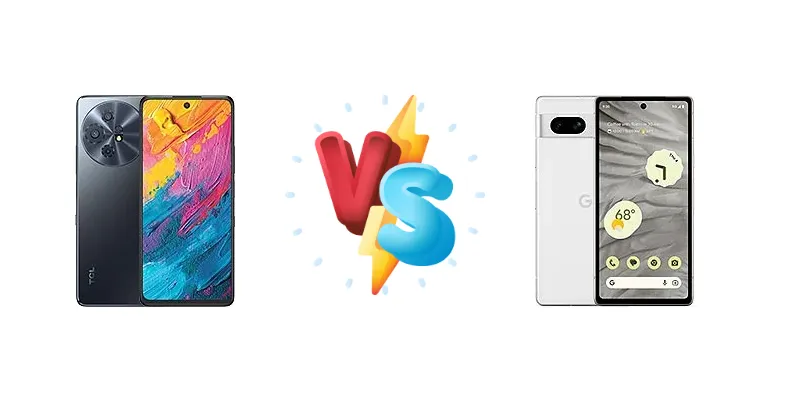
|
🏆 Quick Verdict
For the average user prioritizing camera quality and software experience, the Google Pixel 7a is the clear winner. Its Tensor G2 chipset delivers smoother performance and superior image processing. However, the TCL 60 XE NxtPaper presents a compelling alternative for those seeking a more eye-friendly display and extended battery life at a lower price point.
| PHONES | ||
|---|---|---|
| Phone Names | TCL 60 XE NxtPaper | Google Pixel 7a |
| Network | ||
|---|---|---|
| 2G bands | GSM 850 / 900 / 1800 / 1900 | GSM 850 / 900 / 1800 / 1900 |
| 3G bands | HSDPA 850 / 1700(AWS) / 1900 / 2100 | HSDPA 800 / 850 / 900 / 1700(AWS) / 1900 / 2100 |
| 4G bands | 1, 2, 3, 4, 5, 7, 12, 13, 17, 20, 25, 26, 28, 29, 30, 38, 41, 42, 66, 71 | 1, 2, 3, 4, 5, 7, 8, 12, 13, 14, 17, 20, 25, 26, 28, 29, 30, 38, 40, 41, 48, 66, 71 - GWKK3, G0DZQ |
| 5G bands | 1, 2, 3, 5, 12, 20, 25, 28, 30, 38, 40, 41, 48, 66, 70, 71, 77, 78 SA/NSA | 1, 2, 3, 5, 7, 8, 12, 14, 20, 25, 28, 30, 38, 41, 48, 66, 71, 77, 78 SA/NSA/Sub6 - GWKK3 |
| Speed | HSPA, LTE, 5G | HSPA, LTE, 5G |
| Technology | GSM / HSPA / LTE / 5G | GSM / HSPA / LTE / 5G |
| - | 1, 2, 3, 5, 7, 8, 12, 20, 25, 28, 38, 40, 41, 66, 75, 76, 77, 78, 79 SA/NSA/Sub6 - GHL1X, G82U8 | |
| Launch | ||
|---|---|---|
| Announced | 2025, March 03 | 2023, May 10 |
| Status | Available. Released 2025, May | Available. Released 2023, May 10 |
| Body | ||
|---|---|---|
| Build | - | Glass front (Gorilla Glass 3), aluminum frame, plastic back |
| Dimensions | 167.6 x 75.5 x 8.2 mm (6.60 x 2.97 x 0.32 in) | 152 x 72.9 x 9 mm (5.98 x 2.87 x 0.35 in) |
| SIM | Nano-SIM + eSIM | Nano-SIM + eSIM |
| Weight | 199.5 g (7.02 oz) | 193.5 g (6.84 oz) |
| - | IP67 dust/water resistant (up to 1m for 30 min) | |
| Display | ||
|---|---|---|
| Protection | - | Corning Gorilla Glass 3 |
| Resolution | 1080 x 2460 pixels (~396 ppi density) | 1080 x 2400 pixels, 20:9 ratio (~429 ppi density) |
| Size | 6.78 inches, 109.2 cm2 (~86.3% screen-to-body ratio) | 6.1 inches, 90.7 cm2 (~81.8% screen-to-body ratio) |
| Type | IPS LCD, 120Hz | OLED, HDR, 90Hz |
| - | Always-on display | |
| Platform | ||
|---|---|---|
| CPU | Octa-core (2x2.4 GHz Cortex-A76 & 6x2.0 GHz Cortex-A55) | Octa-core (2x2.85 GHz Cortex-X1 & 2x2.35 GHz Cortex-A78 & 4x1.80 GHz Cortex-A55) |
| Chipset | Mediatek Dimensity 6100+ (6 nm) | Google Tensor G2 (5 nm) |
| GPU | Mali-G57 MC2 | Mali-G710 MP7 |
| OS | Android 15 | Android 13, upgradable to Android 15, up to 5 major Android upgrades |
| Memory | ||
|---|---|---|
| Card slot | microSDXC (dedicated slot) | No |
| Internal | 128GB 6GB RAM, 256GB 8GB RAM | 128GB 8GB RAM |
| - | UFS 3.1 | |
| Main Camera | ||
|---|---|---|
| Dual | - | 64 MP, f/1.9, 26mm (wide), 1/1.73", 0.8µm, dual pixel PDAF, OIS 13 MP, f/2.2, 120˚ (ultrawide), 1.12µm |
| Features | LED flash, HDR | Dual-LED flash, Pixel Shift, Auto-HDR, panorama |
| Triple | 50 MP, (wide), PDAF 5 MP, (ultrawide) Auxiliary lens | - |
| Video | 1080p@30fps, gyro-EIS | 4K@30/60fps, 1080p@30/60/120/240fps, OIS |
| Selfie camera | ||
|---|---|---|
| Features | - | HDR, panorama |
| Single | 32 MP, (wide) | 13 MP, f/2.2, 20mm (ultrawide), 1.12µm |
| Video | 1080p@30fps | 4K@30fps, 1080p@30fps |
| Sound | ||
|---|---|---|
| 3.5mm jack | - | No |
| 35mm jack | Yes | No |
| Loudspeaker | Yes, with stereo speakers | Yes, with stereo speakers |
| Comms | ||
|---|---|---|
| Bluetooth | 5.3, A2DP, LE | 5.3, A2DP, LE |
| NFC | Yes | Yes |
| Positioning | GPS, GLONASS, BDS, GALILEO | GPS, GLONASS, GALILEO, BDS, QZSS, NavIC |
| Radio | FM radio | No |
| USB | USB Type-C 2.0, OTG | USB Type-C 3.2 |
| WLAN | Wi-Fi 802.11 a/b/g/n/ac, dual-band, Wi-Fi Direct | Wi-Fi 802.11 a/b/g/n/ac/6e, tri-band |
| Features | ||
|---|---|---|
| Sensors | Fingerprint (side-mounted), accelerometer, gyro, proximity, compass, barometer | Fingerprint (under display, optical), accelerometer, gyro, proximity, compass, barometer |
| Battery | ||
|---|---|---|
| Charging | 18W wired Reverse wired | 18W wired, PD3.0 7.5W wireless |
| Type | 5010 mAh | Li-Po 4385 mAh |
| Misc | ||
|---|---|---|
| Colors | Space Blue | Charcoal, Snow, Sea, Coral |
| Models | T705M, T705M1 | GWKK3, GHL1X, G0DZQ, G82U8 |
| Price | $ 199.00 | € 179.90 / $ 150.00 / £ 170.00 / ₹ 25,980 |
| SAR | 1.30 W/kg (head) 1.13 W/kg (body) | - |
TCL 60 XE NxtPaper
- Unique NxtPaper display reduces eye strain
- Potentially longer battery life due to efficient chipset
- More affordable price point
- Less powerful processor compared to the Pixel 7a
- Likely inferior camera performance
Google Pixel 7a
- Superior performance with Google Tensor G2
- Excellent camera quality and image processing
- Guaranteed software updates from Google
- Higher price compared to the TCL 60 XE NxtPaper
- May not offer significantly longer battery life
Display Comparison
The TCL 60 XE NxtPaper’s defining feature is its NxtPaper display, designed to mimic the texture of paper for enhanced readability. While the resolution isn’t specified, the focus is on reducing blue light and glare. In contrast, the Google Pixel 7a boasts a brighter display, reaching a measured peak brightness of 1070 nits, making it significantly more visible outdoors. The Pixel 7a’s panel likely utilizes OLED technology for vibrant colors and deep blacks, a contrast to the TCL’s emphasis on a matte, paper-like finish. The absence of a high refresh rate on either device suggests a focus on power efficiency over ultra-smooth scrolling.
Camera Comparison
The Pixel 7a’s camera system is a major selling point, leveraging Google’s renowned computational photography algorithms. While specific sensor details are missing for both devices, the Pixel 7a’s reputation suggests a larger main sensor and superior image processing. The TCL 60 XE NxtPaper likely features a more basic camera setup, prioritizing affordability over advanced features. The Pixel 7a’s ability to capture detailed photos in various lighting conditions, along with its excellent video stabilization, sets it apart. Ignoring the likely inclusion of a low-resolution macro lens on the TCL, the Pixel 7a’s focus on core camera performance is a clear advantage.
Performance
The Google Pixel 7a’s Tensor G2 (5nm) chipset, with its Cortex-X1 prime core clocked at 2.85 GHz, offers a substantial performance advantage over the TCL 60 XE NxtPaper’s Mediatek Dimensity 6100+ (6nm). The Tensor G2’s architecture, including the Cortex-A78 performance cores, is designed for AI-driven tasks and image processing. While the Dimensity 6100+ is a capable processor for everyday tasks, the Tensor G2 will handle demanding games and applications with greater ease. The 5nm fabrication process of the Tensor G2 also contributes to better thermal efficiency, potentially reducing throttling during sustained workloads. The Pixel 7a’s likely use of faster LPDDR5x RAM further enhances its performance capabilities.
Battery Life
The Google Pixel 7a has an endurance rating of 76 hours, indicating strong battery life despite not having a massive capacity. The TCL 60 XE NxtPaper, with its more power-efficient Dimensity 6100+ chipset and NxtPaper display, likely offers comparable or even slightly better battery endurance. Both devices support 18W wired charging, but the Pixel 7a adds the convenience of 7.5W wireless charging and PD3.0 support for faster wired charging with compatible adapters. While charging speeds are similar, the Pixel 7a’s wireless charging capability provides added flexibility.
Buying Guide
Buy the TCL 60 XE NxtPaper if you prioritize prolonged reading sessions and media consumption with reduced eye strain, and value a longer-lasting battery. Its NxtPaper display and efficient Dimensity 6100+ chipset cater to this use case. Buy the Google Pixel 7a if you demand a top-tier camera experience, fast and fluid performance for demanding apps, and guaranteed software updates directly from Google. The Tensor G2 and Pixel’s computational photography are key advantages.