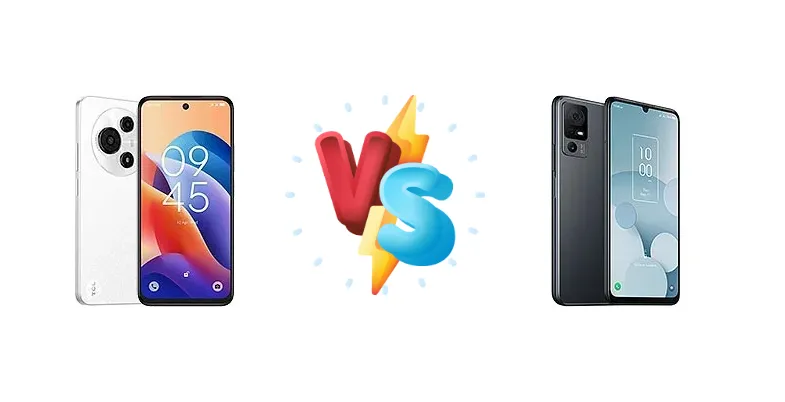
TCL has become a significant player in the budget smartphone space, offering compelling features at aggressive price points. The 60 SE and 40 XL represent two distinct approaches within their lineup. The 60 SE aims for a balance of performance and longevity, while the 40 XL prioritizes a larger display and potentially broader availability. This comparison dissects their core components to determine which device offers the best value.
🏆 Quick Verdict
For most users, the TCL 60 SE emerges as the stronger choice. Its Helio G81 chipset, featuring more powerful Cortex-A75 cores, provides a noticeable performance advantage over the 40 XL’s Helio G37. Coupled with a reported 49:13h endurance, the 60 SE offers a more robust user experience for demanding tasks and extended use.
| Network |
|---|
| 2G bands | GSM 850 / 900 / 1800 / 1900 | GSM 850 / 900 / 1800 / 1900 |
| 3G bands | HSDPA 850 / 900 / 1700(AWS) / 1900 / 2100 | HSDPA 850 / 1700(AWS) / 1900 - USA |
| 4G bands | 1, 2, 3, 4, 5, 7, 8, 12, 13, 17, 20, 26, 28, 38, 40, 41, 66 | 2, 4, 5, 12, 13, 25, 26, 41, 66, 71 - USA |
| Speed | HSPA, LTE | HSPA, LTE |
| Technology | GSM / HSPA / LTE | GSM / HSPA / LTE |
| Launch |
|---|
| Announced | 2025, March 03 | 2023, February 26 |
| Status | Available. Released 2025, July | Available. Released 2023, May |
| Body |
|---|
| Build | Glass front, plastic back, plastic frame | Glass front, plastic frame, plastic back |
| Dimensions | 165.6 x 76.2 x 8.3 mm (6.52 x 3.00 x 0.33 in) | 167.9 x 76.5 x 8.8 mm (6.61 x 3.01 x 0.35 in) |
| SIM | Nano-SIM + Nano-SIM | · Nano-SIM + eSIM· Nano-SIM + Nano-SIM |
| Weight | 190 g (6.70 oz) | 195 g (6.88 oz) |
| Display |
|---|
| Protection | Mohs level 5 | - |
| Resolution | 720 x 1600 pixels, 20:9 ratio (~262 ppi density) | 720 x 1600 pixels, 20:9 ratio (~260 ppi density) |
| Size | 6.7 inches, 108.4 cm2 (~85.9% screen-to-body ratio) | 6.75 inches, 110.0 cm2 (~85.6% screen-to-body ratio) |
| Type | IPS LCD, 90Hz, 480 nits (typ) | IPS LCD, 90Hz |
| Platform |
|---|
| CPU | Octa-core (2x2.0 GHz Cortex-A75 & 6x1.8 GHz Cortex-A55) | Octa-core (4x2.3 GHz Cortex-A53 & 4x1.8 GHz Cortex-A53) |
| Chipset | Mediatek Helio G81 (12 nm) | Mediatek MT6765 Helio G37 (12 nm) |
| GPU | Mali-G52 MC2 | PowerVR GE8320 |
| OS | Android 15 | Android 13, TCL UI |
| Memory |
|---|
| Card slot | microSDXC (dedicated slot) | microSDXC |
| Internal | 512GB 8GB RAM | 128GB 4GB RAM, 256GB 6GB RAM |
| Main Camera |
|---|
| Features | LED flash, HDR, panorama | LED flash, HDR, panorama |
| Single | 50 MP, f/1.8, (wide), 1/2.51", 0.7µm, PDAF | 8 MP, (wide) |
| Triple | - | 50 MP, (wide), PDAF
2 MP (macro)
Auxiliary lens |
| Video | 1080p@30fps | 1080p@30fps |
| Selfie camera |
|---|
| Single | 8 MP, f/2.0, (wide), 1/4.0", 1.12µm | 8 MP, (wide) |
| Video | 1080p@30fps | 1080p@30fps |
| Sound |
|---|
| 3.5mm jack | - | Yes |
| 35mm jack | Yes | Yes |
| Loudspeaker | Yes, with stereo speakers | Yes, with dual speakers |
| Comms |
|---|
| Bluetooth | 5.1, A2DP, LE | 5.1, A2DP, LE |
| NFC | Yes | No |
| Positioning | GPS, GLONASS, GALILEO, BDS | GPS |
| Radio | Unspecified | FM radio |
| USB | USB Type-C 2.0 | USB Type-C 2.0 |
| WLAN | Wi-Fi 802.11 a/b/g/n/ac, dual-band, Wi-Fi Direct | Wi-Fi 802.11 a/b/g/n/ac, dual-band, Wi-Fi Direct |
| Features |
|---|
| Sensors | Fingerprint (side-mounted), accelerometer, proximity | Fingerprint (side-mounted), accelerometer, gyro, proximity, compass, barometer |
| Battery |
|---|
| Charging | 18W wired | 18W wired |
| Type | 5200 mAh | Li-Ion 5000 mAh |
| Misc |
|---|
| Colors | Obsidian Black, Blizzard White | Dark Gray |
| Models | T517H | T608M |
| Price | About 170 EUR | About 140 EUR |
| EU LABEL |
|---|
| Battery | 49:13h endurance, 1000 cycles | - |
| Energy | Class B | - |
| Free fall | Class B (180 falls) | - |
| Repairability | Class B | - |
TCL 60 SE
- Superior CPU performance with Cortex-A75 cores
- Significantly longer battery life (49:13h endurance)
- Better suited for gaming and multitasking
- May be slightly more expensive than the 40 XL
- Specific display details (resolution, brightness) are unknown
TCL 40 XL
- Potentially lower price point
- Larger display size (assumed, based on 'XL' designation)
- Adequate for basic smartphone tasks
- Inferior CPU performance with Cortex-A53 cores
- Shorter battery life (implied by lower chipset efficiency)
- Less responsive user experience
Display Comparison
Both the TCL 60 SE and 40 XL utilize 12nm chipsets, suggesting similar power efficiency constraints impacting display capabilities. While specific display specs (resolution, brightness) are missing, the focus here is on the processing power driving the UI. A smoother experience is expected on the 60 SE due to its superior CPU.
Camera Comparison
Without detailed camera specifications, a direct comparison is limited. However, given the price points, it’s reasonable to assume both phones feature modest camera setups. The focus will likely be on software processing to enhance image quality. The absence of information regarding sensor size or optical image stabilization suggests neither phone will excel in low-light photography. The 40 XL's larger screen may be preferable for reviewing photos, but the 60 SE's processing power could lead to faster image processing times.
Performance
The core difference lies in the chipsets. The TCL 60 SE’s Mediatek Helio G81 features a dual-cluster configuration with 2x 2.0 GHz Cortex-A75 cores and 6x 1.8 GHz Cortex-A55 cores. This architecture provides a significant boost in single-core and multi-core performance compared to the TCL 40 XL’s Helio G37, which utilizes 4x 2.3 GHz Cortex-A53 cores and 4x 1.8 GHz Cortex-A53 cores. The A75 cores in the 60 SE are substantially more powerful than the A53 cores in the 40 XL, translating to faster app loading times, smoother animations, and improved gaming performance. The G81’s architecture is better suited for handling demanding applications.
Battery Life
The TCL 60 SE boasts an impressive 49:13h endurance rating, indicating excellent battery life. Both devices share the same 18W wired charging, meaning charge times will likely be comparable. However, the 60 SE’s superior efficiency, stemming from its more refined chipset, allows it to extract more usage from its battery capacity. While the exact battery capacity of both devices is unknown, the endurance test clearly favors the 60 SE.
Buying Guide
Buy the TCL 60 SE if you prioritize consistent performance for gaming, multitasking, and general app usage, and value long battery life. This phone is ideal for users who actively use their devices throughout the day. Buy the TCL 40 XL if a larger screen is your primary concern and you primarily engage in lighter tasks like browsing, social media, and video consumption, and are looking for the lowest possible price point.
Frequently Asked Questions
❓ Will the Helio G81 in the TCL 60 SE handle demanding games like PUBG or Call of Duty?
The Helio G81 is capable of running PUBG and Call of Duty, but expect to make compromises on graphics settings. While not a flagship-level gaming chip, the A75 cores provide a significant advantage over the G37, allowing for a more playable experience at medium settings. Frame rate stability will depend on the specific game and settings used.
❓ How long will it take to fully charge both the TCL 60 SE and 40 XL with the 18W charger?
Both phones utilize 18W charging, so full charge times should be relatively similar, likely between 2-3 hours from 0% to 100%. However, the 60 SE’s more efficient chipset may result in slightly faster charging due to reduced power draw during the process.
❓ Is the TCL 40 XL a good option for someone who primarily uses their phone for social media and web browsing?
Yes, the TCL 40 XL is a suitable option for basic tasks like social media and web browsing. The Helio G37 is sufficient for these activities, and the potentially larger screen size could enhance the viewing experience. However, users who anticipate heavier usage should consider the 60 SE for its superior performance.