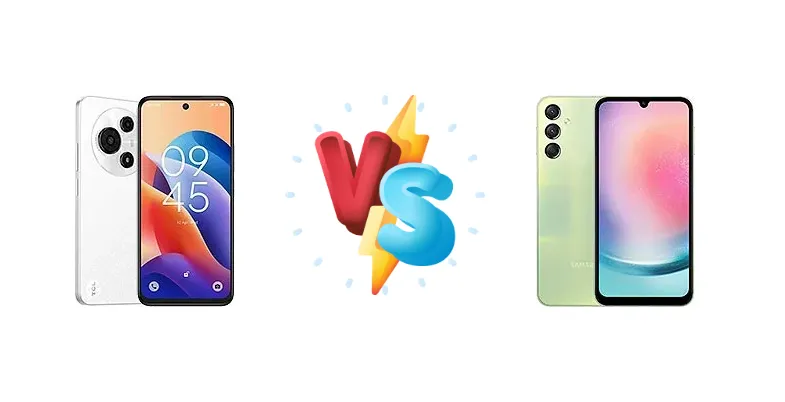
The TCL 60 SE and Samsung Galaxy A24 4G represent compelling options in the crowded budget smartphone space. While both aim to deliver essential features at an accessible price, they diverge significantly in their core strengths. The TCL prioritizes exceptional battery endurance, while the Samsung focuses on a brighter, more vibrant display. This comparison will dissect these differences to determine which device best suits your needs.
🏆 Quick Verdict
For the average user prioritizing longevity, the TCL 60 SE is the clear winner. Its remarkable 49:13h endurance rating significantly outpaces the Samsung Galaxy A24 4G’s 141h, making it ideal for heavy users. However, those valuing a brighter screen and potentially smoother performance will find the A24 more appealing.
| Network |
|---|
| 2G bands | GSM 850 / 900 / 1800 / 1900 | GSM 850 / 900 / 1800 / 1900 |
| 3G bands | HSDPA 850 / 900 / 1700(AWS) / 1900 / 2100 | HSDPA 850 / 900 / 2100 |
| 4G bands | 1, 2, 3, 4, 5, 7, 8, 12, 13, 17, 20, 26, 28, 38, 40, 41, 66 | 1, 3, 5, 7, 8, 20, 28, 38, 40, 41 |
| Speed | HSPA, LTE | HSPA, LTE |
| Technology | GSM / HSPA / LTE | GSM / HSPA / LTE |
| Launch |
|---|
| Announced | 2025, March 03 | 2023, April 19 |
| Status | Available. Released 2025, July | Available. Released 2023, May 05 |
| Body |
|---|
| Build | Glass front, plastic back, plastic frame | Glass front, plastic frame, plastic back |
| Dimensions | 165.6 x 76.2 x 8.3 mm (6.52 x 3.00 x 0.33 in) | 162.1 x 77.6 x 8.3 mm (6.38 x 3.06 x 0.33 in) |
| SIM | Nano-SIM + Nano-SIM | · Nano-SIM· Nano-SIM + Nano-SIM |
| Weight | 190 g (6.70 oz) | 195 g (6.88 oz) |
| Display |
|---|
| Protection | Mohs level 5 | - |
| Resolution | 720 x 1600 pixels, 20:9 ratio (~262 ppi density) | 1080 x 2340 pixels, 19.5:9 ratio (~396 ppi density) |
| Size | 6.7 inches, 108.4 cm2 (~85.9% screen-to-body ratio) | 6.5 inches, 103.7 cm2 (~82.4% screen-to-body ratio) |
| Type | IPS LCD, 90Hz, 480 nits (typ) | Super AMOLED, 90Hz, 1000 nits (peak) |
| Platform |
|---|
| CPU | Octa-core (2x2.0 GHz Cortex-A75 & 6x1.8 GHz Cortex-A55) | Octa-core (2x2.2 GHz Cortex-A76 & 6x2.0 GHz Cortex-A55) |
| Chipset | Mediatek Helio G81 (12 nm) | Mediatek Helio G99 (6 nm) |
| GPU | Mali-G52 MC2 | Mali-G57 MC2 |
| OS | Android 15 | Android 13, up to 4 major Android upgrades, One UI 6 |
| Memory |
|---|
| Card slot | microSDXC (dedicated slot) | microSDXC (dedicated slot) |
| Internal | 512GB 8GB RAM | 128GB 4GB RAM, 128GB 6GB RAM, 128GB 8GB RAM |
| Main Camera |
|---|
| Features | LED flash, HDR, panorama | LED flash, panorama, HDR |
| Single | 50 MP, f/1.8, (wide), 1/2.51", 0.7µm, PDAF | - |
| Triple | - | 50 MP, f/1.8, 27mm (wide), 1/2.76", 0.64µm, PDAF, OIS
5 MP, f/2.2, 17mm, 123˚ (ultrawide), 1/5.0", 1.12µm
2 MP (macro) |
| Video | 1080p@30fps | 1080p@30fps, gyro-EIS |
| Selfie camera |
|---|
| Single | 8 MP, f/2.0, (wide), 1/4.0", 1.12µm | 13 MP, f/2.2, 25mm (wide), 1/3.06", 1.12µm |
| Video | 1080p@30fps | 1080p@30fps |
| Sound |
|---|
| 35mm jack | Yes | Yes |
| Loudspeaker | Yes, with stereo speakers | Yes |
| Comms |
|---|
| Bluetooth | 5.1, A2DP, LE | 5.3, A2DP, LE |
| NFC | Yes | Yes (market/region dependent) |
| Positioning | GPS, GLONASS, GALILEO, BDS | GPS, GLONASS, GALILEO, BDS, QZSS |
| Radio | Unspecified | Unspecified |
| USB | USB Type-C 2.0 | USB Type-C 2.0 |
| WLAN | Wi-Fi 802.11 a/b/g/n/ac, dual-band, Wi-Fi Direct | Wi-Fi 802.11 a/b/g/n/ac, dual-band, Wi-Fi Direct |
| Features |
|---|
| Sensors | Fingerprint (side-mounted), accelerometer, proximity | Fingerprint (side-mounted), accelerometer, gyro, compass |
| Battery |
|---|
| Charging | 18W wired | 25W wired |
| Type | 5200 mAh | Li-Po 5000 mAh |
| Misc |
|---|
| Colors | Obsidian Black, Blizzard White | Black, Lime Green, Blue gradient, Dark red |
| Models | T517H | SM-A245F, SM-A245F/DS, SM-A245F/DSN, SM-A245M, SM-A245M/DS, SM-A245N |
| Price | About 170 EUR | About 150 EUR |
| SAR EU | - | 0.41 W/kg (head) 1.30 W/kg (body) |
| EU LABEL |
|---|
| Battery | 49:13h endurance, 1000 cycles | - |
| Energy | Class B | - |
| Free fall | Class B (180 falls) | - |
| Repairability | Class B | - |
TCL 60 SE
- Unrivaled battery life (49:13h endurance)
- High battery cycle count (1000 cycles)
- Potentially lower price point
- Likely lower display brightness
- Older chipset (Helio G81)
Samsung Galaxy A24 4G
- Brighter display (1012 nits)
- Newer chipset (Helio G99, 6nm)
- Faster charging (25W)
- Significantly shorter battery life
- Potentially higher price
Display Comparison
The Samsung Galaxy A24 4G boasts a significantly brighter display, reaching a measured peak brightness of 1012 nits. This is a substantial advantage over the TCL 60 SE, which lacks published brightness data but is expected to be lower. The higher brightness of the A24 translates to better visibility in direct sunlight. While the TCL 60 SE’s display specifications are not provided, the A24’s panel is likely to offer a more visually engaging experience due to its higher peak output. The TCL 60 SE's display tech is unknown, but the A24's brightness is a clear win for outdoor use.
Camera Comparison
Detailed camera analysis is hampered by limited data on the TCL 60 SE. The Samsung Galaxy A24 4G’s camera system is described as 'Photo / Video,' lacking specific sensor details. It’s reasonable to assume a primary sensor of at least 50MP, common in this price bracket. Without knowing the TCL 60 SE’s sensor size, aperture, or image processing capabilities, it’s difficult to make a direct comparison. The A24 likely benefits from Samsung’s established image processing algorithms, potentially delivering more consistent results. The presence or absence of Optical Image Stabilization (OIS) on either device is unknown, but would be a significant advantage for low-light photography.
Performance
Both devices utilize Mediatek Helio chipsets, but the Samsung Galaxy A24 4G’s Helio G99 (6nm) represents a generational leap over the TCL 60 SE’s Helio G81 (12nm). The 6nm process node allows for greater transistor density and improved power efficiency, potentially leading to better sustained performance and reduced thermal throttling. The A24’s CPU, with its 2x2.2 GHz Cortex-A76 cores, also offers a slight clock speed advantage over the TCL’s 2x2.0 GHz Cortex-A75 cores. While both phones feature octa-core CPUs, the A24’s architecture and fabrication process give it an edge in demanding tasks and gaming. However, the TCL 60 SE's performance is still adequate for everyday tasks.
Battery Life
The TCL 60 SE’s standout feature is its exceptional battery endurance, rated at 49:13h. This is dramatically higher than the Samsung Galaxy A24 4G’s 141h (equivalent to roughly 28:30h). The TCL also boasts a claimed 1000 charge cycles, suggesting long-term battery health. While the A24 supports faster 25W wired charging compared to the TCL’s 18W, the TCL’s massive battery capacity means it will still likely offer significantly longer usage times between charges. The A24’s faster charging will reduce downtime, but the TCL’s endurance is a more impactful benefit for most users.
Buying Guide
Buy the TCL 60 SE if you need a phone that can reliably last through two full days of moderate use, or if you frequently find yourself away from a charger. It’s the perfect companion for travelers, commuters, or anyone who dislikes daily charging. Buy the Samsung Galaxy A24 4G if you prioritize a vibrant and easily viewable display, especially outdoors, and are willing to trade some battery life for potentially smoother application performance thanks to the newer Helio G99 chipset.
Frequently Asked Questions
❓ Does the Mediatek Helio G99 in the Samsung A24 4G get noticeably hot during extended gaming sessions?
The Helio G99's 6nm process should mitigate thermal throttling better than the G81, but sustained gaming will still generate heat. While not a flagship chip, the A24's thermal design is adequate for moderate gaming, but prolonged sessions may lead to some performance reduction. The TCL 60 SE's G81 will likely throttle more quickly.
❓ How does the 18W charging on the TCL 60 SE compare to the 25W charging on the Samsung A24 4G in real-world usage?
While 25W is faster on paper, the TCL 60 SE’s larger battery means a full charge will still take a considerable amount of time. The A24 will likely reach 50% charge faster, but the overall 0-100% time difference may not be as significant as the wattage suggests, especially considering the TCL's battery capacity.
❓ Is the difference in battery life between the TCL 60 SE and Samsung A24 4G noticeable in everyday use, or is it just a difference in lab tests?
The difference is *very* noticeable in everyday use. The TCL 60 SE’s 49:13h endurance translates to easily lasting a full two days with moderate usage, while the A24 will likely require daily charging. This is a significant advantage for users who travel frequently or dislike the inconvenience of daily charging.