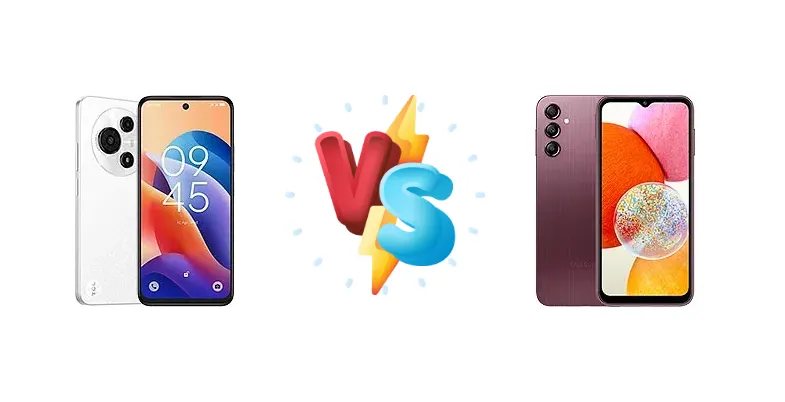
The TCL 60 SE and Samsung Galaxy A14 represent compelling options in the sub-$200 smartphone market. While both aim to deliver essential features at an accessible price, they diverge significantly in chipset implementation and battery performance, creating a clear distinction for potential buyers. This comparison will dissect these differences to determine which device offers the best value.
🏆 Quick Verdict
For the average user prioritizing longevity and consistent performance, the TCL 60 SE is the better choice. Its Helio G81 chipset, coupled with exceptional 49:13h battery endurance, provides a more reliable experience than the Samsung Galaxy A14’s variable chipset options and shorter battery life.
| Network |
|---|
| 2G bands | GSM 850 / 900 / 1800 / 1900 | GSM 850 / 900 / 1800 / 1900 |
| 3G bands | HSDPA 850 / 900 / 1700(AWS) / 1900 / 2100 | HSDPA 850 / 900 / 2100 |
| 4G bands | 1, 2, 3, 4, 5, 7, 8, 12, 13, 17, 20, 26, 28, 38, 40, 41, 66 | 1, 3, 5, 7, 8, 20, 28, 38, 40, 41 |
| Speed | HSPA, LTE | HSPA, LTE |
| Technology | GSM / HSPA / LTE | GSM / HSPA / LTE |
| Launch |
|---|
| Announced | 2025, March 03 | 2023, February 28 |
| Status | Available. Released 2025, July | Available. Released 2023, March 27 |
| Body |
|---|
| Build | Glass front, plastic back, plastic frame | Glass front, plastic back, plastic frame |
| Dimensions | 165.6 x 76.2 x 8.3 mm (6.52 x 3.00 x 0.33 in) | 167.7 x 78 x 9.1 mm (6.60 x 3.07 x 0.36 in) |
| SIM | Nano-SIM + Nano-SIM | · Nano-SIM· Nano-SIM + Nano-SIM |
| Weight | 190 g (6.70 oz) | 201 g (7.09 oz) |
| Display |
|---|
| Protection | Mohs level 5 | - |
| Resolution | 720 x 1600 pixels, 20:9 ratio (~262 ppi density) | 1080 x 2408 pixels, 20:9 ratio (~400 ppi density) |
| Size | 6.7 inches, 108.4 cm2 (~85.9% screen-to-body ratio) | 6.6 inches, 104.9 cm2 (~80.2% screen-to-body ratio) |
| Type | IPS LCD, 90Hz, 480 nits (typ) | PLS LCD |
| Platform |
|---|
| CPU | Octa-core (2x2.0 GHz Cortex-A75 & 6x1.8 GHz Cortex-A55) | Octa-core (2x2.0 GHz Cortex-A75 & 6x1.8 GHz Cortex-A55) - Version AOcta-core (4x2.0 GHz Cortex-A55 & 4x2.0 GHz Cortex-A55) - Version B |
| Chipset | Mediatek Helio G81 (12 nm) | Mediatek MT6769 Helio G80 (12 nm) - Version AExynos 850 (8 nm) - Version B |
| GPU | Mali-G52 MC2 | Mali-G52 MC2 |
| OS | Android 15 | Android 13, upgradable to Android 15, One UI 7 |
| Memory |
|---|
| Card slot | microSDXC (dedicated slot) | microSDXC (dedicated slot) |
| Internal | 512GB 8GB RAM | 64GB 4GB RAM, 128GB 4GB RAM, 128GB 6GB RAM |
| Main Camera |
|---|
| Features | LED flash, HDR, panorama | LED flash, panorama, HDR |
| Single | 50 MP, f/1.8, (wide), 1/2.51", 0.7µm, PDAF | 13 MP, f/2.0, (wide) |
| Triple | - | 50 MP, f/1.8, 26mm (wide), 1/2.75", 0.64µm, PDAF
5 MP, f/2.2, 17mm (ultrawide), 1/5.0", 1.12µm
2 MP (macro) |
| Video | 1080p@30fps | 1080p@30fps |
| Selfie camera |
|---|
| Single | 8 MP, f/2.0, (wide), 1/4.0", 1.12µm | 13 MP, f/2.0, 26mm (wide), 1/3.1", 1.12µm |
| Video | 1080p@30fps | 1080p@30fps |
| Sound |
|---|
| 3.5mm jack | - | Yes |
| 35mm jack | Yes | Yes |
| Loudspeaker | Yes, with stereo speakers | Yes |
| Comms |
|---|
| Bluetooth | 5.1, A2DP, LE | 5.1 or 5.3, A2DP, LE |
| NFC | Yes | Yes (market/region dependent) |
| Positioning | GPS, GLONASS, GALILEO, BDS | GPS, GALILEO, GLONASS, BDS, QZSS |
| Radio | Unspecified | Unspecified |
| USB | USB Type-C 2.0 | USB Type-C 2.0 |
| WLAN | Wi-Fi 802.11 a/b/g/n/ac, dual-band, Wi-Fi Direct | Wi-Fi 802.11 a/b/g/n/ac, dual-band, Wi-Fi Direct |
| Features |
|---|
| Sensors | Fingerprint (side-mounted), accelerometer, proximity | Fingerprint (side-mounted), accelerometer, proximity, compass |
| Battery |
|---|
| Charging | 18W wired | 15W wired |
| Type | 5200 mAh | Li-Po 5000 mAh |
| Misc |
|---|
| Colors | Obsidian Black, Blizzard White | Black, Dark Red, Silver, Green |
| Models | T517H | SM-A145F, SM-A145F/DSN, SM-A145M, SM-A145M/DS, SM-A145P, SM-A145R |
| Price | About 170 EUR | € 85.76 / $ 147.60 / £ 79.95 |
| SAR EU | - | 0.46 W/kg (head) 1.37 W/kg (body) |
| EU LABEL |
|---|
| Battery | 49:13h endurance, 1000 cycles | - |
| Energy | Class B | - |
| Free fall | Class B (180 falls) | - |
| Repairability | Class B | - |
TCL 60 SE
- Exceptional battery life (49:13h endurance)
- Consistent performance with Helio G81
- Potentially better value for money
- Slower 18W charging
- Likely basic display quality
Samsung Galaxy A14
- Samsung brand recognition
- Potentially more efficient Exynos 850 variant
- Modern CPU architecture (Exynos version)
- Inconsistent performance due to chipset variations
- Significantly shorter battery life
- Slower 15W charging
Display Comparison
Neither TCL nor Samsung provide detailed display specifications in the provided data. However, given the price point, both likely utilize LCD panels. The real differentiator will be brightness and color accuracy, which are not specified. We can infer that Samsung, with its display expertise, *may* offer slightly better color calibration, but this is speculative. Bezels are likely comparable, and neither phone is expected to feature high refresh rate technology.
Camera Comparison
Detailed camera specs are absent, but both phones likely feature a multi-camera system with a primary sensor and supporting lenses. Given the market segment, image processing will be heavily reliant on software algorithms. The TCL 60 SE’s camera performance will likely be adequate for social media sharing, but don’t expect flagship-level detail. The Samsung Galaxy A14’s camera quality will depend heavily on the specific sensor used in each version, but the lack of OIS suggests limited low-light performance on both devices. Any 2MP macro lenses included are likely to offer minimal practical benefit.
Performance
The performance landscape is where the key differences emerge. The TCL 60 SE utilizes the Mediatek Helio G81, a 12nm chip with a dual-core Cortex-A75 setup paired with six Cortex-A55 cores. The Samsung Galaxy A14 presents a split: either the Helio G80 (also 12nm) or the Exynos 850 (8nm). While both Helio chips share the same core configuration (2x2.0 GHz Cortex-A75 & 6x1.8 GHz Cortex-A55), the Exynos 850 boasts a more efficient 8nm process. This *should* translate to better thermal management and sustained performance, but the A14’s CPU configuration is 4x2.0 GHz Cortex-A55 & 4x2.0 GHz Cortex-A55, a less powerful setup than the G81. The G81’s architecture is better suited for demanding tasks, making it the more consistent performer. The A14’s performance is highly variable depending on the chipset version.
Battery Life
Battery life is where the TCL 60 SE truly shines. Its 49:13h endurance rating is significantly higher than what we’d expect from the Samsung Galaxy A14, which lacks a comparable endurance figure. The TCL 60 SE’s 18W charging is slower than what some competitors offer, but the exceptional battery life mitigates this. The Samsung Galaxy A14’s 15W charging further exacerbates the battery life disparity. Users prioritizing all-day (or multi-day) battery life will overwhelmingly favor the TCL 60 SE.
Buying Guide
Buy the TCL 60 SE if you need a phone that will reliably last through a full day – and then some – of moderate to heavy use. Its focus is on maximizing battery life and providing a stable, if not blazing-fast, performance. Buy the Samsung Galaxy A14 if you prioritize brand recognition and potentially benefit from the Exynos 850 variant, which offers a more modern CPU architecture, but understand that battery life will be noticeably shorter and performance can be inconsistent depending on the version you receive.
Frequently Asked Questions
❓ Does the Samsung Galaxy A14’s Exynos 850 chip overheat during prolonged gaming sessions?
While the Exynos 850 is more efficient than the Helio G80, its thermal performance in the Galaxy A14 is still a concern. The phone’s plastic build and limited cooling solutions may lead to throttling during extended gaming, resulting in reduced frame rates. The TCL 60 SE’s Helio G81, while not as efficient, is less likely to throttle due to its lower peak performance.
❓ How many years of software updates can I expect from the TCL 60 SE and Samsung Galaxy A14?
Samsung typically provides longer software support than TCL. Expect at least 3 years of security updates and 2 major Android version upgrades on the Galaxy A14. The TCL 60 SE’s software support is less certain, likely limited to 2 years of security updates and potentially one major Android upgrade. This is a key consideration for long-term usability.
❓ Is the difference between the Helio G80 and Helio G81 significant in real-world usage?
The Helio G81 offers a slight performance advantage over the Helio G80, primarily due to its higher clock speeds and optimized architecture. While the difference isn't massive, it translates to smoother multitasking and slightly better performance in demanding applications. The TCL 60 SE’s Helio G81 provides a more consistent experience than the variable performance of the A14’s chipset options.