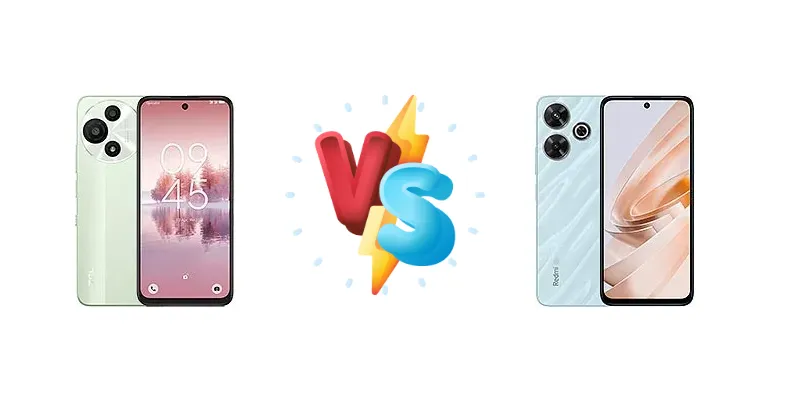
The TCL 60 SE NxtPaper and Xiaomi Redmi Note 13R represent compelling options in the increasingly competitive sub-$200 smartphone market. The TCL focuses on a unique paper-like display experience and long-term battery health, while the Redmi Note 13R prioritizes faster charging and a more recent Qualcomm chipset. This comparison dissects their key differences to determine which device delivers the best value.
🏆 Quick Verdict
For the average user prioritizing sustained performance and quicker top-ups, the Xiaomi Redmi Note 13R emerges as the winner. Its Snapdragon 4+ Gen 2 chipset, built on a more efficient 4nm process, offers a slight edge in responsiveness and gaming, complemented by significantly faster 33W charging. However, the TCL 60 SE NxtPaper remains a strong contender for those valuing a unique display and exceptional battery longevity.
| Network |
|---|
| 2G bands | GSM 850 / 900 / 1800 / 1900 | GSM 850 / 900 / 1800 / 1900 |
| 3G bands | HSDPA 850 / 900 / 1700(AWS) / 1900 / 2100 | HSDPA 850 / 900 / 2100 |
| 4G bands | LTE | 1, 3, 5, 8, 34, 38, 39, 40, 41 |
| 5G bands | SA/NSA | 1, 5, 8, 28, 41, 78 SA/NSA |
| Speed | HSPA, LTE, 5G | HSPA, LTE, 5G |
| Technology | GSM / HSPA / LTE / 5G | GSM / CDMA / HSPA / EVDO / LTE / 5G |
| Launch |
|---|
| Announced | 2025, March 03 | 2024, May 17 |
| Status | Available. Released 2025, May | Available. Released 2024, May 17 |
| Body |
|---|
| Build | - | Glass front, plastic frame, glass back |
| Dimensions | 165.6 x 76.2 x 8.2 mm (6.52 x 3.00 x 0.32 in) | 168.6 x 76.3 x 8.2 mm (6.64 x 3.00 x 0.32 in) |
| SIM | Nano-SIM + Nano-SIM | Nano-SIM + Nano-SIM |
| Weight | 190 g (6.70 oz) | 205 g (7.23 oz) |
| Display |
|---|
| Protection | Mohs level 5 | - |
| Resolution | 720 x 1600 pixels, 20:9 ratio (~262 ppi density) | 1080 x 2460 pixels (~396 ppi density) |
| Size | 6.7 inches, 108.4 cm2 (~85.9% screen-to-body ratio) | 6.79 inches, 109.5 cm2 (~85.1% screen-to-body ratio) |
| Type | IPS LCD, 120Hz, 550 nits (typ) | IPS LCD, 120Hz, 550 nits |
| Platform |
|---|
| CPU | Octa-core (2x2.4 GHz Cortex-A76 & 6x2.0 GHz Cortex-A55) | Octa-core (2x2.3 GHz Cortex-A78 & 6x1.95 GHz Cortex-A55) |
| Chipset | Mediatek Dimensity 6300 (6 nm) | Qualcomm SM4450 Snapdragon 4+ Gen 2 (4 nm) |
| GPU | Mali-G57 MC2 | Adreno 613 |
| OS | Android 15 | Android 14, HyperOS |
| Memory |
|---|
| Card slot | microSDXC (uses shared SIM slot) | No |
| Internal | 256GB 8GB RAM | 128GB 6GB RAM, 128GB 8GB RAM, 256GB 8GB RAM, 256GB 12GB RAM, 512GB 12GB RAM |
| Main Camera |
|---|
| Dual | 50 MP, f/1.8, 26mm (wide), 1/2.5", 0.7µm, PDAF
5 MP, (ultrawide) | 50 MP, f/1.8, (wide), 1/2.76", 0.64µm, PDAF
2 MP (macro) |
| Features | LED flash, HDR, panorama | LED flash, HDR |
| Video | 1080p@30fps | 1080p@30fps |
| Selfie camera |
|---|
| Features | HDR | - |
| Single | 8 MP, f/2.0, (wide), 1/4.0", 1.12µm | 8 MP, (wide), 1/4.0", 1.12µm |
| Video | 1080p@30fps | 1080p@30fps |
| Sound |
|---|
| 35mm jack | Yes | Yes |
| Loudspeaker | Yes, with stereo speakers | Yes |
| Comms |
|---|
| Bluetooth | 5.4, A2DP, LE | 5.3, A2DP, LE |
| Infrared port | - | Yes |
| NFC | Yes | Yes |
| Positioning | GPS, GLONASS, BDS, GALILEO | GPS, GLONASS, GALILEO, BDS |
| Radio | Unspecified | No |
| USB | USB Type-C 2.0 | USB Type-C |
| WLAN | Wi-Fi 802.11 a/b/g/n/ac, dual-band, Wi-Fi Direct | Wi-Fi 802.11 a/b/g/n/ac, dual-band |
| Features |
|---|
| Sensors | Fingerprint (side-mounted), accelerometer, gyro, proximity, compass | Fingerprint (side-mounted), accelerometer, compass |
| Battery |
|---|
| Charging | 18W wired | 33W wired |
| Type | 5200 mAh | 5030 mAh |
| Misc |
|---|
| Colors | Space Gray, Mint Green | Black, Blue, Silver |
| Models | T521K | 2406ERN9CC |
| Price | £ 186.61 | About 180 EUR |
| EU LABEL |
|---|
| Battery | 46:38h endurance, 1000 cycles | - |
| Energy | Class B | - |
| Free fall | Class B (180 falls) | - |
| Repairability | Class B | - |
TCL 60 SE NxtPaper
- Unique NxtPaper display for comfortable reading
- Exceptional battery endurance (46:38h)
- 1000-cycle battery rating for long-term health
- Slower 18W charging
- Older 6nm chipset may limit performance
Xiaomi Redmi Note 13R
- Faster 33W wired charging
- More efficient 4nm Snapdragon 4+ Gen 2 chipset
- Slightly faster CPU clock speeds
- Lacks the unique NxtPaper display technology
- Battery longevity not explicitly highlighted
Display Comparison
Neither device boasts a flagship-level display, but they cater to different needs. While specific display specs (resolution, brightness) are missing for the TCL 60 SE NxtPaper, its defining feature is the NxtPaper technology, aiming to mimic the texture of paper for reduced eye strain during reading. The Redmi Note 13R lacks this specialized feature, focusing on a standard LCD experience. The absence of high refresh rates on both suggests a focus on power efficiency rather than fluid animations. The TCL's NxtPaper tech is the key differentiator here, appealing to users who spend significant time reading ebooks or articles.
Camera Comparison
Detailed camera specifications are limited, but we can infer some differences. Both phones likely feature a primary camera and supporting lenses. Given the market segment, expecting flagship-level camera performance is unrealistic. The TCL 60 SE NxtPaper’s camera performance will likely lean towards balanced image processing, while Xiaomi’s image processing tends to be more vibrant and saturated. Without knowing sensor sizes or aperture values, it’s difficult to definitively declare a winner, but the Redmi Note 13R’s newer chipset may offer slightly improved image signal processing capabilities.
Performance
The core of the performance difference lies in the chipsets. The Xiaomi Redmi Note 13R’s Qualcomm SM4450 Snapdragon 4+ Gen 2 (4nm) benefits from a more advanced fabrication process compared to the TCL 60 SE NxtPaper’s Mediatek Dimensity 6300 (6nm). This 4nm process generally translates to improved power efficiency and thermal management, potentially leading to less throttling under sustained loads. While both utilize octa-core CPUs with similar core configurations (2x high-performance, 6x efficiency), the Redmi Note 13R’s Cortex-A78 cores (2.3 GHz) have a slight clock speed advantage over the TCL’s Cortex-A76 cores (2.4 GHz). This, combined with the process node advantage, suggests the Redmi Note 13R will offer a smoother experience in demanding applications and games.
Battery Life
The TCL 60 SE NxtPaper boasts a remarkable 46:38h endurance rating, suggesting excellent battery life. However, its 18W wired charging is comparatively slow. The Redmi Note 13R, while potentially having a slightly lower endurance (spec not provided), compensates with 33W wired charging. This faster charging significantly reduces the time spent tethered to a wall outlet. The TCL’s 1000-cycle battery rating indicates a focus on long-term battery health, promising minimal degradation over years of use. The Redmi Note 13R prioritizes convenience with faster charging, while the TCL prioritizes longevity.
Buying Guide
Buy the TCL 60 SE NxtPaper if you prioritize a comfortable reading experience with its NxtPaper display, and value long-term battery health with its 1000-cycle rated battery. Buy the Xiaomi Redmi Note 13R if you prefer a more responsive user experience, faster charging speeds, and a slightly more modern chipset for improved app loading and gaming performance.
Frequently Asked Questions
❓ Will the Snapdragon 4+ Gen 2 in the Redmi Note 13R handle demanding games like PUBG Mobile?
The Snapdragon 4+ Gen 2 is capable of running PUBG Mobile, but likely at medium settings to maintain a stable frame rate. While not a gaming powerhouse, it offers a noticeable improvement over older chipsets in this price range, and the 4nm process helps mitigate thermal throttling during extended gaming sessions.
❓ How does the NxtPaper display on the TCL 60 SE affect color accuracy and vibrancy?
The NxtPaper display prioritizes a paper-like texture and reduced eye strain over absolute color accuracy. Colors may appear slightly muted compared to traditional LCDs, but this is intentional to mimic the reading experience of physical paper. It's ideal for long-form reading but may not be the best choice for color-critical tasks like photo or video editing.
❓ Is the 18W charging on the TCL 60 SE noticeably slow in daily use?
Yes, 18W charging is considerably slower than the 33W charging on the Redmi Note 13R. Expect a significantly longer time to fully charge the TCL 60 SE, potentially taking over 2 hours from 0 to 100%. This is a trade-off for the longer battery lifespan and endurance.
❓ Does the Redmi Note 13R support any form of fast charging protocols beyond standard USB Power Delivery?
Xiaomi typically supports proprietary fast charging protocols alongside USB Power Delivery. While the Redmi Note 13R supports 33W charging, using a compatible Xiaomi charger will likely yield the fastest charging speeds. Using a standard USB-PD charger may result in slower charging times.