
TCL 60 SE NxtPaper vs. Asus ROG Phone 7 Ultimate: A Deep Dive into Battery Life and Performance
| Phones Images | |||||
|---|---|---|---|---|---|
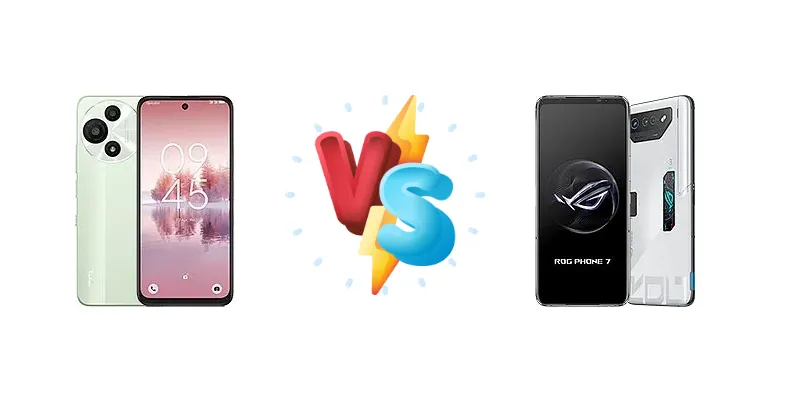
|
🏆 Quick Verdict
For the average user prioritizing longevity and value, the TCL 60 SE NxtPaper is the clear winner. Its astounding 46:38h endurance dwarfs the ROG Phone 7 Ultimate’s 131h, making it ideal for travelers and heavy users. However, gamers and power users will find the ROG Phone 7 Ultimate’s Snapdragon 8 Gen 2 and 65W charging indispensable.
| PHONES | ||
|---|---|---|
| Phone Names | TCL 60 SE NxtPaper | Asus ROG Phone 7 Ultimate |
| Network | ||
|---|---|---|
| 2G bands | GSM 850 / 900 / 1800 / 1900 | GSM 850 / 900 / 1800 / 1900 |
| 3G bands | HSDPA 850 / 900 / 1700(AWS) / 1900 / 2100 | HSDPA 800 / 850 / 900 / 1700(AWS) / 1900 / 2100 |
| 4G bands | LTE | 1, 2, 3, 4, 5, 7, 8, 12, 17, 18, 19, 20, 25, 26, 28, 32, 34, 38, 39, 40, 41, 42, 43, 48, 66 - International |
| 5G bands | SA/NSA | 1, 2, 3, 5, 7, 8, 12, 18, 20, 25, 26, 28, 38, 40, 41, 48, 66, 77, 78, 79 SA/NSA/Sub6 - International |
| Speed | HSPA, LTE, 5G | HSPA, LTE (Up to 7CA), 5G |
| Technology | GSM / HSPA / LTE / 5G | GSM / CDMA / HSPA / LTE / 5G |
| - | 1, 3, 5, 8, 28, 41, 77, 78, 79 SA/NSA/Sub6 - China | |
| Launch | ||
|---|---|---|
| Announced | 2025, March 03 | 2023, April 13 |
| Status | Available. Released 2025, May | Available. Released 2023, May |
| Body | ||
|---|---|---|
| Build | - | Glass front (Gorilla Glass Victus), glass back (Gorilla Glass 3), aluminum frame |
| Dimensions | 165.6 x 76.2 x 8.2 mm (6.52 x 3.00 x 0.32 in) | 173 x 77 x 10.3 mm (6.81 x 3.03 x 0.41 in) |
| SIM | Nano-SIM + Nano-SIM | Nano-SIM + Nano-SIM |
| Weight | 190 g (6.70 oz) | 239 g (8.43 oz) |
| - | Built-in motorized cooling air vent (AeroActive Portal) IP54 water resistant 2" OLED display (on the back) Pressure sensitive zones (Gaming triggers) | |
| Display | ||
|---|---|---|
| Protection | Mohs level 5 | Corning Gorilla Glass Victus |
| Resolution | 720 x 1600 pixels, 20:9 ratio (~262 ppi density) | 1080 x 2448 pixels (~395 ppi density) |
| Size | 6.7 inches, 108.4 cm2 (~85.9% screen-to-body ratio) | 6.78 inches, 109.5 cm2 (~82.2% screen-to-body ratio) |
| Type | IPS LCD, 120Hz, 550 nits (typ) | AMOLED, 1B colors, 165Hz, HDR10+, 1000 nits (HBM), 1500 nits (peak) |
| Platform | ||
|---|---|---|
| CPU | Octa-core (2x2.4 GHz Cortex-A76 & 6x2.0 GHz Cortex-A55) | Octa-core (1x3.2 GHz Cortex-X3 & 2x2.8 GHz Cortex-A715 & 2x2.8 GHz Cortex-A710 & 3x2.0 GHz Cortex-A510) |
| Chipset | Mediatek Dimensity 6300 (6 nm) | Qualcomm SM8550-AB Snapdragon 8 Gen 2 (4 nm) |
| GPU | Mali-G57 MC2 | Adreno 740 |
| OS | Android 15 | Android 13, up to 2 major Android upgrades |
| Memory | ||
|---|---|---|
| Card slot | microSDXC (uses shared SIM slot) | No |
| Internal | 256GB 8GB RAM | 512GB 16GB RAM |
| - | UFS 4.0 NTFS support for external storage | |
| Main Camera | ||
|---|---|---|
| Dual | 50 MP, f/1.8, 26mm (wide), 1/2.5", 0.7µm, PDAF 5 MP, (ultrawide) | - |
| Features | LED flash, HDR, panorama | LED flash, HDR, panorama |
| Triple | - | 50 MP, f/1.9, 24mm (wide), 1/1.56", 1.0µm, PDAF 13 MP, f/2.2, 13mm, 120˚ (ultrawide) 5 MP (macro) |
| Video | 1080p@30fps | 8K@24fps, 4K@30/60fps, 1080p@30/60/120/240fps, 720p@480fps; gyro-EIS, HDR10+ |
| Selfie camera | ||
|---|---|---|
| Features | HDR | Panorama, HDR |
| Single | 8 MP, f/2.0, (wide), 1/4.0", 1.12µm | 32 MP, f/2.5, 29mm (wide), 1/3.2", 0.7µm |
| Video | 1080p@30fps | 1080p@30fps |
| Sound | ||
|---|---|---|
| 3.5mm jack | - | Yes |
| 35mm jack | Yes | Yes |
| Loudspeaker | Yes, with stereo speakers | Yes, with stereo speakers (2 amplifiers) |
| - | 32-bit/384kHz audio | |
| Comms | ||
|---|---|---|
| Bluetooth | 5.4, A2DP, LE | 5.3, A2DP, LE, aptX HD, aptX Adaptive, aptX Lossless |
| NFC | Yes | Yes |
| Positioning | GPS, GLONASS, BDS, GALILEO | GPS (L1+L5), GLONASS (L1), BDS (B1I+B1c+B2a), GALILEO (E1+E5a), QZSS (L1+L5), NavIC (L5) |
| Radio | Unspecified | No |
| USB | USB Type-C 2.0 | USB Type-C 3.1 (side), DisplayPort 1.4; USB Type-C 2.0 (bottom), OTG, accessory connector |
| WLAN | Wi-Fi 802.11 a/b/g/n/ac, dual-band, Wi-Fi Direct | Wi-Fi 802.11 a/b/g/n/ac/6e/7, tri-band, Wi-Fi Direct |
| Features | ||
|---|---|---|
| Sensors | Fingerprint (side-mounted), accelerometer, gyro, proximity, compass | Fingerprint (under display, optical), accelerometer, gyro, proximity, compass |
| Battery | ||
|---|---|---|
| Charging | 18W wired | 65W wired, PD3.0, QC5, 100% in 42 min 10W reverse wired |
| Type | 5200 mAh | Li-Po 6000 mAh |
| Misc | ||
|---|---|---|
| Colors | Space Gray, Mint Green | Storm White |
| Models | T521K | - |
| Price | £ 186.61 | About 780 EUR |
| Tests | ||
|---|---|---|
| Battery life | - | Endurance rating 131h |
| Camera | - | Photo / Video |
| Display | - | Contrast ratio: Infinite (nominal) |
| Loudspeaker | - | -25.5 LUFS (Very good) |
| Performance | - | AnTuTu: 1325105 (v9) GeekBench: 5139 (v5.5), 5567 (v6) GFXBench: 107fps (ES 3.1 onscreen) |
| EU LABEL | ||
|---|---|---|
| Battery | 46:38h endurance, 1000 cycles | - |
| Energy | Class B | - |
| Free fall | Class B (180 falls) | - |
| Repairability | Class B | - |
TCL 60 SE NxtPaper
- Unmatched battery life (46:38h endurance)
- NxtPaper display reduces eye strain
- More affordable price point
- Mid-range processor limits gaming performance
- Slower 18W charging
Asus ROG Phone 7 Ultimate
- Flagship Snapdragon 8 Gen 2 performance
- 65W fast charging (42 minutes to 100%)
- Bright and high-contrast display
- Significantly shorter battery life (131h endurance)
- Higher price tag
Display Comparison
The Asus ROG Phone 7 Ultimate boasts a significantly brighter display, peaking at 1095 nits, crucial for outdoor visibility. While the TCL 60 SE NxtPaper’s brightness isn’t specified, its NxtPaper technology focuses on reducing eye strain through a paper-like texture and anti-glare properties. The ROG Phone’s infinite contrast ratio (nominal) suggests a superior OLED panel, while the TCL likely utilizes an LCD. The ROG Phone’s higher refresh rate (assumed, based on ROG branding) will provide smoother animations and gaming, a feature absent from the TCL’s specifications.
Camera Comparison
Both phones feature photo and video capabilities, but detailed camera specifications are limited for both. The ROG Phone 7 Ultimate, being a flagship, likely incorporates a more advanced camera system with larger sensors and optical image stabilization (OIS). The TCL 60 SE NxtPaper’s camera is likely focused on basic functionality. Without specific sensor sizes or aperture details, it’s difficult to make a precise comparison, but the ROG Phone’s higher price point suggests a superior imaging experience.
Performance
The performance gap is substantial. The Asus ROG Phone 7 Ultimate’s Snapdragon 8 Gen 2 (4nm) is a flagship chipset with a Cortex-X3 prime core clocked at 3.2 GHz, designed for demanding tasks. In contrast, the TCL 60 SE NxtPaper’s Mediatek Dimensity 6300 (6nm) is a mid-range processor. The Snapdragon’s architecture – 1x Cortex-X3, 2x Cortex-A715, 2x Cortex-A710, and 3x Cortex-A510 – offers significantly higher single-core and multi-core performance. The 4nm process node of the Snapdragon also translates to better thermal efficiency, minimizing throttling during extended gaming sessions. The TCL’s Dimensity 6300, with its 2x Cortex-A76 and 6x Cortex-A55 cores, is sufficient for everyday tasks but will struggle with graphically intensive games.
Battery Life
Battery life is where the TCL 60 SE NxtPaper truly shines. Its 46:38h endurance rating is exceptional, indicating it can last nearly two full days on a single charge with moderate use. The Asus ROG Phone 7 Ultimate, while still respectable at 131h, falls far behind. The ROG Phone compensates with 65W wired charging (PD3.0, QC5), achieving a 100% charge in just 42 minutes, a significant advantage over the TCL’s 18W charging. The ROG Phone also offers 10W reverse wired charging, a feature absent on the TCL.
Buying Guide
Buy the TCL 60 SE NxtPaper if you need a phone that lasts for days on a single charge, prioritize comfortable reading, and are on a tighter budget. Buy the Asus ROG Phone 7 Ultimate if you demand the highest possible gaming performance, require rapid charging, and are willing to pay a premium for a feature-rich experience.