
TCL 60 NxtPaper 4G vs Google Pixel 7a: A Detailed Comparison
| Phones Images | |||||
|---|---|---|---|---|---|
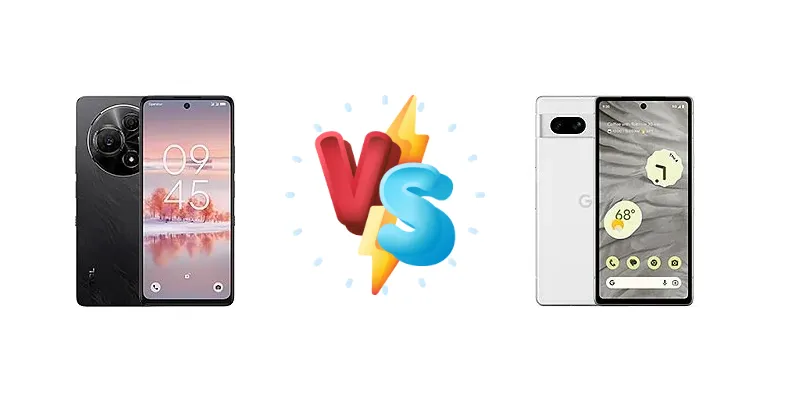
|
🏆 Quick Verdict
For the average user prioritizing camera quality and a smooth software experience, the Google Pixel 7a is the clear winner. Its Tensor G2 chipset and superior image processing capabilities justify the price premium. However, the TCL 60 NxtPaper 4G offers compelling value for those seeking a large display and extended battery life on a tighter budget.
| PHONES | ||
|---|---|---|
| Phone Names | TCL 60 NxtPaper 4G | Google Pixel 7a |
| Network | ||
|---|---|---|
| 2G bands | GSM 850 / 900 / 1800 / 1900 | GSM 850 / 900 / 1800 / 1900 |
| 3G bands | HSDPA 850 / 900 / 1700(AWS) / 1900 / 2100 | HSDPA 800 / 850 / 900 / 1700(AWS) / 1900 / 2100 |
| 4G bands | 1, 2, 3, 4, 5, 7, 8, 12, 13, 17, 20, 26, 28, 38, 40, 41, 66 | 1, 2, 3, 4, 5, 7, 8, 12, 13, 14, 17, 20, 25, 26, 28, 29, 30, 38, 40, 41, 48, 66, 71 - GWKK3, G0DZQ |
| 5G bands | - | 1, 2, 3, 5, 7, 8, 12, 14, 20, 25, 28, 30, 38, 41, 48, 66, 71, 77, 78 SA/NSA/Sub6 - GWKK3 |
| Speed | HSPA, LTE | HSPA, LTE, 5G |
| Technology | GSM / HSPA / LTE | GSM / HSPA / LTE / 5G |
| - | 1, 2, 3, 5, 7, 8, 12, 20, 25, 28, 38, 40, 41, 66, 75, 76, 77, 78, 79 SA/NSA/Sub6 - GHL1X, G82U8 | |
| Launch | ||
|---|---|---|
| Announced | 2025, March 03 | 2023, May 10 |
| Status | Available. Released 2025, May | Available. Released 2023, May 10 |
| Body | ||
|---|---|---|
| Build | - | Glass front (Gorilla Glass 3), aluminum frame, plastic back |
| Dimensions | 167.6 x 75.5 x 7.9 mm (6.60 x 2.97 x 0.31 in) | 152 x 72.9 x 9 mm (5.98 x 2.87 x 0.35 in) |
| SIM | Nano-SIM + Nano-SIM | Nano-SIM + eSIM |
| Weight | 190 g (6.70 oz) | 193.5 g (6.84 oz) |
| - | IP67 dust/water resistant (up to 1m for 30 min) | |
| Display | ||
|---|---|---|
| Protection | - | Corning Gorilla Glass 3 |
| Resolution | 1080 x 2460 pixels (~395 ppi density) | 1080 x 2400 pixels, 20:9 ratio (~429 ppi density) |
| Size | 6.8 inches, 109.8 cm2 (~86.8% screen-to-body ratio) | 6.1 inches, 90.7 cm2 (~81.8% screen-to-body ratio) |
| Type | IPS LCD, 90Hz, 550 nits (typ) | OLED, HDR, 90Hz |
| - | Always-on display | |
| Platform | ||
|---|---|---|
| CPU | Octa-core (2x2.0 GHz Cortex-A75 & 6x1.8 GHz Cortex-A55) | Octa-core (2x2.85 GHz Cortex-X1 & 2x2.35 GHz Cortex-A78 & 4x1.80 GHz Cortex-A55) |
| Chipset | Mediatek Helio G92 (12 nm) | Google Tensor G2 (5 nm) |
| GPU | Mali-G52 MC2 | Mali-G710 MP7 |
| OS | Android 15 | Android 13, upgradable to Android 15, up to 5 major Android upgrades |
| Memory | ||
|---|---|---|
| Card slot | microSDXC (dedicated slot) | No |
| Internal | 256GB 8GB RAM, 512GB 8GB RAM | 128GB 8GB RAM |
| - | UFS 3.1 | |
| Main Camera | ||
|---|---|---|
| Dual | 108 MP, f/1.8, (wide), 1/1.67", 0.64µm, PDAF Auxiliary lens | 64 MP, f/1.9, 26mm (wide), 1/1.73", 0.8µm, dual pixel PDAF, OIS 13 MP, f/2.2, 120˚ (ultrawide), 1.12µm |
| Features | LED flash, HDR | Dual-LED flash, Pixel Shift, Auto-HDR, panorama |
| Video | 1080p@30fps | 4K@30/60fps, 1080p@30/60/120/240fps, OIS |
| Selfie camera | ||
|---|---|---|
| Features | HDR | HDR, panorama |
| Single | 32 MP, f/2.0, (wide), 1/3.35", 0.65µm | 13 MP, f/2.2, 20mm (ultrawide), 1.12µm |
| Video | 1080p@30fps | 4K@30fps, 1080p@30fps |
| Sound | ||
|---|---|---|
| 3.5mm jack | - | No |
| 35mm jack | Yes | No |
| Loudspeaker | Yes, with stereo speakers | Yes, with stereo speakers |
| Comms | ||
|---|---|---|
| Bluetooth | 5.1, A2DP, LE | 5.3, A2DP, LE |
| NFC | Yes | Yes |
| Positioning | GPS, GLONASS, BDS, GALILEO | GPS, GLONASS, GALILEO, BDS, QZSS, NavIC |
| Radio | Unspecified | No |
| USB | USB Type-C 2.0 | USB Type-C 3.2 |
| WLAN | Wi-Fi 802.11 a/b/g/n/ac, dual-band, Wi-Fi Direct | Wi-Fi 802.11 a/b/g/n/ac/6e, tri-band |
| Features | ||
|---|---|---|
| Sensors | Fingerprint (side-mounted), gyro, accelerometer, proximity, compass | Fingerprint (under display, optical), accelerometer, gyro, proximity, compass, barometer |
| Battery | ||
|---|---|---|
| Charging | 33W wired | 18W wired, PD3.0 7.5W wireless |
| Type | 5200 mAh | Li-Po 4385 mAh |
| Misc | ||
|---|---|---|
| Colors | Dark Black, Alps White | Charcoal, Snow, Sea, Coral |
| Models | T626K, T626K1 | GWKK3, GHL1X, G0DZQ, G82U8 |
| Price | About 200 EUR | € 179.90 / $ 150.00 / £ 170.00 / ₹ 25,980 |
TCL 60 NxtPaper 4G
- More affordable price point
- Faster wired charging (33W)
- Unique NxtPaper display for reduced eye strain
- Significantly less powerful processor
- Likely inferior camera performance
- Potentially lower display quality (LCD vs OLED)
Google Pixel 7a
- Superior performance with Google Tensor G2
- Excellent camera quality and image processing
- Brighter and more vibrant display
- Higher price tag
- Slower wired charging (18W)
- Smaller battery capacity (implied)
Display Comparison
The TCL 60 NxtPaper 4G’s defining feature is its NxtPaper display, designed to mimic the texture of paper for reduced eye strain. While the resolution isn’t specified, the Pixel 7a boasts a significantly brighter panel at 1070 nits, ensuring excellent visibility outdoors. The Pixel 7a’s display technology is likely OLED, offering superior contrast and color accuracy compared to the TCL’s LCD. The lack of high refresh rate information for the TCL suggests a standard 60Hz panel, while the Pixel 7a likely offers a smoother 90Hz experience, though this isn't explicitly stated in the provided data.
Camera Comparison
The Pixel 7a’s camera system is a major strength, leveraging Google’s renowned computational photography algorithms. While specific sensor details are missing, the Pixel 7a’s focus on ‘Photo / Video’ suggests a well-rounded and capable system. The TCL 60 NxtPaper 4G’s camera specifications are not provided, making a direct comparison difficult. However, given its price point, it’s unlikely to match the Pixel 7a’s image quality, particularly in low-light conditions. The Pixel 7a’s image processing excels in dynamic range and detail preservation, offering a more consistent and refined photographic experience.
Performance
The Google Pixel 7a’s Tensor G2 (5nm) chipset represents a substantial leap in processing power compared to the TCL 60 NxtPaper 4G’s MediaTek Helio G92 (12nm). The Tensor G2’s Cortex-X1 prime core, clocked at 2.85 GHz, delivers significantly faster single-core performance, crucial for app responsiveness and demanding tasks. The 5nm fabrication process also translates to improved thermal efficiency, reducing throttling during sustained workloads. While the TCL’s octa-core CPU is adequate for everyday tasks, the Pixel 7a will excel in gaming and multitasking. The Pixel 7a likely utilizes faster LPDDR5x RAM, further enhancing performance.
Battery Life
The Pixel 7a boasts an endurance rating of 76 hours, indicating excellent battery life despite its 18W wired and 7.5W wireless charging capabilities. The TCL 60 NxtPaper 4G features 33W wired charging, potentially offering faster top-ups, but its battery capacity is unknown. The Pixel 7a’s Power Delivery (PD3.0) support ensures compatibility with a wider range of chargers. While the TCL’s faster charging is appealing, the Pixel 7a’s overall endurance and optimized power management likely provide a more consistent and reliable battery experience.
Buying Guide
Buy the TCL 60 NxtPaper 4G if you need a large screen for media consumption, prioritize battery endurance over raw performance, and appreciate a unique, eye-friendly display. Buy the Google Pixel 7a if you prefer a more compact form factor, demand excellent camera performance with Google’s computational photography, and value a clean, fast software experience with guaranteed updates.