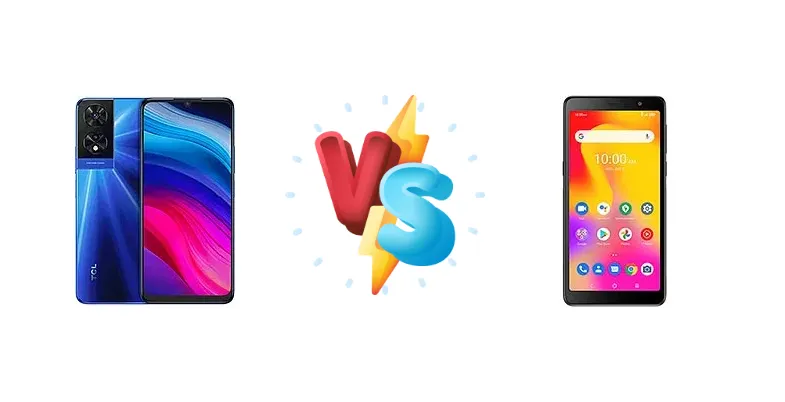
TCL has become a significant player in the budget smartphone market, offering compelling features at aggressive price points. The TCL 505 and A30 represent two of their most affordable options, but they aren't identical. This comparison dives deep into the specifications to determine which device delivers the best value for users prioritizing performance and everyday usability.
🏆 Quick Verdict
For most users, the TCL 505 emerges as the better choice. Its Mediatek Helio G36 chipset, featuring faster Cortex-A53 cores, provides a noticeable performance edge over the A30’s Helio P22, making it more responsive for daily tasks and light gaming. While both offer basic functionality, the 505’s slightly improved processing power justifies the potential price difference.
| Network |
|---|
| 2G bands | GSM 850 / 900 / 1800 / 1900 | GSM 850 / 900 / 1800 / 1900 |
| 3G bands | HSDPA 850 / 900 / 1900 / 2100 | HSDPA 850 / 1700(AWS) / 1900 |
| 4G bands | 1, 3, 5, 7, 8, 20, 26, 28, 38, 40, 41 | 2, 4, 5, 12, 13, 25, 26, 41, 66, 71 |
| Speed | HSPA, LTE | HSPA 42.2/5.76 Mbps, LTE Cat4 150/50 Mbps |
| Technology | GSM / HSPA / LTE | GSM / HSPA / LTE |
| Launch |
|---|
| Announced | 2024, February 06 | 2021, October 05 |
| Status | Available. Released 2024, March | Available. Released 2021, October 05 |
| Body |
|---|
| Dimensions | 168.3 x 76.7 x 8.3 mm (6.63 x 3.02 x 0.33 in) | 145.8 x 71.1 x 9.9 mm (5.74 x 2.80 x 0.39 in) |
| SIM | · Nano-SIM· Nano-SIM + Nano-SIM | Nano-SIM |
| Weight | 190 g (6.70 oz) | 171 g (6.03 oz) |
| Display |
|---|
| Protection | - | Asahi Glass |
| Resolution | 720 x 1600 pixels, 20:9 ratio (~260 ppi density) | 720 x 1440 pixels, 18:9 ratio (~293 ppi density) |
| Size | 6.75 inches, 110.0 cm2 (~85.2% screen-to-body ratio) | 5.5 inches, 78.1 cm2 (~75.3% screen-to-body ratio) |
| Type | IPS LCD, 90Hz, 400 nits (typ) | TFT LCD |
| Platform |
|---|
| CPU | Octa-core (4x2.2 GHz Cortex-A53 & 4x1.6 GHz Cortex-A53) | Octa-core 2.0 GHz Cortex-A53 |
| Chipset | Mediatek Helio G36 (12 nm) | Mediatek MT6762 Helio P22 (12 nm) |
| GPU | PowerVR GE8320 | PowerVR GE8320 |
| OS | Android 14 | Android 11 |
| Memory |
|---|
| Card slot | microSDXC (dedicated slot) | microSDXC (dedicated slot) |
| Internal | 64GB 4GB RAM, 128GB 4GB RAM | 32GB 3GB RAM |
| Main Camera |
|---|
| Dual | 50 MP, f/1.8, 26mm (wide), 1/2.55", 0.7µm, PDAF
Auxiliary lens | - |
| Features | LED flash, HDR, panorama | LED flash |
| Single | - | 8 MP, 1/4.0", 1.12µm |
| Video | 1080p@30fps | 1080p@30fps |
| Selfie camera |
|---|
| Single | 5 MP, f/2.2, 27mm (wide), 1/5.0", 1.12µm | 5 MP, 1/5.0", 1.12µm |
| Video | 1080p@30fps | 1080p@30fps |
| Sound |
|---|
| 35mm jack | Yes | Yes |
| Loudspeaker | Yes, with stereo speakers | Yes |
| Comms |
|---|
| Bluetooth | 5.1, A2DP, LE | 5.0, A2DP, LE |
| NFC | Yes (market/region dependent) | No |
| Positioning | GPS, GLONASS, GALILEO, BDS | GPS |
| Radio | FM radio | Unspecified |
| USB | USB Type-C 2.0, OTG | microUSB 2.0 |
| WLAN | Wi-Fi 802.11 a/b/g/n/ac, dual-band, Wi-Fi Direct | Wi-Fi 802.11 b/g/n, Wi-Fi Direct |
| Features |
|---|
| Sensors | Fingerprint (side-mounted; market/region dependent), accelerometer | Accelerometer, proximity |
| Battery |
|---|
| Charging | 10W wired | - |
| Type | 5010 mAh | Li-Ion 3000 mAh |
| Misc |
|---|
| Colors | Ocean Blue, Space Grey | Black |
| Models | T509K, T509A | 5102, 5102L |
| Price | - | About 90 EUR |
TCL 505
- Faster CPU cores for improved responsiveness
- Slightly newer chipset architecture (Helio G36)
- Potentially better image processing
- 10W charging is slow
- Likely limited storage options
TCL A30
- Very affordable price point
- Functional for basic tasks
- 10W charging is standard for the price
- Slower CPU performance
- Less responsive user experience
- May struggle with multitasking
Display Comparison
Both the TCL 505 and A30 likely utilize LCD panels, common in this price bracket. Specific details like resolution and brightness are not provided, but we can assume they are similar, targeting a 720p+ resolution. The absence of higher refresh rates (90Hz or 120Hz) is expected. The user experience will likely be comparable in terms of visual fidelity, with the display quality being a secondary consideration compared to performance.
Camera Comparison
Without detailed sensor information, a direct camera comparison is difficult. Both phones likely feature a primary camera and potentially a depth or macro sensor. However, the image processing capabilities tied to the chipset will play a role. The Helio G36 in the 505 *may* offer slightly better image signal processing (ISP) capabilities, resulting in marginally improved photo quality, particularly in low-light conditions. The absence of Optical Image Stabilization (OIS) is expected on both devices.
Performance
The core difference lies in the chipsets. The TCL 505’s Mediatek Helio G36 features an octa-core configuration with 4x2.2 GHz Cortex-A53 cores and 4x1.6 GHz Cortex-A53 cores. The TCL A30 uses the Mediatek MT6762 Helio P22, also octa-core, but with a uniform 2.0 GHz Cortex-A53 configuration. The higher clock speeds on four cores of the G36 translate to faster processing for demanding tasks. While both are based on the same Cortex-A53 architecture, the G36’s architecture is slightly newer, offering minor efficiency improvements. This difference will be most noticeable when launching apps or switching between them.
Battery Life
Both devices feature 12nm chipsets, suggesting similar power efficiency. The TCL 505 and A30 both utilize 10W wired charging, indicating a similar charging experience. While battery capacity isn't specified, the 10W charging suggests a full charge will take approximately 2.5-3.5 hours. The slightly more efficient Helio G36 in the 505 *could* translate to marginally longer battery life, but the difference is unlikely to be substantial.
Buying Guide
Buy the TCL 505 if you need a phone that feels reasonably snappy for social media, messaging, and basic app usage. The faster CPU cores will translate to a smoother experience, especially when multitasking. Buy the TCL A30 if your primary needs are extremely basic – calls, texts, and occasional light browsing – and you're prioritizing the absolute lowest possible price point. It's a functional device, but compromises are made in performance.
Frequently Asked Questions
❓ Will the TCL 505 handle popular social media apps like TikTok and Instagram smoothly?
Yes, the TCL 505’s Mediatek Helio G36 chipset, with its faster CPU cores, should provide a noticeably smoother experience when using social media apps compared to the A30. While not a high-end gaming phone, it will handle scrolling through feeds and watching videos without significant lag.
❓ Is the TCL A30 suitable for someone who primarily uses their phone for calls and texts?
Absolutely. The TCL A30 is perfectly adequate for basic communication tasks like making calls and sending texts. Its Helio P22 chipset is sufficient for these functions, and the lower price point makes it an attractive option for users with minimal smartphone needs.
❓ Can either of these phones run multiple apps simultaneously without slowing down?
Multitasking will be limited on both devices. The TCL 505 will handle a few apps open in the background better than the A30 due to its more powerful processor, but neither phone has enough RAM to comfortably run many demanding apps concurrently.