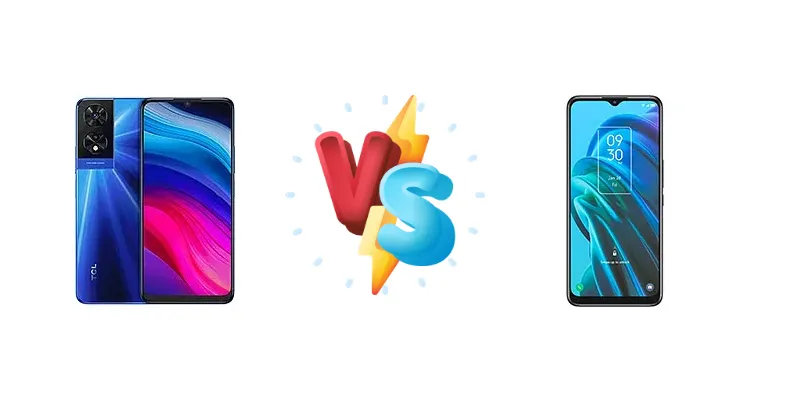
TCL has become a significant player in the budget smartphone space, offering compelling features at aggressive price points. The TCL 505 and 30 XE 5G represent two distinct approaches to affordability – one prioritizing a newer, albeit less powerful, chipset, and the other leveraging a more established 5G platform. This comparison dissects their key differences to determine which device delivers the best value for your money.
🏆 Quick Verdict
For most users, the TCL 30 XE 5G is the better choice. Its Mediatek Dimensity 700, built on a 7nm process, provides a noticeable performance uplift over the TCL 505’s Helio G36, translating to smoother multitasking and a more responsive user experience. While the 505 offers a slightly newer platform, the 30 XE 5G’s superior processing power and faster 18W charging outweigh this advantage.
| Network |
|---|
| 2G bands | GSM 850 / 900 / 1800 / 1900 | GSM 850 / 900 / 1800 / 1900 |
| 3G bands | HSDPA 850 / 900 / 1900 / 2100 | HSDPA 850 / 900 / 1700(AWS) / 1900 / 2100 |
| 4G bands | 1, 3, 5, 7, 8, 20, 26, 28, 38, 40, 41 | 1, 2, 3, 4, 5, 7, 8, 12, 13, 20, 25, 26, 28, 38, 39, 40, 41, 66, 71 |
| 5G bands | - | 25, 41, 66, 71, 77 SA/NSA |
| Speed | HSPA, LTE | HSPA, LTE, 5G |
| Technology | GSM / HSPA / LTE | GSM / HSPA / LTE / 5G |
| Launch |
|---|
| Announced | 2024, February 06 | 2022, January 04 |
| Status | Available. Released 2024, March | Available. Released 2022, March 02 |
| Body |
|---|
| Build | - | Glass front, plastic frame, plastic back |
| Dimensions | 168.3 x 76.7 x 8.3 mm (6.63 x 3.02 x 0.33 in) | 164.1 x 74.9 x 9 mm (6.46 x 2.95 x 0.35 in) |
| SIM | · Nano-SIM· Nano-SIM + Nano-SIM | Nano-SIM |
| Weight | 190 g (6.70 oz) | 195 g (6.88 oz) |
| Display |
|---|
| Protection | - | Dragontrail Glass |
| Resolution | 720 x 1600 pixels, 20:9 ratio (~260 ppi density) | 720 x 1600 pixels, 20:9 ratio (~269 ppi density) |
| Size | 6.75 inches, 110.0 cm2 (~85.2% screen-to-body ratio) | 6.52 inches, 102.6 cm2 (~83.5% screen-to-body ratio) |
| Type | IPS LCD, 90Hz, 400 nits (typ) | IPS LCD, 90Hz |
| Platform |
|---|
| CPU | Octa-core (4x2.2 GHz Cortex-A53 & 4x1.6 GHz Cortex-A53) | Octa-core (2x2.2 GHz Cortex-A76 & 6x2.0 GHz Cortex-A55) |
| Chipset | Mediatek Helio G36 (12 nm) | Mediatek Dimensity 700 (7 nm) |
| GPU | PowerVR GE8320 | Mali-G57 MC2 |
| OS | Android 14 | Android 11, TCL UI |
| Memory |
|---|
| Card slot | microSDXC (dedicated slot) | microSDXC (dedicated slot) |
| Internal | 64GB 4GB RAM, 128GB 4GB RAM | 64GB 4GB RAM |
| Main Camera |
|---|
| Dual | 50 MP, f/1.8, 26mm (wide), 1/2.55", 0.7µm, PDAF
Auxiliary lens | - |
| Features | LED flash, HDR, panorama | LED flash, HDR, panorama |
| Triple | - | 13 MP, f/2.2, 27mm (wide) 1/3.0", 1.12µm, PDAF
2 MP (macro)
Auxiliary lens |
| Video | 1080p@30fps | 1080p@30fps |
| Selfie camera |
|---|
| Single | 5 MP, f/2.2, 27mm (wide), 1/5.0", 1.12µm | 8 MP, f/2.0, 26mm (wide) 1/4.0", 1.12µm |
| Video | 1080p@30fps | 1080p@30fps |
| Sound |
|---|
| 35mm jack | Yes | Yes |
| Loudspeaker | Yes, with stereo speakers | Yes |
| Comms |
|---|
| Bluetooth | 5.1, A2DP, LE | 5.1, A2DP, LE |
| NFC | Yes (market/region dependent) | No |
| Positioning | GPS, GLONASS, GALILEO, BDS | GPS, GLONASS, GALILEO, BDS |
| Radio | FM radio | Unspecified |
| USB | USB Type-C 2.0, OTG | USB Type-C 2.0, OTG |
| WLAN | Wi-Fi 802.11 a/b/g/n/ac, dual-band, Wi-Fi Direct | Wi-Fi 802.11 a/b/g/n/ac, dual-band, Wi-Fi Direct |
| Features |
|---|
| Sensors | Fingerprint (side-mounted; market/region dependent), accelerometer | Fingerprint (rear-mounted), accelerometer, proximity, compass, gyro, barometer |
| Battery |
|---|
| Charging | 10W wired | 18W wired |
| Type | 5010 mAh | Li-Po 4500 mAh |
| Misc |
|---|
| Colors | Ocean Blue, Space Grey | Shadow Black |
| Models | T509K, T509A | T767W |
| Price | - | About 170 EUR |
TCL 505
- Potentially lower price point.
- May have a slightly newer software version (depending on updates).
- Simple and straightforward user experience.
- Significantly weaker performance due to the Helio G36 chipset.
- Slower 10W charging.
- Less capable for multitasking and demanding apps.
TCL 30 XE 5G
- Faster and more responsive performance with the Dimensity 700.
- Faster 18W charging.
- Better 5G connectivity and overall user experience.
- May be slightly more expensive than the TCL 505.
- Potentially older software version at launch.
- May not receive as many software updates.
Display Comparison
Neither TCL provides display specifications beyond size. However, given their price points, both likely utilize IPS LCD panels. The absence of details like resolution, refresh rate, or peak brightness makes a direct comparison difficult. The focus here is on internal performance, as display quality is likely similar and adequate for basic use. Expect standard 60Hz refresh rates on both.
Camera Comparison
Without detailed camera specs, it’s difficult to make a definitive judgment. Both phones likely feature a primary camera and potentially a depth or macro sensor. However, image processing capabilities are heavily tied to the chipset. The Dimensity 700’s integrated image signal processor (ISP) is more advanced than the Helio G36’s, potentially leading to better image quality, especially in low-light conditions. The 30 XE 5G will likely offer more refined noise reduction and dynamic range. We can assume both phones will have similar limitations in terms of zoom capabilities and video recording quality.
Performance
The core difference lies in the chipsets. The TCL 30 XE 5G’s Mediatek Dimensity 700 (7nm) is a significant step up from the TCL 505’s Helio G36 (12nm). The Dimensity 700 features a more modern CPU architecture – Cortex-A76 cores versus the 505’s Cortex-A53 – resulting in substantially better single-core and multi-core performance. The 7nm fabrication process also contributes to improved power efficiency and thermal management. While both are octa-core, the Dimensity 700’s core configuration (2x2.2 GHz A76 + 6x2.0 GHz A55) is optimized for responsiveness and sustained performance, making it better suited for multitasking and demanding apps. The Helio G36’s (4x2.2 GHz A53 + 4x1.6 GHz A53) is geared towards basic functionality.
Battery Life
Battery capacity isn’t specified, but the TCL 30 XE 5G’s 18W wired charging is a clear advantage over the TCL 505’s 10W charging. This translates to significantly faster charging times, reducing downtime. While a larger battery capacity on the 505 could partially offset this, the Dimensity 700’s superior power efficiency means the 30 XE 5G will likely offer comparable or even better battery life despite potentially having a smaller cell. Expect a full charge on the 30 XE 5G in under 2 hours, while the 505 will likely take over 3 hours.
Buying Guide
Buy the TCL 505 if you prioritize a very basic smartphone experience for essential tasks like calls, texts, and light social media, and are on an extremely tight budget. Buy the TCL 30 XE 5G if you want a more capable device for everyday use, including streaming, casual gaming, and benefit from faster 5G connectivity and quicker charging times. The 30 XE 5G is the better all-rounder.
Frequently Asked Questions
❓ Will the TCL 30 XE 5G struggle with graphically intensive games like PUBG Mobile?
While the Dimensity 700 isn't a gaming powerhouse, it's capable of running PUBG Mobile at medium settings with reasonable frame rates. Expect some occasional frame drops during intense action. The TCL 505’s Helio G36 will likely struggle even at the lowest settings, offering a less enjoyable gaming experience.
❓ Does the TCL 505 support VoLTE and Wi-Fi calling?
Support for VoLTE and Wi-Fi calling depends on your carrier. Both devices are likely to support these features, but it's crucial to check with your mobile provider to ensure compatibility in your region. The 5G capability of the 30 XE 5G doesn't guarantee VoLTE/Wi-Fi calling on older network technologies.
❓ How much storage does each phone have, and is it expandable?
Storage capacity isn't specified in the provided data. However, budget phones often include a microSD card slot for expandable storage. Check the product listing or official specifications to confirm the storage options and whether expansion is supported on each model.