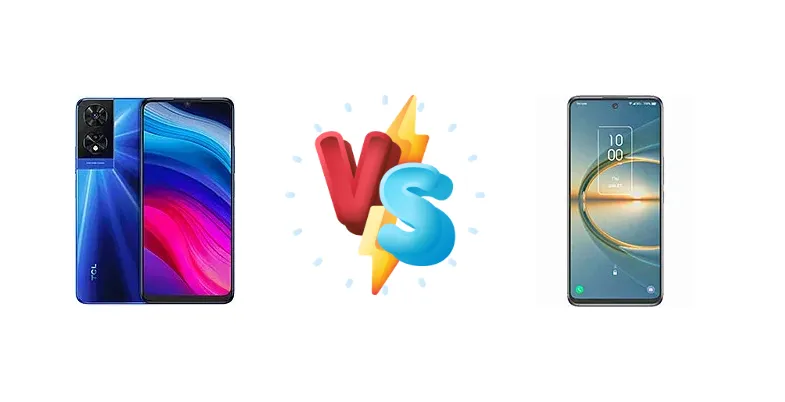
TCL has become a significant player in the budget smartphone space, offering compelling features at aggressive price points. The TCL 505 and TCL 30 V 5G represent two distinct approaches to affordability – one prioritizing a newer chipset and 5G connectivity, the other focusing on a slightly different processor and a more streamlined experience. This comparison dives deep into the specifications to determine which device delivers the best value for your money.
🏆 Quick Verdict
For the average user prioritizing 5G connectivity and slightly better performance, the TCL 30 V 5G is the stronger choice. Its Qualcomm Snapdragon 480 chipset, built on an 8nm process, offers a noticeable efficiency and performance advantage over the TCL 505’s MediaTek Helio G36. However, the 505 remains a viable option for those on a tighter budget.
| Network |
|---|
| 2G bands | GSM 850 / 900 / 1800 / 1900 | GSM 850 / 900 / 1800 / 1900 |
| 3G bands | HSDPA 850 / 900 / 1900 / 2100 | HSDPA 850 / 900 / 1700(AWS) / 1900 / 2100 |
| 4G bands | 1, 3, 5, 7, 8, 20, 26, 28, 38, 40, 41 | 2, 4, 5, 12, 13, 46, 48, 66 |
| 5G bands | - | 2, 5, 48, 66, 77, 260, 261 SA/NSA/Sub6/mmWave |
| Speed | HSPA, LTE | HSPA, LTE, 5G |
| Technology | GSM / HSPA / LTE | GSM / HSPA / LTE / 5G |
| Launch |
|---|
| Announced | 2024, February 06 | 2022, January 04 |
| Status | Available. Released 2024, March | Available. Released 2022, January 28 |
| Body |
|---|
| Build | - | Glass front, plastic frame, plastic back |
| Dimensions | 168.3 x 76.7 x 8.3 mm (6.63 x 3.02 x 0.33 in) | 165.9 x 76 x 9.1 mm (6.53 x 2.99 x 0.36 in) |
| SIM | · Nano-SIM· Nano-SIM + Nano-SIM | Nano-SIM |
| Weight | 190 g (6.70 oz) | 200.4 g (7.09 oz) |
| Display |
|---|
| Protection | - | Corning Gorilla Glass 3 |
| Resolution | 720 x 1600 pixels, 20:9 ratio (~260 ppi density) | 1080 x 2400 pixels, 20:9 ratio (~395 ppi density) |
| Size | 6.75 inches, 110.0 cm2 (~85.2% screen-to-body ratio) | 6.67 inches, 107.4 cm2 (~85.2% screen-to-body ratio) |
| Type | IPS LCD, 90Hz, 400 nits (typ) | IPS LCD |
| Platform |
|---|
| CPU | Octa-core (4x2.2 GHz Cortex-A53 & 4x1.6 GHz Cortex-A53) | Octa-core (2x2.0 GHz Kryo 460 & 6x1.8 GHz Kryo 460) |
| Chipset | Mediatek Helio G36 (12 nm) | Qualcomm SM4350 Snapdragon 480 5G (8 nm) |
| GPU | PowerVR GE8320 | Adreno 619 |
| OS | Android 14 | Android 11, TCL UI |
| Memory |
|---|
| Card slot | microSDXC (dedicated slot) | microSDXC (dedicated slot) |
| Internal | 64GB 4GB RAM, 128GB 4GB RAM | 128GB 4GB RAM |
| Main Camera |
|---|
| Dual | 50 MP, f/1.8, 26mm (wide), 1/2.55", 0.7µm, PDAF
Auxiliary lens | - |
| Features | LED flash, HDR, panorama | LED flash, HDR, panorama |
| Triple | - | 50 MP, (wide), PDAF
5 MP, (ultrawide)
2 MP (macro) |
| Video | 1080p@30fps | 1080p@30fps |
| Selfie camera |
|---|
| Single | 5 MP, f/2.2, 27mm (wide), 1/5.0", 1.12µm | 16 MP, (wide) |
| Video | 1080p@30fps | 1080p@30fps |
| Sound |
|---|
| 35mm jack | Yes | Yes |
| Loudspeaker | Yes, with stereo speakers | Yes, with dual speakers |
| Comms |
|---|
| Bluetooth | 5.1, A2DP, LE | 5.1, A2DP, LE |
| NFC | Yes (market/region dependent) | No |
| Positioning | GPS, GLONASS, GALILEO, BDS | GPS |
| Radio | FM radio | No |
| USB | USB Type-C 2.0, OTG | USB Type-C 3.0, OTG |
| WLAN | Wi-Fi 802.11 a/b/g/n/ac, dual-band, Wi-Fi Direct | Wi-Fi 802.11 a/b/g/n/ac, dual-band, Wi-Fi Direct |
| Features |
|---|
| Sensors | Fingerprint (side-mounted; market/region dependent), accelerometer | Fingerprint (rear-mounted), accelerometer, proximity, compass, gyro, barometer |
| Battery |
|---|
| Charging | 10W wired | 18W wired |
| Type | 5010 mAh | Li-Po 4500 mAh |
| Misc |
|---|
| Colors | Ocean Blue, Space Grey | Midnight Gray |
| Models | T509K, T509A | - |
| Price | - | About 270 EUR |
TCL 505
- Potentially lower price point
- Functional for basic smartphone tasks
- Simple and straightforward user experience
- Less powerful processor
- Slower charging speed
- Less efficient chipset
TCL 30 V 5G
- 5G connectivity for faster data speeds
- More powerful and efficient Snapdragon 480 chipset
- Faster 18W charging
- Slightly higher price
- May not offer significant camera improvements
- Performance still limited by budget constraints
Display Comparison
Neither TCL provides display specifications beyond size. However, given their price points, both likely utilize IPS LCD panels. The key difference lies in the underlying processing power impacting UI smoothness. While panel quality is likely similar, the Snapdragon 480 in the 30 V 5G will contribute to a more responsive visual experience due to its superior GPU.
Camera Comparison
Without detailed camera specifications, it’s difficult to make a definitive judgment. However, given the price bracket, both phones likely feature similar camera setups focused on basic photography. The image signal processor (ISP) within the Snapdragon 480 generally offers better image processing capabilities, potentially resulting in slightly improved photo quality in various lighting conditions. The TCL 30 V 5G’s chipset is more likely to support advanced features like better HDR processing.
Performance
The core difference between these two devices is the chipset. The TCL 30 V 5G’s Qualcomm Snapdragon 480 5G (8nm) is a clear upgrade over the TCL 505’s MediaTek Helio G36 (12nm). The 8nm process node of the Snapdragon 480 translates to better power efficiency and reduced thermal throttling. While both are octa-core CPUs, the Snapdragon 480’s Kryo 460 cores offer a more modern architecture and higher clock speeds (2x2.0 GHz vs 4x2.2 GHz Cortex-A53). This means the 30 V 5G will handle multitasking and more demanding applications with greater ease. The Helio G36’s Cortex-A53 cores, while capable, are older and less efficient.
Battery Life
Battery capacity isn't specified, but the TCL 30 V 5G’s 18W charging is a significant advantage over the TCL 505’s 10W charging. The more efficient Snapdragon 480 chipset will also contribute to longer battery life. While a larger battery capacity on the 505 could offset this, the faster charging speed of the 30 V 5G means less time tethered to a wall outlet. Expect a considerably faster 0-100% charge time on the 30 V 5G.
Buying Guide
Buy the TCL 505 if you need a functional smartphone for basic tasks like calling, texting, and light social media use, and are prioritizing the absolute lowest price. Buy the TCL 30 V 5G if you want a smoother experience with 5G connectivity for faster data speeds, and are willing to spend a bit more for improved performance and efficiency, especially when multitasking or using demanding apps.
Frequently Asked Questions
❓ Will the TCL 30 V 5G actually get significantly faster download speeds with 5G compared to 4G?
Yes, assuming you have 5G coverage and a compatible data plan. The Snapdragon 480 5G modem supports both sub-6GHz and mmWave 5G frequencies, offering potentially several times faster download speeds than 4G LTE. However, real-world speeds will vary based on network conditions and carrier availability.
❓ Is the Helio G36 in the TCL 505 powerful enough for casual gaming like Candy Crush or Angry Birds?
Yes, the Helio G36 is sufficient for basic, less demanding games like Candy Crush or Angry Birds. However, it will struggle with more graphically intensive titles. Expect lower frame rates and potential lag in those scenarios. The TCL 30 V 5G will offer a smoother gaming experience overall.
❓ How much faster will the TCL 30 V 5G charge compared to the TCL 505?
With 18W charging versus 10W, the TCL 30 V 5G will charge significantly faster. While exact times depend on battery capacity (which isn't specified), you can expect a 0-100% charge to take roughly 30-60% less time on the 30 V 5G.