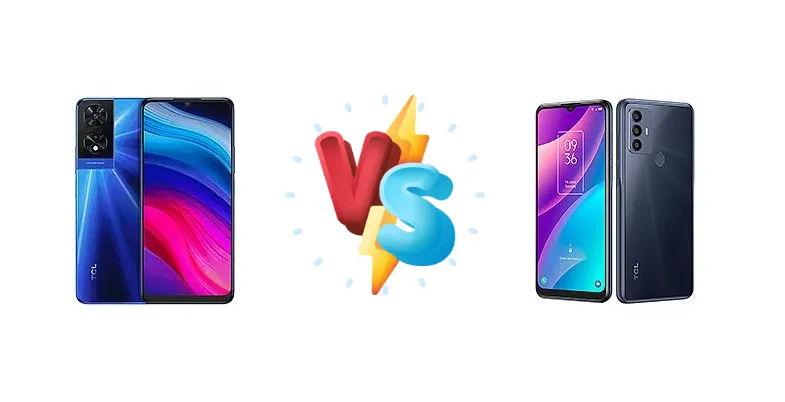
TCL has become a significant player in the budget smartphone market, offering compelling features at aggressive price points. The TCL 505 and TCL 30 SE represent two of their offerings, both targeting cost-conscious consumers. However, subtle differences in their chipsets and charging capabilities create distinct user experiences. This comparison dissects these differences to help you choose the right TCL device.
🏆 Quick Verdict
For most users, the TCL 505 emerges as the slightly better choice. While the 30 SE offers marginally faster 15W charging, the 505’s Helio G36 chipset, with its higher clocked Cortex-A53 cores, provides a noticeable performance edge in everyday tasks and light gaming, making it a more responsive device overall.
| Network |
|---|
| 2G bands | GSM 850 / 900 / 1800 / 1900 | GSM 850 / 900 / 1800 / 1900 |
| 3G bands | HSDPA 850 / 900 / 1900 / 2100 | HSDPA 850 / 900 / 1900 / 2100 - EMEA/APAC |
| 4G bands | 1, 3, 5, 7, 8, 20, 26, 28, 38, 40, 41 | 1, 3, 5, 7, 8, 20, 28, 38, 40, 41 - EMEA |
| Speed | HSPA, LTE | HSPA 42.2/11.5 Mbps, LTE Cat4 150/50 Mbps |
| Technology | GSM / HSPA / LTE | GSM / HSPA / LTE |
| | - | 2, 3, 4, 5, 7, 8, 12, 13, 17, 26, 28, 66 - LATAM |
| Launch |
|---|
| Announced | 2024, February 06 | 2022, February 27 |
| Status | Available. Released 2024, March | Available. Released 2022, April 20 |
| Body |
|---|
| Build | - | Glass front, plastic frame, plastic back |
| Dimensions | 168.3 x 76.7 x 8.3 mm (6.63 x 3.02 x 0.33 in) | 165.2 x 75.5 x 8.9 mm (6.50 x 2.97 x 0.35 in) |
| SIM | · Nano-SIM· Nano-SIM + Nano-SIM | · Nano-SIM· Nano-SIM + Nano-SIM |
| Weight | 190 g (6.70 oz) | 190 g (6.70 oz) |
| Display |
|---|
| Resolution | 720 x 1600 pixels, 20:9 ratio (~260 ppi density) | 720 x 1600 pixels, 20:9 ratio (~269 ppi density) |
| Size | 6.75 inches, 110.0 cm2 (~85.2% screen-to-body ratio) | 6.52 inches, 102.6 cm2 (~82.3% screen-to-body ratio) |
| Type | IPS LCD, 90Hz, 400 nits (typ) | IPS LCD, 450 nits (typ) |
| Platform |
|---|
| CPU | Octa-core (4x2.2 GHz Cortex-A53 & 4x1.6 GHz Cortex-A53) | Octa-core (4x2.0 GHz Cortex-A53 & 4x1.5 GHz Cortex-A53) |
| Chipset | Mediatek Helio G36 (12 nm) | Mediatek MT6762G Helio G25 (12 nm) |
| GPU | PowerVR GE8320 | PowerVR GE8320 |
| OS | Android 14 | Android 12, TCL UI 4.0 |
| Memory |
|---|
| Card slot | microSDXC (dedicated slot) | microSDXC (dedicated slot) |
| Internal | 64GB 4GB RAM, 128GB 4GB RAM | 64GB 4GB RAM, 128GB 4GB RAM |
| | - | eMMC 5.1 |
| Main Camera |
|---|
| Dual | 50 MP, f/1.8, 26mm (wide), 1/2.55", 0.7µm, PDAF
Auxiliary lens | - |
| Features | LED flash, HDR, panorama | LED flash, HDR, panorama |
| Single | - | 8 MP, f/2.0, 26mm (wide), 1/4", 1.12µm |
| Triple | - | 50 MP, f/1.9, 28mm (wide), 1/2.76", 0.64µm, PDAF
2 MP (macro)
Auxiliary lens |
| Video | 1080p@30fps | 1080p@30fps |
| Selfie camera |
|---|
| Features | - | HDR |
| Single | 5 MP, f/2.2, 27mm (wide), 1/5.0", 1.12µm | 8 MP, f/2.0, 26mm (wide), 1/4.0", 1.12µm |
| Video | 1080p@30fps | 1080p@30fps |
| Sound |
|---|
| 3.5mm jack | - | Yes |
| 35mm jack | Yes | Yes |
| Loudspeaker | Yes, with stereo speakers | Yes |
| Comms |
|---|
| Bluetooth | 5.1, A2DP, LE | 5.0, A2DP, LE |
| NFC | Yes (market/region dependent) | Yes (6165H/6165H1 only) |
| Positioning | GPS, GLONASS, GALILEO, BDS | GPS, GLONASS, GALILEO, BDS |
| Radio | FM radio | Unspecified |
| USB | USB Type-C 2.0, OTG | USB Type-C 2.0 |
| WLAN | Wi-Fi 802.11 a/b/g/n/ac, dual-band, Wi-Fi Direct | Wi-Fi 802.11 b/g/n, Wi-Fi Direct |
| Features |
|---|
| Sensors | Fingerprint (side-mounted; market/region dependent), accelerometer | Fingerprint (rear-mounted), accelerometer, proximity, compass |
| Battery |
|---|
| Charging | 10W wired | 15W wired |
| Type | 5010 mAh | Li-Po 5000 mAh |
| Misc |
|---|
| Colors | Ocean Blue, Space Grey | Atlantic Blue, Space Gray, Glacial Blue |
| Models | T509K, T509A | 6165H, 6156H1, 6165A, 6165A1, 6165S |
TCL 505
- Slightly faster CPU performance due to the Helio G36.
- Potentially better multitasking capabilities.
- More responsive user experience.
- Slower 10W charging.
- Likely similar camera performance to the 30 SE.
TCL 30 SE
- Faster 15W wired charging.
- Potentially quicker top-ups.
- Similar overall functionality to the 505.
- Slightly slower CPU performance.
- May exhibit minor lag in demanding apps.
Display Comparison
Neither TCL provides display specifications beyond size, so a direct comparison is limited. Both likely utilize IPS LCD panels, common in this price bracket. Bezels are expected to be substantial on both devices. Color accuracy will likely be standard for the segment, prioritizing vibrancy over absolute fidelity. Without specific data, it's safe to assume similar viewing experiences.
Camera Comparison
Both phones likely feature similar camera setups, focusing on a primary sensor with supporting lenses. Given the price point, detailed camera analysis is difficult without sample images. It’s probable that both rely heavily on software processing to enhance image quality. The inclusion of a 2MP macro lens on either device is largely a marketing tactic, offering limited practical benefit due to the low resolution and lack of optical image stabilization. The primary sensor’s aperture and size will be the key determinants of low-light performance, but this information isn’t provided.
Performance
The core difference lies in the chipsets. The TCL 505’s Mediatek Helio G36 features an octa-core configuration with four cores clocked at 2.2 GHz, paired with another four at 1.6 GHz. The TCL 30 SE utilizes the Helio G25, also octa-core, but with a slightly lower peak clock speed of 2.0 GHz for its primary cores and 1.5 GHz for the efficiency cores. This 200 MHz difference, while seemingly small, translates to a measurable performance advantage for the 505 in CPU-bound tasks. Both utilize the same Cortex-A53 architecture, meaning the G36’s advantage isn’t revolutionary, but it’s present. The GPU performance will be similar, adequate for basic gaming but not demanding titles.
Battery Life
The TCL 30 SE boasts 15W wired charging, a step up from the TCL 505’s 10W charging. This translates to a faster 0-100% charge time, potentially shaving off 30-60 minutes. However, the actual impact depends on the battery capacity, which isn’t specified for either device. A larger battery on the 505 could offset the slower charging speed, providing longer overall usage. Without knowing the battery capacities, the 30 SE’s faster charging is the only definitive advantage in this category.
Buying Guide
Buy the TCL 505 if you prioritize a smoother, more responsive user experience, even if it means slightly slower charging. This phone is ideal for users who frequently switch between apps, browse the web, or enjoy casual mobile gaming. Buy the TCL 30 SE if you absolutely need the fastest possible charging speeds within this budget segment and are willing to accept a minor performance trade-off. This is a good option for users who frequently find themselves with limited charging opportunities.
Frequently Asked Questions
❓ Will the Helio G36 in the TCL 505 handle popular games like PUBG Mobile?
The Helio G36 can run PUBG Mobile, but expect to play at lower graphics settings (Medium or Low) to maintain a stable frame rate. It's not a gaming powerhouse, but it's sufficient for casual gaming sessions. The G25 in the 30 SE will offer a slightly less smooth experience.
❓ How long will it take to fully charge the TCL 30 SE with its 15W charging?
Without knowing the battery capacity, it's difficult to provide an exact time. However, assuming a typical 5000mAh battery, a full charge from 0% should take approximately 2.5 to 3 hours. The TCL 505's 10W charging will likely take around 3.5 to 4 hours for the same capacity.
❓ Is the difference in CPU clock speed between the Helio G36 and G25 noticeable in everyday use?
Yes, the 200 MHz difference in peak clock speed, combined with the G36's slightly more aggressive core configuration, results in a noticeable improvement in responsiveness when launching apps, browsing the web, and multitasking. It won't be a dramatic difference, but it's perceptible.