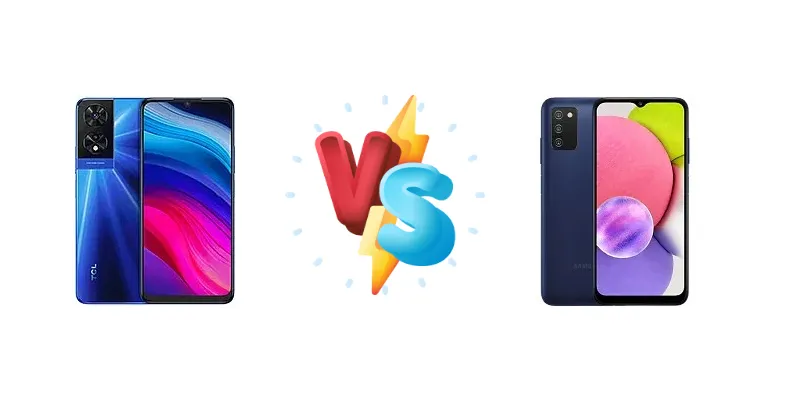
The TCL 505 and Samsung Galaxy A03s represent the extreme end of the smartphone price spectrum, targeting users who prioritize affordability above all else. Both devices offer basic functionality, but key differences in their chipsets and display characteristics dictate which phone is better suited for specific needs. This comparison dives deep into the specs to reveal which device delivers the most value.
🏆 Quick Verdict
For most users, the TCL 505 emerges as the slightly better choice. Its Mediatek Helio G36 chipset, while still entry-level, offers a modest performance advantage over the Galaxy A03s’ Helio P35, translating to a smoother experience with everyday tasks. While both phones share identical battery endurance ratings, the TCL 505’s slightly faster CPU provides a more responsive user experience.
| Network |
|---|
| 2G bands | GSM 850 / 900 / 1800 / 1900 | GSM 850 / 900 / 1800 / 1900 |
| 3G bands | HSDPA 850 / 900 / 1900 / 2100 | HSDPA 850 / 900 / 2100 |
| 4G bands | 1, 3, 5, 7, 8, 20, 26, 28, 38, 40, 41 | 1, 3, 5, 7, 8, 20, 28, 38, 40, 41 |
| Speed | HSPA, LTE | HSPA 42.2/5.76 Mbps, LTE Cat4 150/50 Mbps |
| Technology | GSM / HSPA / LTE | GSM / HSPA / LTE |
| | - | 2, 4, 5, 7, 12, 13, 14, 25, 26, 41, 66, 71 - SM-A037U |
| Launch |
|---|
| Announced | 2024, February 06 | 2021, August 18 |
| Status | Available. Released 2024, March | Available. Released 2021, August 18 |
| Body |
|---|
| Build | - | Glass front, plastic frame, plastic back |
| Dimensions | 168.3 x 76.7 x 8.3 mm (6.63 x 3.02 x 0.33 in) | 164.2 x 75.9 x 9.1 mm (6.46 x 2.99 x 0.36 in) |
| SIM | · Nano-SIM· Nano-SIM + Nano-SIM | Nano-SIM + Nano-SIM |
| Weight | 190 g (6.70 oz) | 196 g (6.91 oz) |
| Display |
|---|
| Resolution | 720 x 1600 pixels, 20:9 ratio (~260 ppi density) | 720 x 1600 pixels, 20:9 ratio (~270 ppi density) |
| Size | 6.75 inches, 110.0 cm2 (~85.2% screen-to-body ratio) | 6.5 inches, 102.0 cm2 (~81.8% screen-to-body ratio) |
| Type | IPS LCD, 90Hz, 400 nits (typ) | PLS LCD |
| Platform |
|---|
| CPU | Octa-core (4x2.2 GHz Cortex-A53 & 4x1.6 GHz Cortex-A53) | Octa-core (4x2.35 GHz Cortex-A53 & 4x1.8 GHz Cortex-A53) |
| Chipset | Mediatek Helio G36 (12 nm) | Mediatek MT6765 Helio P35 (12 nm) |
| GPU | PowerVR GE8320 | PowerVR GE8320 |
| OS | Android 14 | Android 11, upgradable to Android 13, One UI 5.1 Core |
| Memory |
|---|
| Card slot | microSDXC (dedicated slot) | microSDXC (dedicated slot) |
| Internal | 64GB 4GB RAM, 128GB 4GB RAM | 32GB 2GB RAM, 32GB 3GB RAM, 32GB 4GB RAM, 64GB 3GB RAM, 64GB 4GB RAM |
| | - | eMMC 5.1 |
| Main Camera |
|---|
| Dual | 50 MP, f/1.8, 26mm (wide), 1/2.55", 0.7µm, PDAF
Auxiliary lens | - |
| Features | LED flash, HDR, panorama | LED flash |
| Single | - | 5 MP, f/2.2 |
| Triple | - | 13 MP, f/2.2, (wide), AF
2 MP (macro)
Auxiliary lens |
| Video | 1080p@30fps | 1080p@30fps |
| Selfie camera |
|---|
| Single | 5 MP, f/2.2, 27mm (wide), 1/5.0", 1.12µm | 5 MP, f/2.2 |
| Video | 1080p@30fps | 1080p@30fps |
| Sound |
|---|
| 3.5mm jack | - | Yes |
| 35mm jack | Yes | Yes |
| Loudspeaker | Yes, with stereo speakers | Yes |
| Comms |
|---|
| Bluetooth | 5.1, A2DP, LE | 5.0, A2DP |
| NFC | Yes (market/region dependent) | Yes (market/region dependent) |
| Positioning | GPS, GLONASS, GALILEO, BDS | GPS, GLONASS, GALILEO, BDS |
| Radio | FM radio | No |
| USB | USB Type-C 2.0, OTG | USB Type-C 2.0 |
| WLAN | Wi-Fi 802.11 a/b/g/n/ac, dual-band, Wi-Fi Direct | Wi-Fi 802.11 b/g/n, Wi-Fi Direct |
| Features |
|---|
| Sensors | Fingerprint (side-mounted; market/region dependent), accelerometer | Fingerprint (side-mounted), accelerometer, proximity |
| Battery |
|---|
| Charging | 10W wired | 15W wired |
| Type | 5010 mAh | Li-Po 5000 mAh |
| Misc |
|---|
| Colors | Ocean Blue, Space Grey | Black, Blue, White |
| Models | T509K, T509A | SM-A037F, SM-A037F/DS, SM-A037M, SM-A037G, SM-A037U, SM-S134DL, SM-A037W, SM-A037U1, SM-S135DL |
| Price | - | $ 65.65 / £ 82.99 / ₹ 10,800 |
| SAR EU | - | 0.36 W/kg (head) 1.09 W/kg (body) |
| Tests |
|---|
| Battery life | - |
Endurance rating 122h
|
| Camera | - |
Photo / Video |
| Display | - |
Contrast ratio: 1718:1 (nominal) |
| Loudspeaker | - |
-27.4 LUFS (Good)
|
| Performance | - |
AnTuTu: 103465 (v8), 101299 (v9)
GeekBench: 889 (v5.1)
GFXBench: 5.5fps (ES 3.1 onscreen) |
TCL 505
- Slightly better CPU performance with Helio G36
- More modern chipset architecture
- Potentially smoother multitasking experience
- Slower 10W charging
- Display brightness likely lower than A03s
Samsung Galaxy A03s
- Higher peak display brightness (488 nits)
- Faster 15W charging
- Established Samsung brand reputation
- Older Helio P35 chipset
- Potentially less responsive performance
Display Comparison
Both the TCL 505 and Samsung Galaxy A03s feature displays with a 1718:1 contrast ratio, suggesting similar image quality in terms of black levels and color pop. However, the Galaxy A03s boasts a measured peak brightness of 488 nits, which is a significant advantage in outdoor visibility. While the TCL 505’s brightness isn’t specified, the A03s’ higher nits value will make it easier to see in direct sunlight. Both displays likely utilize IPS LCD technology, common in this price bracket, and lack features like high refresh rates or HDR support.
Camera Comparison
Both devices list 'Photo / Video' capabilities, but lack specific details regarding sensor size or resolution. Given the price point, it’s safe to assume both phones feature basic camera setups with limited low-light performance. The inclusion of a 2MP macro camera on the A03s is unlikely to provide significant value, as image quality will be severely limited by the small sensor size. Expect similar image quality from both devices in good lighting conditions, but the A03s’ slightly better display may make reviewing photos more pleasant.
Performance
The core difference between these two phones lies in their chipsets. The TCL 505 utilizes the Mediatek Helio G36, featuring an octa-core CPU clocked up to 2.2 GHz. The Samsung Galaxy A03s, on the other hand, is powered by the Mediatek Helio P35, with a CPU peaking at 2.35 GHz. Despite the slightly higher clock speed of the P35, the G36’s newer architecture and more efficient Cortex-A53 cores provide a more balanced performance profile. The G36’s architecture is better suited for handling modern apps and multitasking, even if the raw clock speed is lower. Both phones likely feature limited RAM and storage, impacting overall responsiveness.
Battery Life
Both the TCL 505 and Samsung Galaxy A03s achieve an endurance rating of 122 hours, indicating comparable battery life under similar usage conditions. The Galaxy A03s supports 15W wired charging, while the TCL 505 is limited to 10W. This means the A03s will charge slightly faster, potentially reducing downtime. However, the identical endurance ratings suggest that neither phone will require daily charging for moderate users. The slower charging speed of the TCL 505 is a minor drawback, but unlikely to be a dealbreaker for most.
Buying Guide
Buy the TCL 505 if you need a phone that feels a bit more responsive for basic multitasking and social media. The Helio G36 offers a small but noticeable performance boost. Buy the Samsung Galaxy A03s if you prioritize a brand with a well-established ecosystem and potentially wider service availability, and if the slightly lower price point is a deciding factor. Both phones are suitable for very light users.
Frequently Asked Questions
❓ Will the Helio G36 in the TCL 505 handle popular apps like WhatsApp and Facebook smoothly?
Yes, the Mediatek Helio G36 is sufficient for running basic apps like WhatsApp, Facebook, and web browsing. While it won't excel at demanding tasks, it provides a more responsive experience than the older Helio P35 in the A03s, especially when multitasking between these apps.
❓ Is the 15W charging on the Samsung Galaxy A03s a significant advantage over the TCL 505's 10W charging?
While not a massive difference, the 15W charging on the A03s will reduce charging times by approximately 30-45 minutes for a full charge. This can be convenient for users who need to quickly top up their battery.
❓ Can either of these phones handle basic mobile gaming?
Both phones can handle very basic mobile games, but don't expect a smooth experience with graphically intensive titles. The Helio G36 in the TCL 505 offers a slight advantage, but both phones will likely require low graphics settings and may experience frame drops.
❓ How does the software experience differ between TCL and Samsung?
Samsung's One UI is a more polished and feature-rich software experience compared to TCL's typically more stock Android approach. However, both phones are likely to receive limited software updates, and the performance impact of the software is minimal given the hardware limitations.