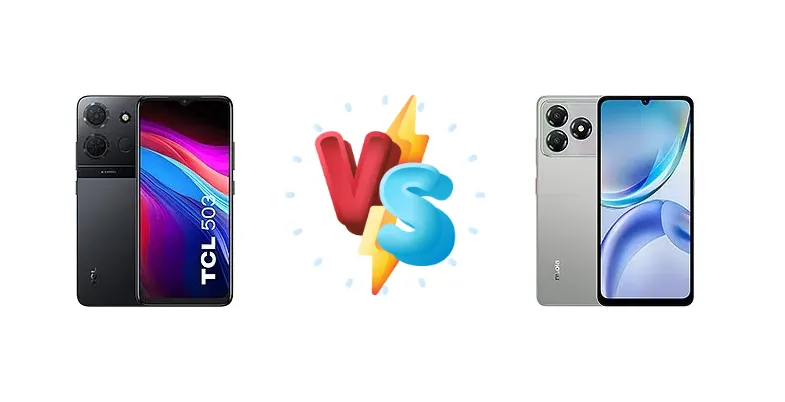
The sub-$150 smartphone market is fiercely competitive. Both the TCL 503 and ZTE Blade A36 aim to deliver essential smartphone functionality at an incredibly accessible price point, relying on Unisoc chipsets to keep costs down. This comparison dives deep into their specifications to determine which device offers the best balance of performance, battery life, and overall value.
🏆 Quick Verdict
For the average user prioritizing longevity and consistent performance, the ZTE Blade A36 emerges as the better choice. Its Unisoc T7200 chipset, built on a more efficient 12nm process, and impressive 54:13h endurance rating outweigh the TCL 503’s lower price, offering a smoother, more reliable experience.
| Network |
|---|
| 2G bands | GSM 850 / 900 / 1800 / 1900 | GSM 850 / 900 / 1800 / 1900 |
| 3G bands | HSDPA 850 / 900 / 1900 / 2100 - T442M | HSDPA 850 / 900 / 1900 / 2100 |
| 4G bands | 1, 3, 5, 7, 8, 20, 26, 28, 38, 40, 41 - T442M | 1, 3, 5, 7, 8, 20, 28, 38, 40, 41 |
| Speed | HSPA, LTE | HSPA, LTE |
| Technology | GSM / HSPA / LTE | GSM / HSPA / LTE |
| Launch |
|---|
| Announced | 2024, February 26 | 2025, June 18 |
| Status | Available. Released 2024, October | Available. Released 2025, June |
| Body |
|---|
| Build | Glass front, plastic back, plastic frame | Glass front, plastic frame, plastic back |
| Dimensions | 163.9 x 75.5 x 8.9 mm (6.45 x 2.97 x 0.35 in) | 167.6 x 77.4 x 8.3 mm (6.60 x 3.05 x 0.33 in) |
| SIM | · Nano-SIM· Nano-SIM + Nano-SIM | Nano-SIM + Nano-SIM |
| Weight | 185.5 g (6.56 oz) | - |
| Display |
|---|
| Protection | - | Mohs level 4 |
| Resolution | 720 x 1612 pixels, 20:9 ratio (~267 ppi density) | 720 x 1600 pixels, 20:9 ratio (~260 ppi density) |
| Size | 6.6 inches, 104.6 cm2 (~84.6% screen-to-body ratio) | 6.75 inches, 110.0 cm2 (~84.8% screen-to-body ratio) |
| Type | IPS LCD, 350 nits (typ) | IPS LCD, 90Hz |
| Platform |
|---|
| CPU | Octa-core (4x1.6 GHz Cortex-A55 & 4x1.2 GHz Cortex-A55) | Octa-core (2x1.6 GHz Cortex-A75 & 6x1.6 GHz Cortex-A55) |
| Chipset | Unisoc SC9863A (28 nm) | Unisoc T7200 (12 nm) |
| GPU | PowerVR GE8322 | Mali-G57 MP1 |
| OS | Android 14 (Go edition) | Android 15 |
| Memory |
|---|
| Card slot | microSDXC (dedicated slot) | microSDXC (dedicated slot) |
| Internal | 64GB 3GB RAM | 64GB 4GB RAM |
| Main Camera |
|---|
| Features | LED flash, HDR, panorama | LED flash |
| Single | 8 MP (upscaled to 13 MP), f/2.0, (wide), 1/4.0", 1.12µm, AF
Auxiliary lens | 13 MP, AF
Auxiliary lens |
| Video | 1080p@30fps | 1080p@30fps |
| Selfie camera |
|---|
| Single | 5 MP (upscaled to 8 MP), f/2.2, (wide), 1/5.0", 1.12µm | 5 MP |
| Video | 1080p@30fps | Yes |
| Sound |
|---|
| 35mm jack | Yes | Yes |
| Loudspeaker | Yes | Yes |
| Comms |
|---|
| Bluetooth | 4.2, A2DP | 5.2, A2DP, LE |
| NFC | No | No |
| Positioning | GPS, GLONASS, GALILEO, BDS | GPS, GALILEO, GLONASS |
| Radio | Unspecified | FM radio |
| USB | USB Type-C 2.0 | USB Type-C 2.0 |
| WLAN | Wi-Fi 802.11 b/g/n, Wi-Fi Direct | Wi-Fi 802.11 a/b/g/n/ac |
| Features |
|---|
| Sensors | Fingerprint (rear-mounted), accelerometer | Accelerometer, proximity, compass |
| Battery |
|---|
| Charging | 10W wired | 10W wired |
| Type | 5000 mAh | 5000 mAh |
| Misc |
|---|
| Colors | Space Gray, Midnight Blue | Black, Green, Silver |
| Models | T442M, T442A, T442J | Z2472 |
| Price | About 100 EUR | About 60 EUR |
| EU LABEL |
|---|
| Battery | - | 54:13h endurance, 800 cycles |
| Energy | - | Class A |
| Free fall | - | Class D (80 falls) |
| Repairability | - | Class B |
TCL 503
- Potentially lower price point
- Functional for basic smartphone tasks
- Acceptable for light usage
- Less powerful Unisoc SC9863A chipset
- Less efficient 28nm fabrication process
- Likely shorter battery life
ZTE Blade A36
- More powerful Unisoc T7200 chipset
- More efficient 12nm fabrication process
- Exceptional 54:13h battery endurance
- 800 charge cycle battery lifespan
- Slightly higher price
- 10W charging is slow
- Camera specifications are limited
Display Comparison
Neither TCL nor ZTE provide display specifications beyond the basic screen size. Given the price point, both likely utilize LCD panels with 720p+ resolution. The absence of details like peak brightness or color gamut suggests neither phone will excel in outdoor visibility or color accuracy. Bezels are expected to be substantial on both devices, contributing to a less immersive viewing experience.
Camera Comparison
Detailed camera specifications are unavailable for either device. However, given the target market, it’s safe to assume both phones feature basic camera setups focused on capturing acceptable images in good lighting conditions. The absence of information regarding sensor size or optical image stabilization suggests image quality will be limited in low-light scenarios. Any secondary cameras (likely 2MP macro or depth sensors) should be considered supplementary and not relied upon for high-quality photography.
Performance
The ZTE Blade A36’s Unisoc T7200 represents a significant architectural leap over the TCL 503’s Unisoc SC9863A. While both are octa-core CPUs, the A36 features two Cortex-A75 cores alongside six A55 cores, offering considerably better performance in demanding tasks compared to the 503’s all-A55 configuration. The T7200’s 12nm fabrication process is also more efficient than the SC9863A’s 28nm node, resulting in lower power consumption and potentially less thermal throttling. This translates to smoother multitasking and a more responsive user interface on the ZTE Blade A36.
Battery Life
The ZTE Blade A36 boasts a remarkable 54:13h endurance rating, indicating exceptional battery life. While both phones share the same 10W wired charging, the A36’s more efficient Unisoc T7200 chipset and potentially larger battery capacity (unspecified) allow it to operate for significantly longer on a single charge. The TCL 503, with its less efficient chipset, will likely require more frequent charging, even with similar usage patterns. The 800 charge cycles rating on the ZTE Blade A36 also suggests a longer lifespan for the battery itself.
Buying Guide
Buy the TCL 503 if you absolutely need the lowest possible upfront cost and are willing to compromise on performance and long-term battery health. It’s a functional device for basic tasks. Buy the ZTE Blade A36 if you value a more responsive user experience, extended battery life, and a chipset built on a more modern manufacturing process, even if it means spending slightly more.
Frequently Asked Questions
❓ Will the ZTE Blade A36 struggle with popular apps like Facebook or WhatsApp?
While not a powerhouse, the ZTE Blade A36’s Unisoc T7200 chipset with its Cortex-A75 cores should handle everyday apps like Facebook and WhatsApp without significant lag. However, expect slower loading times and potential stuttering when multitasking heavily or using more demanding features within these apps.
❓ How long will the ZTE Blade A36’s battery last with moderate use (calls, texts, social media)?
With moderate use, the ZTE Blade A36’s 54:13h endurance rating translates to approximately 2-3 days of typical usage on a single charge. This is a significant advantage over the TCL 503, which will likely require daily charging under similar conditions.
❓ Is the 10W charging speed on both phones a major drawback?
Yes, 10W charging is relatively slow by modern standards. Expect it to take around 3-4 hours to fully charge either device from 0%. However, the ZTE Blade A36’s superior battery life mitigates this issue somewhat, as you won’t need to charge it as frequently.
❓ Can either of these phones handle basic mobile gaming?
Both phones can handle basic 2D games and less demanding 3D titles. However, don’t expect a smooth experience with graphically intensive games like PUBG or Call of Duty. The ZTE Blade A36’s more powerful chipset will offer slightly better performance in gaming scenarios, but frame rates will still be limited.