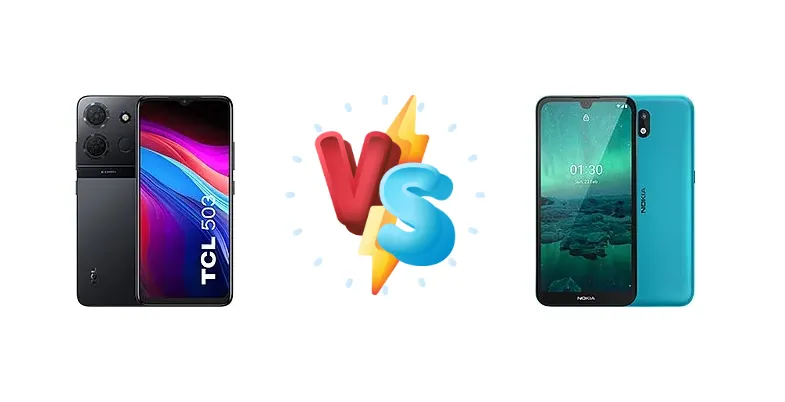
The TCL 503 and Nokia 1.3 represent the extreme end of the smartphone price spectrum. Both aim to deliver basic smartphone functionality at an incredibly low cost, but they achieve this with significantly different hardware. This comparison dissects their core components to determine which offers the best experience for users prioritizing affordability.
🏆 Quick Verdict
For the average user seeking the most responsive experience, the TCL 503 emerges as the better choice. Its Unisoc SC9863A chipset, with its octa-core configuration, provides a noticeable performance advantage over the Nokia 1.3’s quad-core Snapdragon 215, making everyday tasks smoother.
| Network |
|---|
| 2G bands | GSM 850 / 900 / 1800 / 1900 | GSM 850 / 900 / 1800 / 1900 |
| 3G bands | HSDPA 850 / 900 / 1900 / 2100 - T442M | HSDPA 850 / 900 / 2100 - International |
| 4G bands | 1, 3, 5, 7, 8, 20, 26, 28, 38, 40, 41 - T442M | 1, 3, 5, 7, 8, 20, 28 - International |
| Speed | HSPA, LTE | HSPA 42.2/5.76 Mbps, LTE Cat4 150/50 Mbps |
| Technology | GSM / HSPA / LTE | GSM / HSPA / LTE |
| | - | 1, 2, 3, 4, 5, 7, 8, 12, 17, 28, 66 - LATAM |
| Launch |
|---|
| Announced | 2024, February 26 | 2020, March 19. Released 2020, April 02 |
| Status | Available. Released 2024, October | Discontinued |
| Body |
|---|
| Build | Glass front, plastic back, plastic frame | Glass front, plastic back, plastic frame |
| Dimensions | 163.9 x 75.5 x 8.9 mm (6.45 x 2.97 x 0.35 in) | 147.3 x 71.2 x 9.4 mm (5.80 x 2.80 x 0.37 in) |
| SIM | · Nano-SIM· Nano-SIM + Nano-SIM | · Nano-SIM· Nano-SIM + Nano-SIM |
| Weight | 185.5 g (6.56 oz) | 155 g (5.47 oz) |
| Display |
|---|
| Resolution | 720 x 1612 pixels, 20:9 ratio (~267 ppi density) | 720 x 1520 pixels, 19:9 ratio (~295 ppi density) |
| Size | 6.6 inches, 104.6 cm2 (~84.6% screen-to-body ratio) | 5.71 inches, 81.4 cm2 (~77.6% screen-to-body ratio) |
| Type | IPS LCD, 350 nits (typ) | IPS LCD, 400 nits (typ) |
| Platform |
|---|
| CPU | Octa-core (4x1.6 GHz Cortex-A55 & 4x1.2 GHz Cortex-A55) | Quad-core 1.3 GHz Cortex-A53 |
| Chipset | Unisoc SC9863A (28 nm) | Qualcomm QM215 Snapdragon 215 (28 nm) |
| GPU | PowerVR GE8322 | Adreno 308 |
| OS | Android 14 (Go edition) | Android 10 (Go edition), upgradable to Android 11 (Go edition), Android One |
| Memory |
|---|
| Card slot | microSDXC (dedicated slot) | microSDXC (dedicated slot) |
| Internal | 64GB 3GB RAM | 16GB 1GB RAM |
| | - | eMMC 5.1 |
| Main Camera |
|---|
| Features | LED flash, HDR, panorama | LED flash, HDR |
| Single | 8 MP (upscaled to 13 MP), f/2.0, (wide), 1/4.0", 1.12µm, AF
Auxiliary lens | 8 MP, (wide), AF |
| Video | 1080p@30fps | 720p@30fps |
| Selfie camera |
|---|
| Single | 5 MP (upscaled to 8 MP), f/2.2, (wide), 1/5.0", 1.12µm | 5 MP |
| Video | 1080p@30fps | 720p@30fps |
| Sound |
|---|
| 3.5mm jack | - | Yes |
| 35mm jack | Yes | Yes |
| Loudspeaker | Yes | Yes |
| Comms |
|---|
| Bluetooth | 4.2, A2DP | 4.2, A2DP, LE, aptX HD |
| NFC | No | No |
| Positioning | GPS, GLONASS, GALILEO, BDS | GPS, GLONASS, BDS |
| Radio | Unspecified | FM radio |
| USB | USB Type-C 2.0 | microUSB 2.0, OTG |
| WLAN | Wi-Fi 802.11 b/g/n, Wi-Fi Direct | Wi-Fi 802.11 b/g/n |
| Features |
|---|
| Sensors | Fingerprint (rear-mounted), accelerometer | Accelerometer, proximity |
| Battery |
|---|
| Charging | 10W wired | - |
| Type | 5000 mAh | Li-Po 3000 mAh, removable |
| Misc |
|---|
| Colors | Space Gray, Midnight Blue | Cyan, Charcoal, Sand |
| Models | T442M, T442A, T442J | TA-1216, TA-1205 |
| Price | About 100 EUR | About 170 EUR |
| SAR | - | 0.64 W/kg (head) 1.17 W/kg (body) |
| SAR EU | - | 0.38 W/kg (head) 0.86 W/kg (body) |
TCL 503
- More powerful octa-core processor
- Potentially better multitasking performance
- Slightly more efficient chipset
- Brand recognition is lower than Nokia
- Likely similar display quality to Nokia 1.3
Nokia 1.3
- Clean Android Go experience
- Strong brand reputation for reliability
- Simple and easy to use
- Significantly weaker processor
- Limited multitasking capabilities
- Slower app loading times
Display Comparison
Neither device boasts a standout display. Both are likely to feature LCD panels, typical for this price point. Detailed display specs (resolution, brightness) are unavailable, but the focus here is on performance, not visual fidelity. Expect basic viewing experiences suitable for essential tasks. Bezels are likely to be substantial on both models, maximizing screen real estate within their budget constraints.
Camera Comparison
Camera performance is expected to be basic on both devices. Without specific sensor details, it’s difficult to make a definitive comparison. However, the TCL 503’s chipset likely offers slightly more image processing capability. It’s reasonable to assume both phones will feature a primary camera and potentially a depth sensor, but image quality will be heavily reliant on lighting conditions. Focusing on the chipset, the TCL 503 has a slight edge in processing power which could translate to better image processing.
Performance
The TCL 503’s Unisoc SC9863A is the clear winner in terms of raw processing power. Its octa-core CPU, comprised of four 1.6 GHz Cortex-A55 cores and four 1.2 GHz Cortex-A55 cores, significantly outperforms the Nokia 1.3’s quad-core 1.3 GHz Cortex-A53. The Cortex-A55 architecture is more efficient than the A53, offering better performance per watt. While both chipsets are fabricated on a 28nm process, the TCL 503’s core count and architecture translate to a more fluid user experience, particularly when switching between apps. The Nokia 1.3 will likely struggle with even moderate multitasking.
Battery Life
Both devices feature 10W wired charging, indicating similar charging speeds. Battery capacity is not specified, but given the budget nature of these phones, it’s likely to be in the 3000-4000 mAh range. The TCL 503’s more efficient chipset *could* result in slightly better battery life, despite potentially having a similar capacity, due to reduced power consumption during typical usage. Expect a full charge to take several hours with either device.
Buying Guide
Buy the TCL 503 if you need a phone capable of handling multiple apps and light multitasking without significant lag. It’s ideal for users who occasionally browse social media, stream videos, or play simple games. Buy the Nokia 1.3 if you prioritize simplicity and a clean Android Go experience, and your usage is limited to basic communication – calls, texts, and very light app use. It’s a good option for first-time smartphone users or those needing a reliable backup device.
Frequently Asked Questions
❓ Will the Nokia 1.3 struggle with popular apps like WhatsApp and Facebook?
The Nokia 1.3’s Snapdragon 215 chipset is a very basic processor. While it can run apps like WhatsApp and Facebook, expect noticeable lag when opening them, scrolling through feeds, or sending media. The TCL 503 will provide a smoother experience with these apps due to its more powerful processor.
❓ Is the TCL 503 a good choice for playing mobile games?
The TCL 503 is not designed for demanding mobile games. While it can handle very simple games, more graphically intensive titles will likely be unplayable or suffer from severe frame rate drops. The Nokia 1.3 is even less suited for gaming.
❓ Does either phone support software updates beyond the initial Android Go release?
Given the price point of both devices, long-term software support is unlikely. Nokia typically offers a more reliable update schedule than TCL, but even with Nokia, expect limited updates. Both phones will likely receive security patches for a limited time.
❓ Which phone is better for a first-time smartphone user?
The Nokia 1.3, with its clean Android Go interface, is arguably better for a first-time smartphone user. The simplified interface and reduced bloatware make it less overwhelming. However, the TCL 503's smoother performance might be appreciated even by a novice user.