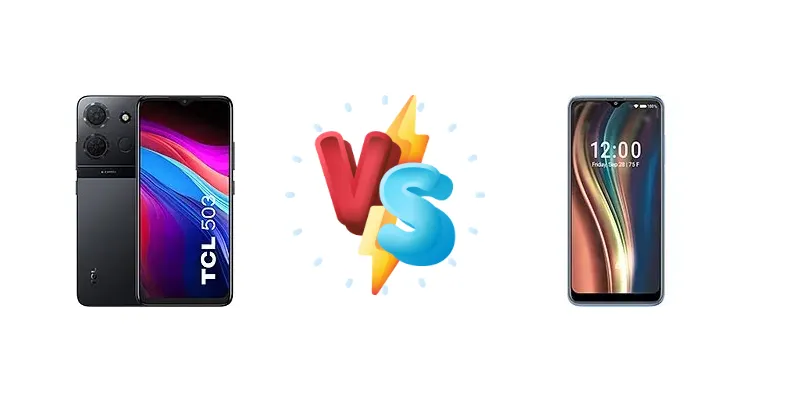
The TCL 503 and Coolpad Legacy 5G represent the increasingly competitive sub-$200 5G smartphone market. Both aim to deliver connectivity without breaking the bank, but they take drastically different approaches to achieving that goal, particularly in their core processing power and charging capabilities. This comparison dissects those differences to determine which device offers the best experience for your money.
🏆 Quick Verdict
For most users, the Coolpad Legacy 5G is the superior choice. Its Qualcomm Snapdragon 765G chipset provides a significantly more responsive experience and better long-term software support than the TCL 503’s Unisoc SC9863A. While the TCL 503 is cheaper, the performance gap justifies the price difference.
| Network |
|---|
| 2G bands | GSM 850 / 900 / 1800 / 1900 | GSM 850 / 900 / 1800 / 1900 |
| 3G bands | HSDPA 850 / 900 / 1900 / 2100 - T442M | HSDPA 850 / 1700(AWS) / 1900 |
| 4G bands | 1, 3, 5, 7, 8, 20, 26, 28, 38, 40, 41 - T442M | LTE |
| 5G bands | - | SA/NSA/Sub6 |
| Speed | HSPA, LTE | HSPA, LTE, 5G (2+ Gbps DL) |
| Technology | GSM / HSPA / LTE | GSM / CDMA / HSPA / EVDO / LTE / 5G |
| | - | CDMA2000 1xEV-DO |
| Launch |
|---|
| Announced | 2024, February 26 | 2020, January |
| Status | Available. Released 2024, October | Cancelled |
| Body |
|---|
| Build | Glass front, plastic back, plastic frame | - |
| Dimensions | 163.9 x 75.5 x 8.9 mm (6.45 x 2.97 x 0.35 in) | 165 x 77 x 9.5 mm (6.50 x 3.03 x 0.37 in) |
| SIM | · Nano-SIM· Nano-SIM + Nano-SIM | Nano-SIM |
| Weight | 185.5 g (6.56 oz) | 195 g (6.88 oz) |
| Display |
|---|
| Resolution | 720 x 1612 pixels, 20:9 ratio (~267 ppi density) | 1080 x 2340 pixels, 19.5:9 ratio (~395 ppi density) |
| Size | 6.6 inches, 104.6 cm2 (~84.6% screen-to-body ratio) | 6.53 inches, 104.7 cm2 (~82.4% screen-to-body ratio) |
| Type | IPS LCD, 350 nits (typ) | IPS LCD, HDR10 |
| Platform |
|---|
| CPU | Octa-core (4x1.6 GHz Cortex-A55 & 4x1.2 GHz Cortex-A55) | Octa-core (1x2.4 GHz Kryo 475 Prime & 1x2.2 GHz Kryo 475 Gold & 6x1.8 GHz Kryo 475 Silver) |
| Chipset | Unisoc SC9863A (28 nm) | Qualcomm SM7250 Snapdragon 765G 5G (7 nm) |
| GPU | PowerVR GE8322 | Adreno 620 |
| OS | Android 14 (Go edition) | Android 10 |
| Memory |
|---|
| Card slot | microSDXC (dedicated slot) | microSD |
| Internal | 64GB 3GB RAM | 64GB 4GB RAM |
| | - | UFS 2.1 |
| Main Camera |
|---|
| Dual | - | 48 MP, (wide), 1/2.0", 0.8µm, PDAF
8 MP, (ultrawide) |
| Features | LED flash, HDR, panorama | LED flash, panorama, HDR |
| Single | 8 MP (upscaled to 13 MP), f/2.0, (wide), 1/4.0", 1.12µm, AF
Auxiliary lens | - |
| Video | 1080p@30fps | 4K@30fps, 1080p@30fps |
| Selfie camera |
|---|
| Features | - | HDR |
| Single | 5 MP (upscaled to 8 MP), f/2.2, (wide), 1/5.0", 1.12µm | 16 MP |
| Video | 1080p@30fps | 1080p@30fps |
| Sound |
|---|
| 3.5mm jack | - | Yes |
| 35mm jack | Yes | Yes |
| Loudspeaker | Yes | Yes |
| Comms |
|---|
| Bluetooth | 4.2, A2DP | 5.0, A2DP, LE |
| NFC | No | No |
| Positioning | GPS, GLONASS, GALILEO, BDS | GPS (L1+L5), GLONASS, BDS, GALILEO |
| Radio | Unspecified | FM radio |
| USB | USB Type-C 2.0 | USB Type-C 2.0 |
| WLAN | Wi-Fi 802.11 b/g/n, Wi-Fi Direct | Wi-Fi 802.11 a/b/g/n/ac, dual-band, Wi-Fi Direct |
| Features |
|---|
| Sensors | Fingerprint (rear-mounted), accelerometer | Fingerprint (rear-mounted), accelerometer, gyro, proximity, compass |
| Battery |
|---|
| Charging | 10W wired | 18W wired, QC3 |
| Type | 5000 mAh | Li-Po 4000 mAh |
| Misc |
|---|
| Colors | Space Gray, Midnight Blue | Yellow/Blue |
| Models | T442M, T442A, T442J | - |
| Price | About 100 EUR | About 360 EUR |
TCL 503
- Lowest possible price point for 5G connectivity.
- Acceptable for basic smartphone tasks.
- May have longer software update support due to simpler hardware.
- Significantly slower performance compared to the Coolpad.
- Slow 10W charging.
- Unisoc chipset may limit app compatibility.
Coolpad Legacy 5G
- Much faster and more responsive performance thanks to the Snapdragon 765G.
- Faster 18W charging with QC3 support.
- Better long-term software support from Qualcomm.
- Improved gaming capabilities.
- Slightly higher price than the TCL 503.
- May not have the absolute longest battery life due to more powerful processor.
Display Comparison
Neither TCL nor Coolpad provide display specifications beyond the basic screen size. However, given the price points, we can assume both utilize LCD panels. The key difference lies in the processing power driving them. The TCL 503’s weaker Unisoc chipset will struggle to deliver smooth animations or responsive touch input, impacting the perceived quality of the display. The Coolpad Legacy 5G, with its more powerful GPU, will offer a noticeably smoother visual experience, even if the panel itself is similar.
Camera Comparison
Without detailed camera specs, a direct comparison is difficult. However, the processing power of the Snapdragon 765G in the Coolpad Legacy 5G will likely result in better image processing, including improved noise reduction and dynamic range. The TCL 503’s Unisoc chipset will struggle to handle complex image processing algorithms, potentially leading to softer images and less detail. It’s reasonable to assume both phones feature basic camera setups geared towards casual photography, but the Coolpad will deliver superior results.
Performance
The performance disparity is the most significant factor in this comparison. The Coolpad Legacy 5G’s Qualcomm Snapdragon 765G, built on a 7nm process, is a substantial upgrade over the TCL 503’s Unisoc SC9863A (28nm). The Snapdragon 765G features a Kryo 475 tri-cluster architecture (1x2.4 GHz Prime, 1x2.2 GHz Gold, 6x1.8 GHz Silver) designed for efficient performance scaling. In contrast, the Unisoc SC9863A’s octa-core configuration (4x1.6 GHz Cortex-A55 & 4x1.2 GHz Cortex-A55) relies on less efficient Cortex-A55 cores across the board. This translates to significantly faster app loading times, smoother multitasking, and a more enjoyable gaming experience on the Coolpad. The 7nm process also contributes to better thermal management, reducing the likelihood of performance throttling under sustained load.
Battery Life
Battery capacity isn’t specified for either device. However, the Coolpad Legacy 5G’s 18W wired charging with Quick Charge 3 (QC3) support is a clear advantage over the TCL 503’s slow 10W charging. This means the Coolpad can replenish its battery much faster, minimizing downtime. While a larger battery capacity on the TCL 503 might partially offset the slower charging, the convenience of faster charging is a significant benefit for users who rely heavily on their smartphones.
Buying Guide
Buy the TCL 503 if your primary need is basic smartphone functionality – calls, texts, and light social media – and you are extremely budget-constrained. The lower price point makes it suitable for first-time smartphone users or as a temporary device. Buy the Coolpad Legacy 5G if you prioritize a smoother, more capable user experience, enjoy mobile gaming, or anticipate using demanding apps. The Snapdragon 765G offers a substantial performance boost and faster charging for a relatively small premium.
Frequently Asked Questions
❓ Will the Unisoc chipset in the TCL 503 struggle with popular apps like TikTok or Instagram?
Yes, the Unisoc SC9863A is a low-end chipset and will likely exhibit noticeable lag and slowdowns when running demanding apps like TikTok or Instagram, especially with multiple apps open simultaneously. Expect longer loading times and a less fluid experience compared to the Coolpad Legacy 5G.
❓ Does the Coolpad Legacy 5G support carrier aggregation for faster 5G speeds?
The Snapdragon 765G in the Coolpad Legacy 5G *does* support carrier aggregation, allowing it to combine multiple 5G channels for potentially faster download and upload speeds, provided your carrier and network support it. The TCL 503’s Unisoc chipset has limited carrier aggregation capabilities.
❓ How long will it take to fully charge the Coolpad Legacy 5G from 0% with the included charger?
With 18W charging and Quick Charge 3 support, the Coolpad Legacy 5G should fully charge from 0% in approximately 1 hour and 45 minutes to 2 hours, depending on battery capacity. This is significantly faster than the TCL 503, which will likely take over 3 hours with its 10W charger.