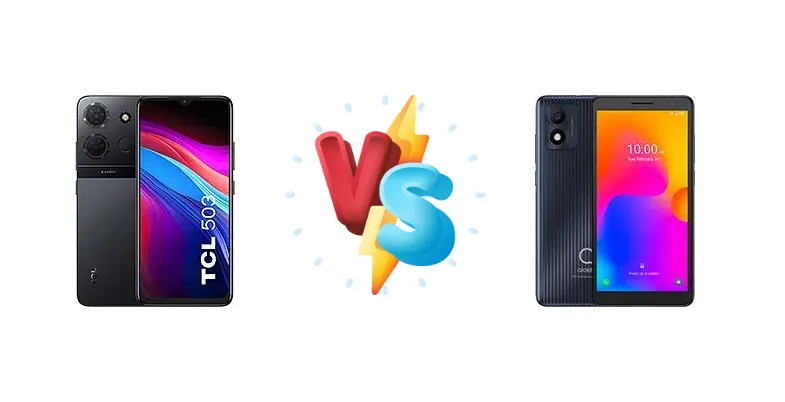
The sub-$100 smartphone market is fiercely competitive. Both the TCL 503 and the alcatel 1B (2022) aim to deliver essential smartphone functionality at an incredibly affordable price. However, they take different approaches to achieving this, with the TCL 503 leveraging an octa-core Unisoc processor and the alcatel 1B opting for a quad-core Mediatek Helio A22. This comparison will dissect the key differences to determine which device offers the best value.
🏆 Quick Verdict
For the average user prioritizing multitasking and smoother app performance, the TCL 503 emerges as the better choice. Its octa-core Unisoc SC9863A chipset, despite being built on a larger 28nm process, offers a significant advantage over the alcatel 1B’s quad-core Helio A22, especially for handling multiple applications simultaneously.
| Network |
|---|
| 2G bands | GSM 850 / 900 / 1800 / 1900 | GSM 850 / 900 / 1800 / 1900 |
| 3G bands | HSDPA 850 / 900 / 1900 / 2100 - T442M | HSDPA 850 / 900 / 1900 / 2100 |
| 4G bands | 1, 3, 5, 7, 8, 20, 26, 28, 38, 40, 41 - T442M | 1, 3, 5, 7, 8, 20, 28, 38, 40, 41 - 5031D, 5031G |
| Speed | HSPA, LTE | HSPA 42.2/11.1 Mbps, LTE Cat4 150/50 Mbps |
| Technology | GSM / HSPA / LTE | GSM / HSPA / LTE |
| | - | 2, 3, 4, 5, 7, 8, 12, 13, 17, 26, 28, 38, 40, 66 - 5031A, 5041J |
| Launch |
|---|
| Announced | 2024, February 26 | 2022, May 31 |
| Status | Available. Released 2024, October | Available. Released 2022, May 31 |
| Body |
|---|
| Build | Glass front, plastic back, plastic frame | - |
| Dimensions | 163.9 x 75.5 x 8.9 mm (6.45 x 2.97 x 0.35 in) | 146.7 x 71.9 x 10 mm (5.78 x 2.83 x 0.39 in) |
| SIM | · Nano-SIM· Nano-SIM + Nano-SIM | · Nano-SIM· Nano-SIM + Nano-SIM |
| Weight | 185.5 g (6.56 oz) | 172 g (6.07 oz) |
| Display |
|---|
| Resolution | 720 x 1612 pixels, 20:9 ratio (~267 ppi density) | 720 x 1440 pixels, 18:9 ratio (~293 ppi density) |
| Size | 6.6 inches, 104.6 cm2 (~84.6% screen-to-body ratio) | 5.5 inches, 78.1 cm2 (~74.0% screen-to-body ratio) |
| Type | IPS LCD, 350 nits (typ) | TFT LCD |
| Platform |
|---|
| CPU | Octa-core (4x1.6 GHz Cortex-A55 & 4x1.2 GHz Cortex-A55) | Quad-core 2.0 GHz Cortex-A53 |
| Chipset | Unisoc SC9863A (28 nm) | Mediatek MT6761 Helio A22 (12 nm) |
| GPU | PowerVR GE8322 | PowerVR GE8300 |
| OS | Android 14 (Go edition) | Android 11 (Go edition) |
| Memory |
|---|
| Card slot | microSDXC (dedicated slot) | microSDXC (dedicated slot) |
| Internal | 64GB 3GB RAM | 32GB 2GB RAM |
| | - | eMMC 5.1 |
| Main Camera |
|---|
| Features | LED flash, HDR, panorama | LED flash, HDR, panorama |
| Single | 8 MP (upscaled to 13 MP), f/2.0, (wide), 1/4.0", 1.12µm, AF
Auxiliary lens | 8 MP, f/2.0, 25 mm (wide), 1/4.0", 1.12µm, AF |
| Video | 1080p@30fps | 1080p@30fps |
| Selfie camera |
|---|
| Single | 5 MP (upscaled to 8 MP), f/2.2, (wide), 1/5.0", 1.12µm | 5 MP, f/2.2, 24 mm (wide), 1/5.0", 1.12µm |
| Video | 1080p@30fps | 1080p@30fps |
| Sound |
|---|
| 3.5mm jack | - | Yes |
| 35mm jack | Yes | Yes |
| Loudspeaker | Yes | Yes |
| Comms |
|---|
| Bluetooth | 4.2, A2DP | 5.0, A2DP |
| NFC | No | No |
| Positioning | GPS, GLONASS, GALILEO, BDS | GPS |
| Radio | Unspecified | FM radio |
| USB | USB Type-C 2.0 | microUSB 2.0 |
| WLAN | Wi-Fi 802.11 b/g/n, Wi-Fi Direct | Wi-Fi 802.11 b/g/n, Wi-Fi Direct |
| Features |
|---|
| Sensors | Fingerprint (rear-mounted), accelerometer | Accelerometer |
| Battery |
|---|
| Charging | 10W wired | - |
| Type | 5000 mAh | Li-Ion 3000 mAh battery, removable |
| Misc |
|---|
| Colors | Space Gray, Midnight Blue | Prime Black, Atlantic Blue |
| Models | T442M, T442A, T442J | 5031D, 5031G, 5031A, 5031J |
| Price | About 100 EUR | About 100 EUR |
TCL 503
- Octa-core processor offers better multitasking.
- More modern CPU architecture (Cortex-A55).
- Potentially smoother app experience.
- Larger 28nm process may lead to slightly higher power consumption.
- Limited information on display quality.
alcatel 1B (2022)
- More efficient 12nm process.
- Potentially longer battery life for basic usage.
- Lower price point (likely).
- Quad-core processor struggles with multitasking.
- Older CPU architecture (Cortex-A53).
Display Comparison
Neither TCL nor Alcatel provide display specifications beyond the basic screen size. Given the price point, both likely utilize LCD panels with modest resolutions. However, the absence of detailed specs makes a direct comparison impossible. We can infer that both displays are optimized for power efficiency rather than color accuracy or brightness, targeting a user who prioritizes battery life over visual fidelity.
Camera Comparison
Both devices likely feature basic camera setups geared towards casual photography. Without detailed sensor information, it’s difficult to make a meaningful comparison. It’s safe to assume both phones will struggle in low-light conditions and offer limited image detail. The presence of a 2MP macro camera on either device is largely a marketing tactic, offering minimal practical benefit due to the small sensor size and lack of optical image stabilization.
Performance
The core difference lies in the chipsets. The TCL 503’s Unisoc SC9863A features an octa-core configuration – four Cortex-A55 cores clocked at 1.6 GHz and four at 1.2 GHz. This contrasts sharply with the alcatel 1B’s Mediatek Helio A22, a quad-core processor with Cortex-A53 cores clocked at 2.0 GHz. While the Helio A22 boasts a higher clock speed per core, the TCL 503’s eight cores provide superior multitasking capabilities. The Unisoc chip is fabricated on a 28nm process, while the Helio A22 uses a more efficient 12nm process. This means the Helio A22 *should* be more power efficient per core, but the TCL 503’s ability to distribute workload across more cores may offset this in real-world usage. The A55 architecture in the TCL 503 is also more modern and efficient than the A53 in the Alcatel, even considering the process node difference.
Battery Life
Neither device specifies battery capacity. However, the Mediatek Helio A22’s 12nm process *should* contribute to better power efficiency compared to the Unisoc SC9863A’s 28nm process. Both phones feature 10W wired charging, indicating a focus on affordability over fast charging speeds. Expect roughly 2-3 hours to fully charge either device. The actual battery life will heavily depend on usage patterns, but the alcatel 1B may have a slight edge in longevity for users primarily engaged in light tasks.
Buying Guide
Buy the TCL 503 if you need a phone capable of handling more than just basic tasks like calls and messaging – its octa-core processor provides a noticeable boost in responsiveness for social media, light browsing, and running multiple apps. Buy the alcatel 1B (2022) if your primary needs are extremely basic communication and you prioritize potentially longer battery life due to the more efficient, albeit less powerful, Helio A22 chipset.
Frequently Asked Questions
❓ Will the TCL 503 struggle with popular apps like Facebook or WhatsApp?
While the TCL 503 isn't a powerhouse, its octa-core processor and more modern CPU architecture should handle apps like Facebook and WhatsApp without significant lag. However, expect slower loading times and occasional stutters when multitasking or using resource-intensive features within these apps.
❓ Is the Mediatek Helio A22 in the alcatel 1B sufficient for basic web browsing?
Yes, the Helio A22 is capable of handling basic web browsing, but the experience will be noticeably slower compared to devices with more powerful processors. Expect longer page loading times and potential difficulties with websites containing complex scripts or multimedia content.
❓ Can either of these phones run PUBG Mobile?
While technically possible to *install* PUBG Mobile on either device, the experience will be severely limited. The processors lack the graphical power and RAM to run the game smoothly, even at the lowest settings. Expect extremely low frame rates and frequent lag, making the game unplayable.
❓ How does the 28nm process of the Unisoc SC9863A affect battery life in the TCL 503?
The 28nm process is less efficient than the 12nm process used in the alcatel 1B's Helio A22. This means the TCL 503's processor will consume more power for the same task, potentially resulting in shorter battery life, especially during demanding activities like gaming or video playback.