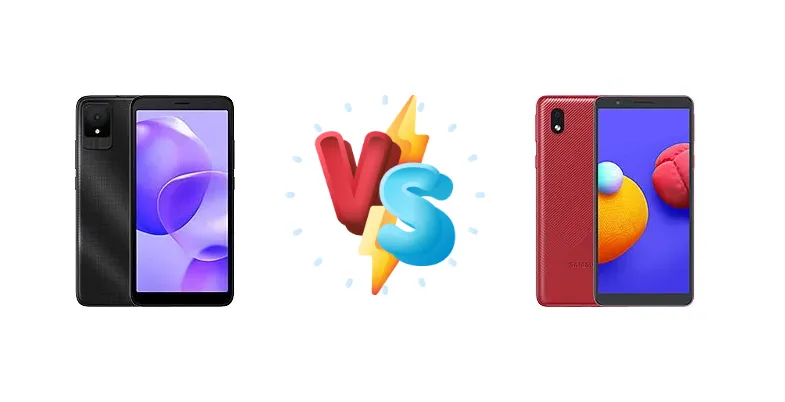
The TCL 502 and Samsung Galaxy A01 Core represent the absolute bottom end of the smartphone market, targeting users who prioritize affordability above all else. Both devices aim to provide essential smartphone functionality at the lowest possible price point, but significant differences in their underlying hardware dictate a clear performance gap.
🏆 Quick Verdict
For the average user, the TCL 502 is the better choice. Its newer Mediatek Helio A22 chipset, fabricated on a more efficient 12nm process, provides a noticeable performance advantage over the Samsung Galaxy A01 Core’s older, 28nm MT6739, resulting in a smoother user experience.
| Network |
|---|
| 2G bands | GSM 850 / 900 / 1800 / 1900 | GSM 850 / 900 / 1800 / 1900 |
| 3G bands | HSDPA 850 / 900 / 1700(AWS) / 1900 / 2100 | HSDPA 850 / 900 / 2100 |
| 4G bands | 2, 4, 5, 7, 12, 13, 17, 66, 71 | 1, 3, 5, 7, 8, 20, 28, 38, 40, 41 |
| Speed | HSPA, LTE | HSPA 21.1/5.76 Mbps, LTE |
| Technology | GSM / HSPA / LTE | GSM / HSPA / LTE |
| Launch |
|---|
| Announced | 2023, December 04 | 2020, July 21. Released 2020, August 06 |
| Status | Available. Released 2023, December | Discontinued |
| Body |
|---|
| Build | - | Plastic back, plastic frame |
| Dimensions | 159 x 78 x 9.6 mm (6.26 x 3.07 x 0.38 in) | 141.7 x 67.5 x 8.6 mm (5.58 x 2.66 x 0.34 in) |
| SIM | Nano-SIM | · Nano-SIM· Nano-SIM + Nano-SIM |
| Weight | 182 g (6.42 oz) | 150 g (5.29 oz) |
| Display |
|---|
| Resolution | 480 x 960 pixels, 18:9 ratio (~179 ppi density) | 720 x 1480 pixels, 18.5:9 ratio (~311 ppi density) |
| Size | 6.0 inches, 92.9 cm2 (~74.9% screen-to-body ratio) | 5.3 inches, 71.3 cm2 (~74.5% screen-to-body ratio) |
| Type | IPS LCD, 90Hz | PLS LCD |
| Platform |
|---|
| CPU | Quad-core 2.0 GHz Cortex-A53 | Quad-core 1.5 GHz Cortex-A53 |
| Chipset | Mediatek Helio A22 (12 nm) | Mediatek MT6739 (28 nm) |
| GPU | PowerVR GE8320 | PowerVR GE8100 |
| OS | Android 13 (Go edition) | Android 10 (Go edition) |
| Memory |
|---|
| Card slot | microSDXC (dedicated slot) | microSDXC (dedicated slot) |
| Internal | 32GB 2GB RAM | 16GB 1GB RAM, 16GB 2GB RAM, 32GB 2GB RAM |
| | - | eMMC 5.1 |
| Main Camera |
|---|
| Features | LED flash | LED flash |
| Single | 5 MP | 8 MP, f/2.2, AF |
| Video | 1080p@30fps | 1080p@30fps |
| Selfie camera |
|---|
| Single | 2 MP | 5 MP, f/2.4 |
| Video | 720p@30fps | - |
| Sound |
|---|
| 3.5mm jack | - | Yes |
| 35mm jack | Yes | Yes |
| Loudspeaker | Yes | Yes |
| Comms |
|---|
| Bluetooth | 5.1, A2DP, LE | 5.0, A2DP, LE |
| NFC | No | No |
| Positioning | GPS, GLONASS, GALILEO, BDS | GPS |
| Radio | No | FM radio |
| USB | USB Type-C, OTG | microUSB 2.0 |
| WLAN | Wi-Fi 802.11 b/g/n | Wi-Fi 802.11 b/g/n, Wi-Fi Direct |
| Features |
|---|
| Sensors | Accelerometer, proximity | Accelerometer |
| Battery |
|---|
| Charging | 10W wired | - |
| Type | 3000 mAh | Li-Ion 3000 mAh |
| Misc |
|---|
| Colors | Black | Black, Blue, Red |
| Models | T432J | SM-A013F, SM-A013F/DS, SM-A013G, SM-A013G/DS, SM-A013M |
| Price | About 60 EUR | About 150 EUR |
| SAR EU | - | 0.64 W/kg (head) 1.18 W/kg (body) |
TCL 502
- More efficient 12nm chipset
- Faster CPU clock speed (2.0 GHz)
- Likely better battery life due to chipset efficiency
- Limited brand recognition compared to Samsung
- Likely similar camera performance to the A01 Core
Samsung Galaxy A01 Core
- Strong brand recognition (Samsung)
- Potentially better software optimization (though minimal)
- Wider availability in some markets
- Less efficient 28nm chipset
- Slower CPU clock speed (1.5 GHz)
- Shorter battery life compared to TCL 502
Display Comparison
Neither device boasts a particularly impressive display. Details regarding panel type, resolution, and brightness are scarce, typical of this segment. However, the focus here is on the underlying hardware impacting performance, not display quality. Both are likely to feature low-resolution LCD panels, adequate for basic viewing but lacking in vibrancy and sharpness.
Camera Comparison
Both phones likely feature basic camera setups, and detailed specifications are limited. It’s safe to assume both will include a primary camera and potentially a secondary depth sensor. Given the price point, image quality will be heavily reliant on software processing and will likely be subpar in low-light conditions. Focusing on sensor size or aperture is irrelevant given the overall limitations of these devices; the chipset’s image signal processor (ISP) is the primary bottleneck.
Performance
The core difference lies in the chipsets. The TCL 502’s Mediatek Helio A22, built on a 12nm process, offers a significant advantage over the Samsung Galaxy A01 Core’s Mediatek MT6739, which uses a much older 28nm process. This process node difference translates directly to improved power efficiency and thermal performance for the TCL 502. While both CPUs feature quad-core Cortex-A53 cores, the Helio A22’s higher clock speed of 2.0 GHz versus the MT6739’s 1.5 GHz further contributes to its performance lead. Users will experience faster app loading times and smoother multitasking on the TCL 502.
Battery Life
Battery capacity details are unavailable for both devices. However, the TCL 502’s more efficient 12nm Helio A22 chipset will undoubtedly result in longer battery life compared to the Samsung Galaxy A01 Core’s power-hungry 28nm MT6739. While both phones likely support 10W wired charging, the TCL 502 will reach a full charge faster due to its lower power draw during charging.
Buying Guide
Buy the TCL 502 if you need a phone capable of handling basic tasks like messaging, social media, and light web browsing without significant lag. It’s the better option for those who value a slightly more responsive experience. Buy the Samsung Galaxy A01 Core if you absolutely prioritize brand recognition and are willing to accept a slower, less efficient device, potentially benefiting from Samsung’s software optimizations, however minimal they may be at this price point.
Frequently Asked Questions
❓ Will the Samsung Galaxy A01 Core struggle with popular apps like WhatsApp and Facebook?
Yes, the MT6739 chipset in the A01 Core is quite limited. While it can run these apps, expect noticeable lag and slow loading times, especially with multiple apps open. The TCL 502’s Helio A22 will provide a smoother experience, even if it’s not ideal.
❓ Is the difference in chipset fabrication (12nm vs 28nm) really that important for everyday use?
Absolutely. A smaller fabrication process (like 12nm) means more transistors can be packed into the same space, leading to increased performance and significantly improved power efficiency. This translates to longer battery life and less overheating, making the TCL 502 the more practical choice.
❓ Can either of these phones handle basic mobile gaming?
Both phones will struggle with most modern mobile games. Simple, 2D games might be playable at low settings, but demanding 3D titles will likely be unplayable due to the limited processing power and graphics capabilities of both chipsets.