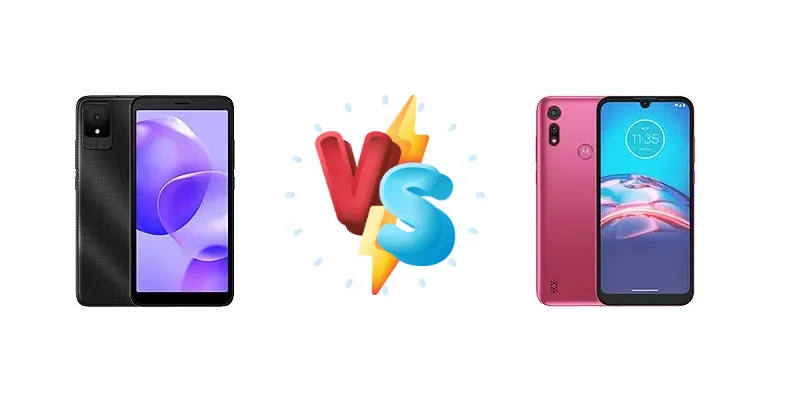
The TCL 502 and Motorola Moto E6i represent the extreme end of the smartphone price spectrum. Both aim to deliver essential functionality at a minimal cost, but they take different approaches to achieving this. The TCL 502 leverages a newer, albeit modest, Mediatek Helio A22, while the Moto E6i relies on the older, but octa-core, Unisoc SC9863A. This comparison dissects these choices to determine which device offers the best value for users prioritizing affordability.
🏆 Quick Verdict
For the average user prioritizing responsiveness in everyday tasks, the Motorola Moto E6i is the better choice. Its octa-core processor, despite being built on an older 28nm process, provides a noticeable advantage in multi-tasking and app loading times compared to the TCL 502’s quad-core Helio A22. However, the TCL 502’s more efficient chipset may offer slightly better battery longevity under light use.
| Network |
|---|
| 2G bands | GSM 850 / 900 / 1800 / 1900 | GSM 850 / 900 / 1800 / 1900 |
| 3G bands | HSDPA 850 / 900 / 1700(AWS) / 1900 / 2100 | HSDPA 850 / 900 / 1700(AWS) / 1900 / 2100 |
| 4G bands | 2, 4, 5, 7, 12, 13, 17, 66, 71 | 1, 2, 3, 4, 5, 7, 8, 19, 28, 66 |
| Speed | HSPA, LTE | HSPA, LTE |
| Technology | GSM / HSPA / LTE | GSM / HSPA / LTE |
| Launch |
|---|
| Announced | 2023, December 04 | 2021, February 11 |
| Status | Available. Released 2023, December | Available. Released 2021, February 11 |
| Body |
|---|
| Build | - | Glass front, plastic back, plastic frame |
| Dimensions | 159 x 78 x 9.6 mm (6.26 x 3.07 x 0.38 in) | 155.6 x 73 x 8.5 mm (6.13 x 2.87 x 0.33 in) |
| SIM | Nano-SIM | Nano-SIM + Nano-SIM |
| Weight | 182 g (6.42 oz) | 160 g (5.64 oz) |
| Display |
|---|
| Resolution | 480 x 960 pixels, 18:9 ratio (~179 ppi density) | 720 x 1560 pixels, 19.5:9 ratio (~282 ppi density) |
| Size | 6.0 inches, 92.9 cm2 (~74.9% screen-to-body ratio) | 6.1 inches, 91.3 cm2 (~80.4% screen-to-body ratio) |
| Type | IPS LCD, 90Hz | IPS LCD |
| Platform |
|---|
| CPU | Quad-core 2.0 GHz Cortex-A53 | Octa-core (4x1.6 GHz Cortex-A55 & 4x1.2 GHz Cortex-A55) |
| Chipset | Mediatek Helio A22 (12 nm) | Unisoc SC9863A (28 nm) |
| GPU | PowerVR GE8320 | IMG8322 |
| OS | Android 13 (Go edition) | Android 10 (Go edition) |
| Memory |
|---|
| Card slot | microSDXC (dedicated slot) | microSDXC (uses shared SIM slot) |
| Internal | 32GB 2GB RAM | 32GB 2GB RAM |
| | - | eMMC 5.1 |
| Main Camera |
|---|
| Dual | - | 13 MP, f/2.2, 26mm (wide), 1/3.1", 1.12µm, PDAF
Auxiliary lens |
| Features | LED flash | LED flash, HDR, panorama |
| Single | 5 MP | - |
| Video | 1080p@30fps | 1080p@30fps |
| Selfie camera |
|---|
| Single | 2 MP | 5 MP, f/2.2, 27mm (wide), 1.12µm |
| Video | 720p@30fps | 1080p@30fps |
| Sound |
|---|
| 3.5mm jack | - | Yes |
| 35mm jack | Yes | Yes |
| Loudspeaker | Yes | Yes |
| Comms |
|---|
| Bluetooth | 5.1, A2DP, LE | 4.2, A2DP, LE |
| NFC | No | No |
| Positioning | GPS, GLONASS, GALILEO, BDS | GPS, GLONASS |
| Radio | No | Unspecified |
| USB | USB Type-C, OTG | microUSB 2.0, OTG |
| WLAN | Wi-Fi 802.11 b/g/n | Wi-Fi 802.11 b/g/n |
| Features |
|---|
| Sensors | Accelerometer, proximity | Fingerprint (rear-mounted), accelerometer, proximity |
| Battery |
|---|
| Charging | 10W wired | 10W wired |
| Type | 3000 mAh | Li-Ion 3000 mAh |
| Misc |
|---|
| Colors | Black | Titanium Gray, Pink |
| Models | T432J | XT2053-5 |
| Price | About 60 EUR | About 170 EUR |
TCL 502
- More efficient chipset (12nm)
- Potentially longer battery life under light use
- Simpler processor architecture may lead to fewer software glitches
- Quad-core CPU limits multitasking performance
- Slower app loading times
- Less responsive user experience
Motorola Moto E6i
- Octa-core CPU provides better multitasking
- More responsive user interface
- Potentially better image processing
- Less efficient chipset (28nm)
- Potentially shorter battery life during heavy use
- Older processor architecture
Display Comparison
Neither device boasts a standout display. Details are missing, but given the price point, expect 720p+ resolution panels. The TCL 502’s Helio A22 likely has a less capable ISP, potentially impacting display color processing. The Moto E6i’s Unisoc chipset, while older, may offer similar display capabilities. Bezels are expected to be substantial on both, and neither is likely to feature high brightness or color accuracy.
Camera Comparison
Camera performance on both devices will be limited. Details are scarce, but both are likely to feature a primary sensor paired with a basic depth or macro lens. Given the TCL 502’s Helio A22 ISP, image processing may be slower and less refined than on the Moto E6i. However, the Unisoc SC9863A isn’t known for exceptional image signal processing either. Expect acceptable results in good lighting conditions, but poor performance in low light. Focusing on sensor size and aperture would be more relevant than pixel count.
Performance
This is where the core difference lies. The TCL 502’s Mediatek Helio A22 (12nm) features a quad-core Cortex-A53 CPU clocked at 2.0 GHz. The Motorola Moto E6i counters with the Unisoc SC9863A (28nm) and an octa-core configuration – four Cortex-A55 cores at 1.6 GHz and four at 1.2 GHz. While the Helio A22 has higher clock speeds per core, the Moto E6i’s eight cores provide superior multi-tasking capabilities. The Unisoc’s 28nm process is less efficient, meaning it will generate more heat and consume more power than the TCL’s 12nm chip, but the core count advantage is significant for responsiveness. The Cortex-A55 cores in the Moto E6i are also more efficient *per core* than the A53 in the TCL 502, partially mitigating the process node disadvantage.
Battery Life
Both phones feature 10W wired charging, indicating similar charging speeds. The TCL 502’s more efficient Mediatek Helio A22 (12nm) should translate to better battery life under light usage scenarios – primarily calls, texts, and minimal app usage. However, the Moto E6i’s octa-core processor will draw more power during active use. The actual battery capacity (mAh) is unknown, but the TCL 502’s chipset efficiency gives it a slight edge in longevity for users who don’t heavily utilize the device.
Buying Guide
Buy the TCL 502 if you need a phone primarily for basic communication – calls, texts, and light social media – and value potential battery savings. You’re willing to accept slower app loading and less fluid multitasking. Buy the Motorola Moto E6i if you prefer a more responsive experience for everyday tasks, enjoy occasional light gaming, and don’t mind potentially slightly shorter battery life. You prioritize usability over absolute efficiency.
Frequently Asked Questions
❓ Will the Motorola Moto E6i struggle with popular apps like Facebook or WhatsApp?
While the Moto E6i won't offer a flagship-level experience, its octa-core processor should handle Facebook and WhatsApp without significant lag. However, running multiple apps simultaneously or using resource-intensive features within these apps may cause slowdowns. The TCL 502 will likely struggle more with these tasks.
❓ Is the Unisoc SC9863A chipset known for overheating?
The Unisoc SC9863A, being built on a 28nm process, is more prone to generating heat than newer chipsets. However, given the low performance targets of the Moto E6i, overheating is unlikely to be a major issue during typical usage. Prolonged gaming or demanding tasks could lead to some warmth, but not to the point of significant throttling.
❓ Can either of these phones handle basic mobile games like Candy Crush or Subway Surfers?
Both the TCL 502 and Motorola Moto E6i should be capable of running basic mobile games like Candy Crush or Subway Surfers, but don't expect high frame rates or detailed graphics. The Moto E6i’s octa-core processor will provide a slightly smoother experience, especially in games with more complex animations.