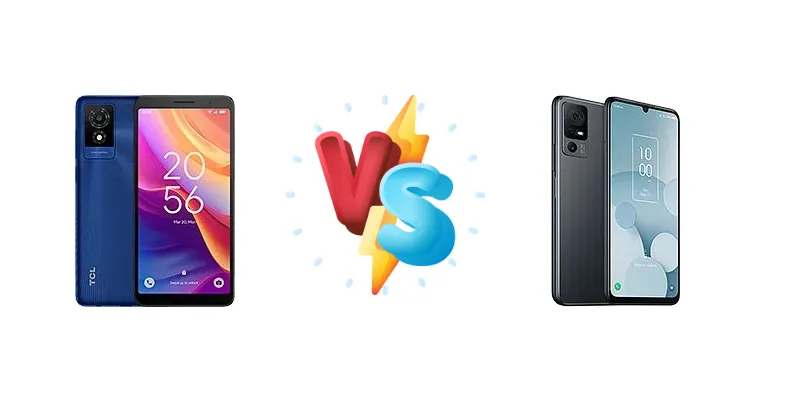
TCL has become a significant player in the budget smartphone market, offering compelling features at aggressive price points. The TCL 501 and TCL 40 XL represent two of their recent offerings, both targeting cost-conscious consumers. However, subtle differences in their chipsets and charging capabilities could make one a better fit for your needs. This comparison dives deep into the specifications to reveal which device delivers the best value.
🏆 Quick Verdict
For most users, the TCL 40 XL is the better choice. While the core CPU architecture is similar, the Helio G37’s slightly higher clock speeds and, crucially, the 18W charging support provide a noticeable advantage in everyday responsiveness and convenience. The 501 remains a viable option for those prioritizing absolute lowest cost.
| Network |
|---|
| 2G bands | GSM 850 / 900 / 1800 / 1900 | GSM 850 / 900 / 1800 / 1900 |
| 3G bands | HSDPA 850 / 900 / 1900 / 2100 | HSDPA 850 / 1700(AWS) / 1900 - USA |
| 4G bands | 1, 3, 5, 7, 8, 20, 28, 38, 40, 41 | 2, 4, 5, 12, 13, 25, 26, 41, 66, 71 - USA |
| Speed | HSPA, LTE | HSPA, LTE |
| Technology | GSM / HSPA / LTE | GSM / HSPA / LTE |
| Launch |
|---|
| Announced | 2024, February 26 | 2023, February 26 |
| Status | Available. Released 2024, April | Available. Released 2023, May |
| Body |
|---|
| Build | - | Glass front, plastic frame, plastic back |
| Dimensions | 156.5 x 74.9 x 9.7 mm (6.16 x 2.95 x 0.38 in) | 167.9 x 76.5 x 8.8 mm (6.61 x 3.01 x 0.35 in) |
| SIM | Nano-SIM + Nano-SIM | · Nano-SIM + eSIM· Nano-SIM + Nano-SIM |
| Weight | - | 195 g (6.88 oz) |
| Display |
|---|
| Resolution | 540 x 1092 pixels (~203 ppi density) | 720 x 1600 pixels, 20:9 ratio (~260 ppi density) |
| Size | 6.0 inches, 92.3 cm2 (~78.7% screen-to-body ratio) | 6.75 inches, 110.0 cm2 (~85.6% screen-to-body ratio) |
| Type | IPS LCD | IPS LCD, 90Hz |
| Platform |
|---|
| CPU | Octa-core (4x2.2 GHz Cortex-A53 & 4x1.6 GHz Cortex-A53) | Octa-core (4x2.3 GHz Cortex-A53 & 4x1.8 GHz Cortex-A53) |
| Chipset | Mediatek Helio G36 (12 nm) | Mediatek MT6765 Helio G37 (12 nm) |
| GPU | PowerVR GE8320 | PowerVR GE8320 |
| OS | Android 14 (Go edition) | Android 13, TCL UI |
| Memory |
|---|
| Card slot | microSDXC (dedicated slot) | microSDXC |
| Internal | 32GB 2GB RAM | 128GB 4GB RAM, 256GB 6GB RAM |
| Main Camera |
|---|
| Features | LED flash | LED flash, HDR, panorama |
| Single | 5 MP, f/2.2 | 8 MP, (wide) |
| Triple | - | 50 MP, (wide), PDAF
2 MP (macro)
Auxiliary lens |
| Video | 1080p@30fps | 1080p@30fps |
| Selfie camera |
|---|
| Single | 2 MP, f/2.8 | 8 MP, (wide) |
| Video | 720p@30fps | 1080p@30fps |
| Sound |
|---|
| 3.5mm jack | - | Yes |
| 35mm jack | Yes | Yes |
| Loudspeaker | Yes | Yes, with dual speakers |
| Comms |
|---|
| Bluetooth | 5.1, A2DP, LE | 5.1, A2DP, LE |
| NFC | No | No |
| Positioning | GPS, GLONASS, GALILEO, BDS | GPS |
| Radio | Unspecified | FM radio |
| USB | USB Type-C | USB Type-C 2.0 |
| WLAN | Wi-Fi 802.11 a/b/g/n/ac, dual-band, Wi-Fi Direct | Wi-Fi 802.11 a/b/g/n/ac, dual-band, Wi-Fi Direct |
| Features |
|---|
| Sensors | Accelerometer | Fingerprint (side-mounted), accelerometer, gyro, proximity, compass, barometer |
| Battery |
|---|
| Charging | 10W wired | 18W wired |
| Type | 3000 mAh | Li-Ion 5000 mAh |
| Misc |
|---|
| Colors | Black, Glacial Blue | Dark Gray |
| Models | T433D | T608M |
| Price | - | About 140 EUR |
TCL 501
- Potentially lower price point
- Functional for basic smartphone tasks
- Reliable Mediatek chipset
- Slower charging speed (10W)
- Slightly less powerful chipset
- Likely limited RAM and storage options
TCL 40 XL
- Faster 18W wired charging
- Slightly improved CPU performance
- More responsive user experience
- Potentially higher price
- Still limited gaming capabilities
- Likely similar display quality to the 501
Display Comparison
Both the TCL 501 and TCL 40 XL likely feature LCD panels, typical for this price segment. Specific details like resolution and brightness are not provided, but we can assume they are similar. The absence of high refresh rates or advanced panel technologies like LTPO is expected. Bezels are likely to be substantial on both devices, contributing to a less immersive viewing experience compared to higher-end phones. Color accuracy will likely be standard for the price point, prioritizing vibrancy over absolute fidelity.
Camera Comparison
Camera specifications are not detailed enough to draw significant conclusions. Both phones likely feature a primary camera and potentially a depth or macro sensor. Without knowing sensor size, aperture, or image processing algorithms, it’s difficult to assess image quality. The presence of a 2MP macro camera on either device is unlikely to provide meaningful improvements in image detail. The G37’s slightly more powerful ISP (Image Signal Processor) *could* result in marginally better image processing, but this is speculative without further data.
Performance
The core difference lies in the chipsets: the TCL 501 utilizes the Mediatek Helio G36, while the TCL 40 XL features the Helio G37. Both are 12nm chips employing an octa-core configuration with the same Cortex-A53 architecture. However, the G37 boasts slightly higher clock speeds – 2.3 GHz vs 2.2 GHz for the performance cores and 1.8 GHz vs 1.6 GHz for the efficiency cores. This translates to a marginal performance boost in CPU-intensive tasks. While neither chipset is a gaming powerhouse, the G37 will offer a smoother experience with less stuttering in less demanding titles. The RAM configuration is not specified, but LPDDR4X is likely used in both, limiting memory bandwidth. Thermal management will be passive, relying on the phone’s chassis to dissipate heat, potentially leading to throttling under sustained load.
Battery Life
Battery capacity is not specified for either device. However, the TCL 40 XL’s 18W wired charging is a significant advantage over the TCL 501’s 10W charging. This means the 40 XL will charge from 0-100% considerably faster, reducing downtime. Even with a similar battery capacity, the faster charging speed makes the 40 XL more convenient for users who frequently need to top up their battery throughout the day. The slower charging on the 501 will require a longer connection to the charger.
Buying Guide
Buy the TCL 501 if you are on an extremely tight budget and prioritize minimizing upfront cost above all else. It’s a functional device for basic tasks. Buy the TCL 40 XL if you value faster charging, slightly improved performance for multitasking, and a more responsive user experience, even if it means spending a little more. It’s the better all-rounder for daily use.
Frequently Asked Questions
❓ Will the Helio G37 in the TCL 40 XL handle popular games like PUBG Mobile or Call of Duty?
The Helio G37 can run PUBG Mobile and Call of Duty, but expect to play at lower graphics settings and frame rates to maintain a smooth experience. It's not a dedicated gaming chipset, so demanding titles will likely require compromises. The 501's G36 will perform slightly worse in these scenarios.
❓ How long will it take to fully charge the TCL 40 XL with the 18W charger?
While a precise charging time depends on the battery capacity (which isn't specified), the 18W charging should take approximately 2-3 hours for a full charge from 0%. This is significantly faster than the TCL 501's 10W charging, which could take 4+ hours.
❓ Is the difference in CPU clock speed between the G36 and G37 noticeable in everyday use?
The difference in clock speed (2.2 GHz vs 2.3 GHz) is relatively small, but it can contribute to a slightly snappier experience when opening apps, multitasking, and browsing the web on the TCL 40 XL. It won't be a dramatic difference, but it's a measurable improvement.