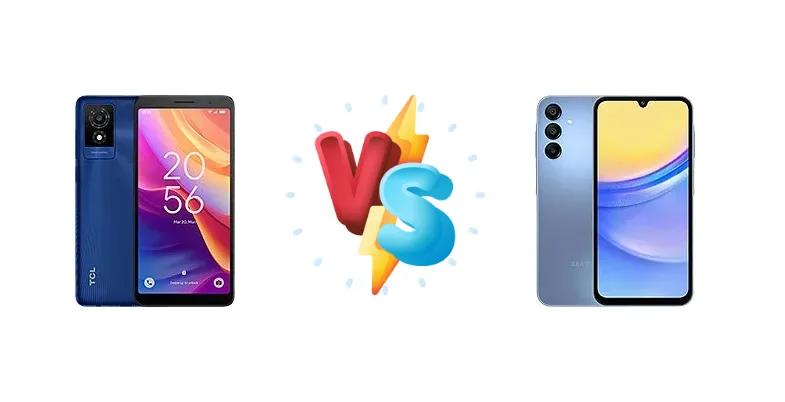
The sub-$200 5G smartphone market is heating up, and the TCL 501 and Samsung Galaxy A15 5G are two key players. While both aim to deliver 5G connectivity at an accessible price, they take different approaches to achieving this. The TCL 501 focuses on a basic, functional experience, while the Samsung A15 5G attempts to offer a more polished experience with a brighter display and faster charging.
🏆 Quick Verdict
For the average user prioritizing battery life and a more vibrant viewing experience, the Samsung Galaxy A15 5G is the better choice. Its Dimensity 6100+ chipset and 786 nit display offer a noticeable upgrade over the TCL 501's Helio G36 and basic specs, justifying the potential price difference.
| Network |
|---|
| 2G bands | GSM 850 / 900 / 1800 / 1900 | GSM 850 / 900 / 1800 / 1900 |
| 3G bands | HSDPA 850 / 900 / 1900 / 2100 | HSDPA 850 / 900 / 1700(AWS) / 1900 / 2100 |
| 4G bands | 1, 3, 5, 7, 8, 20, 28, 38, 40, 41 | 1, 2, 3, 4, 5, 7, 8, 12, 17, 20, 26, 28, 38, 40, 41, 66 |
| 5G bands | - | 1, 3, 5, 7, 8, 26, 28, 40, 41, 66, 77, 78 SA/NSA/Sub6 |
| Speed | HSPA, LTE | HSPA, LTE, 5G |
| Technology | GSM / HSPA / LTE | GSM / HSPA / LTE / 5G |
| Launch |
|---|
| Announced | 2024, February 26 | 2023, December 11 |
| Status | Available. Released 2024, April | Available. Released 2023, December 16 |
| Body |
|---|
| Build | - | Glass front, plastic back, plastic frame |
| Dimensions | 156.5 x 74.9 x 9.7 mm (6.16 x 2.95 x 0.38 in) | 160.1 x 76.8 x 8.4 mm (6.30 x 3.02 x 0.33 in) |
| SIM | Nano-SIM + Nano-SIM | · Nano-SIM· Nano-SIM + Nano-SIM |
| Weight | - | 200 g (7.05 oz) |
| Display |
|---|
| Resolution | 540 x 1092 pixels (~203 ppi density) | 1080 x 2340 pixels, 19.5:9 ratio (~396 ppi density) |
| Size | 6.0 inches, 92.3 cm2 (~78.7% screen-to-body ratio) | 6.5 inches, 103.7 cm2 (~84.3% screen-to-body ratio) |
| Type | IPS LCD | Super AMOLED, 90Hz, 800 nits (HBM) |
| Platform |
|---|
| CPU | Octa-core (4x2.2 GHz Cortex-A53 & 4x1.6 GHz Cortex-A53) | Octa-core (2x2.2 GHz Cortex-A76 & 6x2.0 GHz Cortex-A55) |
| Chipset | Mediatek Helio G36 (12 nm) | Mediatek Dimensity 6100+ (6 nm) |
| GPU | PowerVR GE8320 | Mali-G57 MC2 |
| OS | Android 14 (Go edition) | Android 14, upgradable to Android 16, One UI 8, up to 4 major Android upgrades |
| Memory |
|---|
| Card slot | microSDXC (dedicated slot) | microSDXC (uses shared SIM slot) |
| Internal | 32GB 2GB RAM | 64GB 4GB RAM, 128GB 4GB RAM, 128GB 6GB RAM, 128GB 8GB RAM, 256GB 8GB RAM |
| Main Camera |
|---|
| Features | LED flash | LED flash, panorama, HDR |
| Single | 5 MP, f/2.2 | - |
| Triple | - | 50 MP, f/1.8, (wide), AF
5 MP, f/2.2, (ultrawide)
2 MP (macro) |
| Video | 1080p@30fps | 1080p@30fps, gyro-EIS |
| Selfie camera |
|---|
| Single | 2 MP, f/2.8 | 13 MP, f/2.0, (wide) |
| Video | 720p@30fps | 1080p@30fps |
| Sound |
|---|
| 35mm jack | Yes | Yes |
| Loudspeaker | Yes | Yes |
| Comms |
|---|
| Bluetooth | 5.1, A2DP, LE | 5.3, A2DP, LE |
| NFC | No | Yes (market/region dependent) |
| Positioning | GPS, GLONASS, GALILEO, BDS | GPS, GALILEO, GLONASS, BDS, QZSS |
| Radio | Unspecified | No |
| USB | USB Type-C | USB Type-C 2.0 |
| WLAN | Wi-Fi 802.11 a/b/g/n/ac, dual-band, Wi-Fi Direct | Wi-Fi 802.11 a/b/g/n/ac, dual-band, Wi-Fi Direct |
| Features |
|---|
| Sensors | Accelerometer | Fingerprint (side-mounted), accelerometer, gyro, compass |
| Battery |
|---|
| Charging | 10W wired | 25W wired |
| Type | 3000 mAh | 5000 mAh |
| Misc |
|---|
| Colors | Black, Glacial Blue | Brave Black, Personality Yellow, Magical Blue, Optimistic Blue |
| Models | T433D | SM-A156B, SM-A156B/DS, SM-A156P, SM-A156P/DS, SM-A156U, SM-A156U1, SM-A156U1/DS, SM-A156W, SM-A156P/N, SM-A156P/DSN, SM-S156VL, SM-A156M, SM-A156E, SM-A156E/DSN |
| Price | - | € 167.00 / $ 79.97 / ₹ 17,490 |
| SAR EU | - | 0.80 W/kg (head) 1.46 W/kg (body) |
TCL 501
- Potentially lower price point
- Functional and reliable for basic tasks
- 5G connectivity
- Outdated chipset (Helio G36)
- Slow 10W charging
- Likely lower display brightness
Samsung Galaxy A15 5G
- Brighter 786 nit display
- More powerful Dimensity 6100+ chipset
- Faster 25W charging
- Longer battery life (14:31h active use)
- Potentially higher price
- May still lack advanced camera features
- Software updates may be slower than flagship models
Display Comparison
The Samsung Galaxy A15 5G boasts a significantly brighter display, reaching a measured 786 nits. This is a substantial advantage over what we'd expect from the TCL 501, making the A15 5G far more usable outdoors. While the TCL 501's panel specifications are not provided, it's likely a lower-brightness IPS LCD. The A15 5G's brightness translates to better visibility in sunlight and a more vibrant viewing experience overall. We can assume the TCL 501 will struggle in direct sunlight.
Camera Comparison
Without detailed camera specifications for either device, it's difficult to make a definitive comparison. However, given the market positioning, we can expect both phones to feature basic camera setups. The TCL 501 likely relies on software processing to enhance image quality, while the A15 5G’s Dimensity 6100+ ISP may offer slightly better image processing capabilities. It's safe to assume neither phone will excel in low-light photography. We'd caution against expecting high-quality results from either device, particularly from any included macro lenses.
Performance
The chipset is where the biggest difference lies. The Samsung Galaxy A15 5G's Mediatek Dimensity 6100+ (6nm) is a clear upgrade over the TCL 501's Mediatek Helio G36 (12nm). The Dimensity 6100+ features more modern CPU cores – 2x Cortex-A76 at 2.2 GHz and 6x Cortex-A55 at 2.0 GHz – compared to the Helio G36’s 4x Cortex-A53 at 2.2 GHz and 4x Cortex-A53 at 1.6 GHz. This architectural difference, combined with the smaller 6nm process node, results in significantly improved performance and efficiency. The A15 5G will handle multitasking and demanding apps with greater ease, and will likely exhibit less thermal throttling under sustained load. The Helio G36 is adequate for basic tasks, but will struggle with more intensive applications.
Battery Life
The Samsung Galaxy A15 5G shines in battery performance, achieving an active use score of 14 hours and 31 minutes. While the TCL 501’s battery capacity is unknown, the A15 5G’s endurance is a significant advantage. Furthermore, the A15 5G supports 25W wired charging, allowing for much faster top-ups compared to the TCL 501’s slow 10W charging. This means less downtime and more time using the phone. The faster charging is a key benefit for users who frequently need to recharge their devices.
Buying Guide
Buy the TCL 501 if you need a functional, no-frills 5G phone and are on an extremely tight budget. It's a solid option for basic communication and light tasks. Buy the Samsung Galaxy A15 5G if you prefer a brighter, more responsive display, faster charging, and a more capable processor for everyday tasks and occasional gaming. The A15 5G offers a better overall user experience for a small premium.
Frequently Asked Questions
❓ Is the Mediatek Dimensity 6100+ in the Galaxy A15 5G powerful enough for gaming?
The Dimensity 6100+ is capable of handling many popular mobile games at medium settings. While it won't deliver flagship-level performance, it provides a noticeable improvement over the Helio G36 in the TCL 501, allowing for smoother gameplay and fewer frame drops in titles like PUBG Mobile and Call of Duty: Mobile.
❓ How long does it realistically take to charge the Samsung Galaxy A15 5G from 0% to 100%?
With the 25W charger (sold separately), the Samsung Galaxy A15 5G can charge from 0% to 100% in approximately 1 hour and 30 minutes to 2 hours, depending on usage during charging. This is significantly faster than the TCL 501's 10W charging, which would likely take over 3 hours.
❓ Does the Samsung Galaxy A15 5G support VoWiFi (Wi-Fi Calling)?
Support for VoWiFi varies by carrier. The Samsung Galaxy A15 5G *has* the hardware capability to support VoWiFi, but whether it functions correctly depends on your mobile carrier's implementation and compatibility. Check with your carrier for confirmation.