
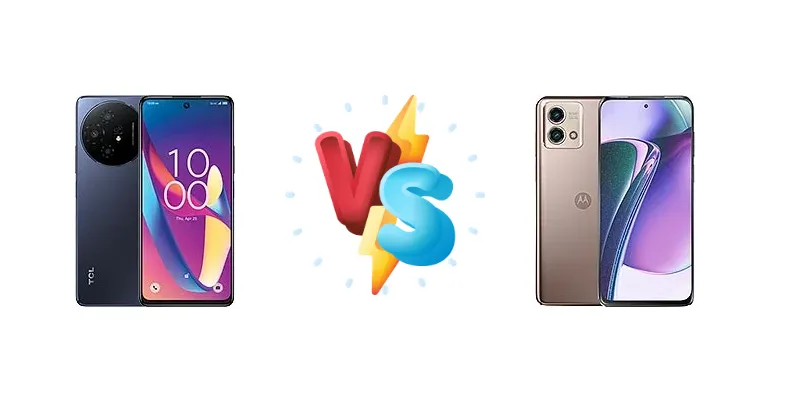
TCL 50 XL vs. Motorola Moto G Stylus 5G (2023): Which Budget 5G Phone Reigns Supreme?
| Phones Images | |||||
|---|---|---|---|---|---|
|
🏆 Quick Verdict
For the average user prioritizing sustained performance and slightly faster charging, the Motorola Moto G Stylus 5G (2023) emerges as the better choice. Its Snapdragon 6 Gen 1, built on a more efficient 4nm process, provides a noticeable edge in multi-tasking and gaming, despite the TCL 50 XL's Cortex-A76 cores.
| PHONES | ||
|---|---|---|
| Phone Names | TCL 50 XL | Motorola Moto G Stylus 5G (2023) |
| Network | ||
|---|---|---|
| 2G bands | GSM 850 / 900 / 1800 / 1900 | GSM 850 / 900 / 1800 / 1900 |
| 3G bands | HSDPA 850 / 1700(AWS) / 1900 / 2100 | HSDPA 850 / 900 / 1700(AWS) / 1900 / 2100 |
| 4G bands | 1, 2, 3, 4, 5, 7, 8, 12, 13, 20, 25, 26, 28, 38, 39, 40, 41, 48, 66, 71 | 1, 2, 3, 4, 5, 7, 8, 12, 13, 14, 17, 18, 19, 20, 25, 26, 29, 30, 38, 39, 40, 41, 48, 66, 71 |
| 5G bands | 25, 41, 66, 71, 77 SA/NSA/Sub6 | 1, 2, 3, 5, 7, 12, 13, 14, 25, 26, 29, 30, 38, 41, 48, 66, 70, 71, 77, 78 SA/NSA |
| Speed | HSPA, LTE, 5G | HSPA, LTE, 5G |
| Technology | GSM / HSPA / LTE / 5G | GSM / HSPA / LTE / 5G |
| Launch | ||
|---|---|---|
| Announced | 2024, June 26 | 2023, May 30 |
| Status | Available. Released 2024, July 05 | Available. Released 2023, June 02 |
| Body | ||
|---|---|---|
| Build | - | Glass front, plastic frame, plastic back |
| Dimensions | 167.6 x 75.5 x 8.2 mm (6.60 x 2.97 x 0.32 in) | 162.8 x 73.8 x 9.2 mm (6.41 x 2.91 x 0.36 in) |
| SIM | Nano-SIM | Nano-SIM |
| Weight | 195 g (6.88 oz) | 202 g (7.13 oz) |
| Display | ||
|---|---|---|
| Resolution | 1080 x 2460 pixels (~396 ppi density) | 1080 x 2400 pixels, 20:9 ratio (~399 ppi density) |
| Size | 6.78 inches, 109.2 cm2 (~86.3% screen-to-body ratio) | 6.6 inches, 105.2 cm2 (~87.5% screen-to-body ratio) |
| Type | IPS LCD, 120Hz | IPS LCD, 120Hz |
| Platform | ||
|---|---|---|
| CPU | Octa-core (2x2.2 GHz Cortex-A76 & 6x2.0 GHz Cortex-A55) | Octa-core (4x2.2 GHz Cortex-A78 & 4x1.8 GHz Cortex-A55) |
| Chipset | Mediatek Dimensity 6100+ (6 nm) | Qualcomm SM6450 Snapdragon 6 Gen 1 (4 nm) |
| GPU | Mali-G57 MC2 | Adreno 710 |
| OS | Android 14 | Android 13, planned upgrade to Android 14 |
| Memory | ||
|---|---|---|
| Card slot | microSDXC | microSDXC (dedicated slot) |
| Internal | 128GB 6GB RAM | 64GB 4GB RAM, 128GB 4GB RAM, 128GB 6GB RAM, 256GB 6GB RAM |
| Main Camera | ||
|---|---|---|
| Dual | 50 MP, (wide), PDAF 2 MP, (ultrawide) Auxiliary lens | 50 MP, f/1.9, (wide), 1.0µm, PDAF 8 MP, f/2.2, (ultrawide), 1/4.0", 1.12µm, AF |
| Features | LED flash, HDR, panorama | LED flash, HDR, panorama |
| Video | 1080p@30fps | 4K@30fps, 1080p@30/60fps |
| Selfie camera | ||
|---|---|---|
| Features | - | HDR |
| Single | 8 MP, (wide) | 16 MP, f/2.5, (wide), 1.0µm |
| Video | 1080p@30fps | 1080p@30fps |
| Sound | ||
|---|---|---|
| 35mm jack | Yes | Yes |
| Loudspeaker | Yes, with stereo speakers | Yes, with stereo speakers |
| Comms | ||
|---|---|---|
| Bluetooth | 5.3, A2DP, LE | 5.1, A2DP, LE |
| NFC | Yes (market/region dependent) | Yes |
| Positioning | GPS, GLONASS, BDS, GALILEO | GPS (L1+L5), GALILEO |
| Radio | FM radio | FM radio |
| USB | USB Type-C, OTG | USB Type-C 2.0 |
| WLAN | Wi-Fi 802.11 a/b/g/n/ac, dual-band | Wi-Fi 802.11 a/b/g/n/ac, dual-band |
| Features | ||
|---|---|---|
| Sensors | Fingerprint (side-mounted), gyro, accelerometer, proximity, compass, barometer | Fingerprint (side-mounted), accelerometer, gyro, proximity, compass, barometer |
| Battery | ||
|---|---|---|
| Charging | 18W wired | 20W wired |
| Type | 5010 mAh | Li-Po 5000 mAh |
| Misc | ||
|---|---|---|
| Colors | Slate Gray | Cosmic Black, Rose Champagne |
| Models | T702W | XT2315-1, XT2315-4 |
| Price | About 90 EUR | $ 93.43 |
| SAR | 1.22 W/kg (head) 0.87 W/kg (body) | - |
TCL 50 XL
- Potentially larger display for immersive media consumption.
- Competitive price point.
- Decent performance for everyday tasks.
- Less efficient 6nm Dimensity 6100+ chipset.
- May experience more throttling under heavy load.
- Slower charging speed (18W).
Motorola Moto G Stylus 5G (2023)
- More efficient 4nm Snapdragon 6 Gen 1 chipset.
- Faster 20W charging.
- Integrated stylus for enhanced productivity and creativity.
- Potentially smaller display.
- May be slightly more expensive.
- Stylus may not be useful for all users.
Display Comparison
Neither TCL nor Motorola provide detailed display specs beyond resolution. However, the TCL 50 XL's larger size suggests a focus on media consumption. The Moto G Stylus 5G likely prioritizes usability with the stylus. The absence of high refresh rates on both devices indicates a cost-saving measure. Color accuracy and peak brightness are unknown, but likely similar given the price bracket. The TCL 50 XL's larger screen will be more immersive for video, while the Moto G Stylus 5G's display is optimized for stylus interaction.
Camera Comparison
Without detailed camera specs, a direct comparison is difficult. However, both phones likely employ similar budget-oriented camera setups. The Motorola Moto G Stylus 5G (2023) may benefit from Qualcomm’s image signal processor (ISP), potentially offering slightly better image processing and low-light performance. The TCL 50 XL may focus on software enhancements to compensate. The presence of a stylus on the Motorola could also be leveraged for creative camera features. We anticipate both phones will include a standard wide, ultrawide, and potentially a macro lens, but image quality will largely depend on sensor size and software optimization.
Performance
The core difference lies in the chipsets. The Motorola Moto G Stylus 5G (2023) utilizes the Qualcomm SM6450 Snapdragon 6 Gen 1 (4nm), featuring four Cortex-A78 cores clocked at 2.2 GHz. This architecture is demonstrably more efficient and offers higher single-core performance than the TCL 50 XL’s Mediatek Dimensity 6100+ (6nm) with its two Cortex-A76 cores at 2.2 GHz. The 4nm fabrication process of the Snapdragon gives it a significant advantage in thermal management, reducing throttling during prolonged use. While the Dimensity 6100+ has six Cortex-A55 cores versus the Snapdragon’s four, the architectural superiority of the A78 cores in the Motorola will translate to a smoother experience in most scenarios. The Snapdragon's integrated Adreno GPU will also provide a better gaming experience.
Battery Life
The TCL 50 XL charges at 18W, while the Motorola Moto G Stylus 5G (2023) supports 20W wired charging. While the difference isn't massive, the 20W charging on the Motorola will result in slightly faster top-ups. The Snapdragon 6 Gen 1’s 4nm process contributes to better power efficiency, potentially offsetting any capacity differences. Real-world battery life will depend heavily on usage patterns, but the Motorola has a slight edge due to its more efficient chipset.
Buying Guide
Buy the TCL 50 XL if you prioritize a larger screen and are primarily focused on everyday tasks like browsing, social media, and streaming. Its Dimensity 6100+ is capable, but best suited for lighter workloads. Buy the Motorola Moto G Stylus 5G (2023) if you value smoother performance in demanding apps, enjoy mobile gaming, or frequently use the integrated stylus for note-taking and creative tasks. The Snapdragon 6 Gen 1 offers a more responsive experience.