
TCL 50 XE NxtPaper vs Samsung Galaxy A15 5G: A Deep Dive into Dimensity 6100+ Performance
| Phones Images | |||||
|---|---|---|---|---|---|
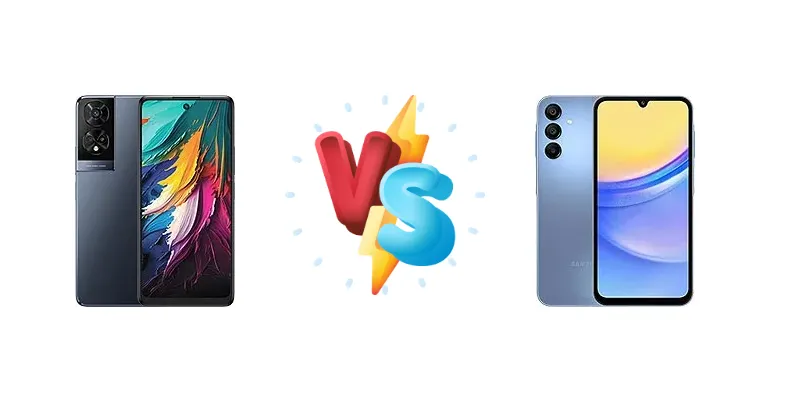
|
🏆 Quick Verdict
For the average user prioritizing display brightness and faster charging, the Samsung Galaxy A15 5G is the better choice. Its 786 nit display and 25W charging offer a more polished experience, despite the TCL’s unique NxtPaper display technology. However, the TCL offers a unique display experience.
| PHONES | ||
|---|---|---|
| Phone Names | TCL 50 XE NxtPaper | Samsung Galaxy A15 5G |
| Network | ||
|---|---|---|
| 2G bands | GSM 850 / 900 / 1800 / 1900 | GSM 850 / 900 / 1800 / 1900 |
| 3G bands | HSDPA 850 / 1700(AWS) / 1900 | HSDPA 850 / 900 / 1700(AWS) / 1900 / 2100 |
| 4G bands | 1, 2, 3, 4, 5, 7, 8, 12, 13, 20, 25, 26, 28, 38, 39, 40, 41, 66, 71 | 1, 2, 3, 4, 5, 7, 8, 12, 17, 20, 26, 28, 38, 40, 41, 66 |
| 5G bands | 2, 5, 25, 41, 48, 66, 71, 77 SA/NSA/Sub6 | 1, 3, 5, 7, 8, 26, 28, 40, 41, 66, 77, 78 SA/NSA/Sub6 |
| Speed | HSPA, LTE, 5G | HSPA, LTE, 5G |
| Technology | GSM / HSPA / LTE / 5G | GSM / HSPA / LTE / 5G |
| Launch | ||
|---|---|---|
| Announced | 2024, June | 2023, December 11 |
| Status | Available. Released 2024, July | Available. Released 2023, December 16 |
| Body | ||
|---|---|---|
| Build | - | Glass front, plastic back, plastic frame |
| Dimensions | 164.1 x 75 x 8.3 mm (6.46 x 2.95 x 0.33 in) | 160.1 x 76.8 x 8.4 mm (6.30 x 3.02 x 0.33 in) |
| SIM | Nano-SIM | · Nano-SIM· Nano-SIM + Nano-SIM |
| Weight | 185 g (6.53 oz) | 200 g (7.05 oz) |
| Display | ||
|---|---|---|
| Resolution | 720 x 1612 pixels, 20:9 ratio (~269 ppi density) | 1080 x 2340 pixels, 19.5:9 ratio (~396 ppi density) |
| Size | 6.56 inches, 103.4 cm2 (~84.0% screen-to-body ratio) | 6.5 inches, 103.7 cm2 (~84.3% screen-to-body ratio) |
| Type | IPS LCD, 90Hz | Super AMOLED, 90Hz, 800 nits (HBM) |
| Platform | ||
|---|---|---|
| CPU | Octa-core (2x1.8 GHz Cortex-A76 & 6x1.8 GHz Cortex-A55) | Octa-core (2x2.2 GHz Cortex-A76 & 6x2.0 GHz Cortex-A55) |
| Chipset | Mediatek Dimensity 6100+ (6 nm) | Mediatek Dimensity 6100+ (6 nm) |
| GPU | Mali-G57 MC2 | Mali-G57 MC2 |
| OS | Android 14 | Android 14, upgradable to Android 16, One UI 8, up to 4 major Android upgrades |
| Memory | ||
|---|---|---|
| Card slot | microSDXC | microSDXC (uses shared SIM slot) |
| Internal | 128GB 4GB RAM | 64GB 4GB RAM, 128GB 4GB RAM, 128GB 6GB RAM, 128GB 8GB RAM, 256GB 8GB RAM |
| Main Camera | ||
|---|---|---|
| Dual | 50 MP, (wide), PDAF 5 MP, (ultrawide) Auxiliary lens | - |
| Features | LED flash, HDR, panorama | LED flash, panorama, HDR |
| Triple | - | 50 MP, f/1.8, (wide), AF 5 MP, f/2.2, (ultrawide) 2 MP (macro) |
| Video | 1080p@30fps | 1080p@30fps, gyro-EIS |
| Selfie camera | ||
|---|---|---|
| Single | 8 MP, (wide) | 13 MP, f/2.0, (wide) |
| Video | 1080p@30fps | 1080p@30fps |
| Sound | ||
|---|---|---|
| 35mm jack | Yes | Yes |
| Loudspeaker | Yes, with stereo speakers | Yes |
| Comms | ||
|---|---|---|
| Bluetooth | 5.3, A2DP, LE | 5.3, A2DP, LE |
| NFC | Yes (market/region dependent) | Yes (market/region dependent) |
| Positioning | GPS, GLONASS, BDS, GALILEO | GPS, GALILEO, GLONASS, BDS, QZSS |
| Radio | FM radio | No |
| USB | USB Type-C, OTG | USB Type-C 2.0 |
| WLAN | Wi-Fi 802.11 a/b/g/n/ac, dual-band, Wi-Fi Direct | Wi-Fi 802.11 a/b/g/n/ac, dual-band, Wi-Fi Direct |
| Features | ||
|---|---|---|
| Sensors | Fingerprint (side-mounted), gyro, accelerometer, proximity, compass, barometer | Fingerprint (side-mounted), accelerometer, gyro, compass |
| Battery | ||
|---|---|---|
| Charging | 18W wired | 25W wired |
| Type | 5010 mAh | 5000 mAh |
| Misc | ||
|---|---|---|
| Colors | Space Blue | Brave Black, Personality Yellow, Magical Blue, Optimistic Blue |
| Models | T614J, T614WS | SM-A156B, SM-A156B/DS, SM-A156P, SM-A156P/DS, SM-A156U, SM-A156U1, SM-A156U1/DS, SM-A156W, SM-A156P/N, SM-A156P/DSN, SM-S156VL, SM-A156M, SM-A156E, SM-A156E/DSN |
| Price | - | € 167.00 / $ 79.97 / ₹ 17,490 |
| SAR | 1.19 W/kg (head) 1.10 W/kg (body) | - |
| SAR EU | - | 0.80 W/kg (head) 1.46 W/kg (body) |
TCL 50 XE NxtPaper
- Unique NxtPaper display for eye comfort
- Potentially lower price point
- Matte finish reduces glare
- Lower display brightness
- Slower 18W charging
- Potentially less refined image processing
Samsung Galaxy A15 5G
- Brighter 786 nit display
- Faster 25W charging
- Longer active use battery life (14:31h)
- Lacks the unique NxtPaper display technology
- Potentially higher price
- Standard LCD panel may lack contrast
Display Comparison
The TCL 50 XE NxtPaper features its proprietary NxtPaper display, designed to mimic the texture of paper, reducing eye strain. While the exact panel technology isn't specified, it prioritizes a matte finish and blue light filtering. Conversely, the Samsung Galaxy A15 5G boasts a significantly brighter display, reaching a measured 786 nits. This higher peak brightness makes the A15 5G far more usable outdoors and in brightly lit environments. The A15’s panel type is likely PLS LCD, offering good color reproduction, but lacking the contrast of an AMOLED panel. The NxtPaper’s matte finish will reduce glare, but also impact color vibrancy.
Camera Comparison
Detailed camera specs are limited, but both phones likely feature a multi-camera setup geared towards general photography. The focus should be on the main sensor performance. Without specific sensor size information, it’s difficult to definitively declare a winner. However, Samsung’s image processing algorithms are generally more refined, potentially leading to better dynamic range and color accuracy. The inclusion of a 2MP macro camera on both devices is largely a marketing tactic, offering limited practical benefit due to the small sensor size and lack of optical image stabilization (OIS).
Performance
Both devices are powered by the Mediatek Dimensity 6100+ (6nm), featuring an octa-core CPU configuration. However, Samsung slightly edges out with a higher CPU clock speed – 2x2.2 GHz Cortex-A76 vs TCL’s 2x1.8 GHz Cortex-A76. While the core count is identical, the higher clock speed on the A15 suggests marginally faster processing in CPU-intensive tasks. Both devices likely utilize LPDDR4X RAM, as is common in this price segment. Thermal management will be crucial; the 6nm Dimensity 6100+ is efficient, but sustained loads could lead to throttling, potentially impacting gaming performance on both devices.
Battery Life
The Samsung Galaxy A15 5G demonstrates a clear advantage in battery performance, achieving 14:31 hours of active use. While the TCL 50 XE NxtPaper’s battery capacity isn’t specified, the A15’s longer runtime suggests superior power efficiency or a larger battery. Furthermore, the A15 supports 25W wired charging, significantly faster than the TCL’s 18W charging. This translates to quicker top-ups and less downtime, a crucial benefit for users who rely heavily on their smartphones throughout the day.
Buying Guide
Buy the TCL 50 XE NxtPaper if you prioritize eye comfort and a paper-like reading experience, and are willing to trade off display brightness and charging speed. Buy the Samsung Galaxy A15 5G if you value a brighter, more vibrant display, faster charging, and longer sustained battery life during active use, making it ideal for media consumption and everyday tasks.