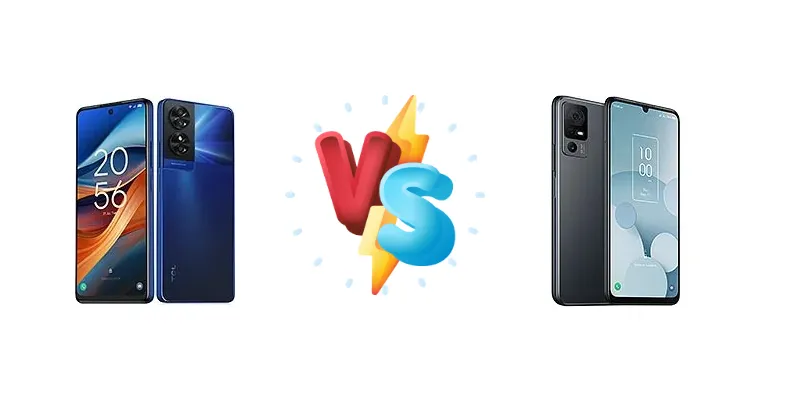
TCL has become a significant player in the budget smartphone space, offering compelling features at aggressive price points. The 50 SE and 40 XL represent two distinct approaches within that strategy. The 50 SE prioritizes faster charging and a more capable processor, while the 40 XL aims for a balance of features at an even lower cost. This comparison dissects the key differences to help you choose the right TCL for your needs.
🏆 Quick Verdict
For most users, the TCL 50 SE is the better choice. Its Mediatek Helio G88 chipset, coupled with 33W fast charging, provides a noticeably smoother experience and quicker top-ups compared to the 40 XL’s Helio G37 and 18W charging. While the 40 XL is cheaper, the performance trade-offs are significant.
| Network |
|---|
| 2G bands | GSM 850 / 900 / 1800 / 1900 | GSM 850 / 900 / 1800 / 1900 |
| 3G bands | HSDPA 850 / 900 / 1700(AWS) / 1900 / 2100 | HSDPA 850 / 1700(AWS) / 1900 - USA |
| 4G bands | 1, 2, 3, 4, 5, 7, 8, 12, 13, 17, 20, 26, 28, 38, 40, 41, 66 | 2, 4, 5, 12, 13, 25, 26, 41, 66, 71 - USA |
| Speed | HSPA, LTE | HSPA, LTE |
| Technology | GSM / HSPA / LTE | GSM / HSPA / LTE |
| Launch |
|---|
| Announced | 2024, February 26 | 2023, February 26 |
| Status | Available. Released 2024, April 08 | Available. Released 2023, May |
| Body |
|---|
| Build | Glass front, plastic frame, plastic back | Glass front, plastic frame, plastic back |
| Dimensions | 168.2 x 75.5 x 8.1 mm (6.62 x 2.97 x 0.32 in) | 167.9 x 76.5 x 8.8 mm (6.61 x 3.01 x 0.35 in) |
| SIM | · Nano-SIM· Nano-SIM + Nano-SIM | · Nano-SIM + eSIM· Nano-SIM + Nano-SIM |
| Weight | 195 g (6.88 oz) | 195 g (6.88 oz) |
| Display |
|---|
| Resolution | 1080 x 2460 pixels (~396 ppi density) | 720 x 1600 pixels, 20:9 ratio (~260 ppi density) |
| Size | 6.78 inches, 109.2 cm2 (~86.0% screen-to-body ratio) | 6.75 inches, 110.0 cm2 (~85.6% screen-to-body ratio) |
| Type | IPS LCD, 90Hz, 550 nits (typ) | IPS LCD, 90Hz |
| Platform |
|---|
| CPU | Octa-core (2x2.0 GHz Cortex-A75 & 6x1.8 GHz Cortex-A55) | Octa-core (4x2.3 GHz Cortex-A53 & 4x1.8 GHz Cortex-A53) |
| Chipset | Mediatek Helio G88 (12 nm) | Mediatek MT6765 Helio G37 (12 nm) |
| GPU | Mali-G52 MC2 | PowerVR GE8320 |
| OS | Android 14, planned upgrade to Android 15 | Android 13, TCL UI |
| Memory |
|---|
| Card slot | microSDXC (dedicated slot) | microSDXC |
| Internal | 128GB 4GB RAM, 256GB 6GB RAM | 128GB 4GB RAM, 256GB 6GB RAM |
| Main Camera |
|---|
| Dual | 50 MP, f/1.8, (wide), 1/2.76", 0.64µm, PDAF
2 MP (macro) | - |
| Features | LED flash, HDR, panorama | LED flash, HDR, panorama |
| Single | - | 8 MP, (wide) |
| Triple | - | 50 MP, (wide), PDAF
2 MP (macro)
Auxiliary lens |
| Video | 1080p@30fps | 1080p@30fps |
| Selfie camera |
|---|
| Features | HDR | - |
| Single | 8 MP, f/2.0, (wide), 1/4.0", 1.12µm | 8 MP, (wide) |
| Video | 1080p@30fps | 1080p@30fps |
| Sound |
|---|
| 3.5mm jack | - | Yes |
| 35mm jack | Yes | Yes |
| Loudspeaker | Yes, with stereo speakers | Yes, with dual speakers |
| Comms |
|---|
| Bluetooth | 5.1, A2DP, LE | 5.1, A2DP, LE |
| NFC | Yes (market/region dependent) | No |
| Positioning | GPS, GLONASS, GALILEO, BDS | GPS |
| Radio | Unspecified | FM radio |
| USB | USB Type-C 2.0 | USB Type-C 2.0 |
| WLAN | Wi-Fi 802.11 a/b/g/n/ac, dual-band, Wi-Fi Direct | Wi-Fi 802.11 a/b/g/n/ac, dual-band, Wi-Fi Direct |
| Features |
|---|
| Sensors | Fingerprint (side-mounted), accelerometer, proximity, compass | Fingerprint (side-mounted), accelerometer, gyro, proximity, compass, barometer |
| Battery |
|---|
| Charging | 33W wired, 50% in 30 min | 18W wired |
| Type | 5010 mAh | Li-Ion 5000 mAh |
| Misc |
|---|
| Colors | Midnight Blue, Space Gray | Dark Gray |
| Models | T611B | T608M |
| Price | About 150 EUR | About 140 EUR |
TCL 50 SE
- Faster processor (Helio G88)
- 33W fast charging
- More responsive user experience
- Likely slightly higher price
- May not have significantly better camera performance
TCL 40 XL
- Lower price point
- Acceptable for basic tasks
- Potentially longer battery life (depending on capacity)
- Slower processor (Helio G37)
- Slow 18W charging
- Noticeably less responsive UI
Display Comparison
Neither TCL provides display specifications beyond size. However, given their price points, both likely utilize IPS LCD panels. The real difference lies in the processing power driving them. A smoother UI experience on the 50 SE, thanks to the faster processor, will translate to more responsive scrolling and app loading, indirectly enhancing the perceived display quality.
Camera Comparison
Without detailed camera specs, it’s difficult to make a definitive judgment. However, both phones likely feature similar sensor configurations geared towards basic photography. The chipset plays a role here; the G88’s image signal processor (ISP) is more advanced, potentially leading to better image processing and noise reduction, especially in low-light conditions. Expect both to struggle with complex scenes or demanding photography tasks.
Performance
The TCL 50 SE’s Mediatek Helio G88 chipset is the clear winner here. Its octa-core configuration, featuring two 2.0 GHz Cortex-A75 cores and six 1.8 GHz Cortex-A55 cores, offers a significant performance advantage over the 40 XL’s Helio G37. The G37 uses four 2.3 GHz Cortex-A53 cores and four 1.8 GHz Cortex-A53 cores. While the G37’s cores clock slightly higher, the A75 architecture in the G88 provides superior single-core performance, crucial for app responsiveness. This translates to faster app launches and smoother multitasking. The G88 also has a more capable GPU, making it better suited for light gaming.
Battery Life
Battery capacity isn’t specified, but the 33W charging on the TCL 50 SE is a major advantage. This allows for a 50% charge in just 30 minutes, significantly reducing downtime. The TCL 40 XL’s 18W charging is considerably slower, requiring more time to reach a full charge. Even if the 40 XL has a slightly larger battery, the faster charging of the 50 SE will likely result in less perceived battery anxiety for most users.
Buying Guide
Buy the TCL 50 SE if you need a phone that can handle moderate multitasking, occasional gaming, and benefits from faster charging speeds. This is ideal for users who rely on their phone throughout the day and don't want to be tethered to a charger. Buy the TCL 40 XL if you prioritize absolute affordability and your usage is limited to basic tasks like calls, texts, and light social media browsing. It’s a good option for first-time smartphone users or as a reliable backup device.
Frequently Asked Questions
❓ Will the TCL 50 SE handle popular games like PUBG Mobile or Call of Duty?
The Helio G88 in the TCL 50 SE can run PUBG Mobile and Call of Duty, but you’ll likely need to lower the graphics settings to medium or low to achieve a smooth frame rate. It’s not a dedicated gaming phone, but it’s capable of casual gaming sessions.
❓ Is the 18W charging on the TCL 40 XL really that slow compared to 33W?
Yes, the difference is noticeable. 18W charging will take significantly longer to fully charge the phone, potentially over two hours from 0%. The 33W charging on the 50 SE can get you to 50% in just 30 minutes, making it much more convenient for users who are frequently on the go.
❓ How much multitasking can the TCL 40 XL handle before slowing down?
The TCL 40 XL, with its Helio G37 chipset, will start to show signs of slowdown with more than 3-4 apps open simultaneously. Switching between apps will become less fluid, and app loading times will increase. It's best suited for running one app at a time.