
TCL 50 SE vs Samsung Galaxy A14 5G: A Deep Dive into Budget 5G Contenders
| Phones Images | |||||
|---|---|---|---|---|---|
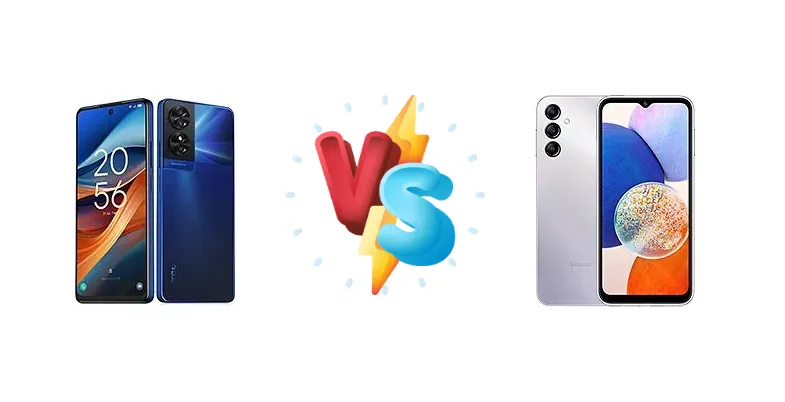
|
🏆 Quick Verdict
For the average user prioritizing sustained performance and future-proofing, the Samsung Galaxy A14 5G (specifically the Exynos 1330 variant) is the better choice. Its more modern 5nm Exynos 1330 chipset offers a noticeable performance advantage over the TCL 50 SE’s Helio G88, despite the TCL’s faster charging.
| PHONES | ||
|---|---|---|
| Phone Names | TCL 50 SE | Samsung Galaxy A14 5G |
| Network | ||
|---|---|---|
| 2G bands | GSM 850 / 900 / 1800 / 1900 | GSM 850 / 900 / 1800 / 1900 |
| 3G bands | HSDPA 850 / 900 / 1700(AWS) / 1900 / 2100 | HSDPA 850 / 900 / 1700(AWS) / 1900 / 2100 |
| 4G bands | 1, 2, 3, 4, 5, 7, 8, 12, 13, 17, 20, 26, 28, 38, 40, 41, 66 | 1, 2, 3, 4, 5, 7, 8, 12, 17, 20, 26, 28, 38, 40, 41, 66 - International |
| 5G bands | - | 2, 5, 66, 77 Sub6/mmWave - USA |
| Speed | HSPA, LTE | HSPA, LTE, 5G |
| Technology | GSM / HSPA / LTE | GSM / HSPA / LTE / 5G |
| - | 1, 3, 5, 7, 8, 20, 28, 40, 41, 78 SA/NSA/Sub6 - India | |
| Launch | ||
|---|---|---|
| Announced | 2024, February 26 | 2023, January 04 |
| Status | Available. Released 2024, April 08 | Available. Released 2023, January 12 |
| Body | ||
|---|---|---|
| Build | Glass front, plastic frame, plastic back | Glass front, plastic back, plastic frame |
| Dimensions | 168.2 x 75.5 x 8.1 mm (6.62 x 2.97 x 0.32 in) | 167.7 x 78 x 9.1 mm (6.60 x 3.07 x 0.36 in) |
| SIM | · Nano-SIM· Nano-SIM + Nano-SIM | · Nano-SIM· Nano-SIM + Nano-SIM |
| Weight | 195 g (6.88 oz) | 202 g (7.13 oz) |
| Display | ||
|---|---|---|
| Resolution | 1080 x 2460 pixels (~396 ppi density) | 1080 x 2408 pixels, 20:9 ratio (~400 ppi density) |
| Size | 6.78 inches, 109.2 cm2 (~86.0% screen-to-body ratio) | 6.6 inches, 104.9 cm2 (~80.2% screen-to-body ratio) |
| Type | IPS LCD, 90Hz, 550 nits (typ) | PLS LCD, 90Hz |
| Platform | ||
|---|---|---|
| CPU | Octa-core (2x2.0 GHz Cortex-A75 & 6x1.8 GHz Cortex-A55) | Octa-core (2x2.4 GHz Cortex-A78 & 6x2.0 GHz Cortex-A55) - SM-A146BOcta-core (2x2.2 GHz Cortex-A76 & 6x2.0 GHz Cortex-A55) - SM-A146P |
| Chipset | Mediatek Helio G88 (12 nm) | Exynos 1330 (5 nm) - SM-A146BMediatek Dimensity 700 (7 nm) - SM-A146P |
| GPU | Mali-G52 MC2 | Mali-G68 MP2 - SM-A146BMali-G57 MC2 - SM-A146P |
| OS | Android 14, planned upgrade to Android 15 | Android 13, upgradable to Android 15, One UI Core 7 |
| Memory | ||
|---|---|---|
| Card slot | microSDXC (dedicated slot) | microSDXC (uses shared SIM slot) - USA onlymicroSDXC (dedicated slot) - International |
| Internal | 128GB 4GB RAM, 256GB 6GB RAM | 64GB 4GB RAM, 128GB 4GB RAM, 128GB 6GB RAM, 128GB 8GB RAM |
| Main Camera | ||
|---|---|---|
| Dual | 50 MP, f/1.8, (wide), 1/2.76", 0.64µm, PDAF 2 MP (macro) | - |
| Features | LED flash, HDR, panorama | LED flash, panorama, HDR |
| Single | - | 13 MP, f/2.0, (wide) |
| Triple | - | 50 MP, f/1.8, 26mm (wide), 1/2.76", 0.64µm, PDAF 2 MP (macro) Auxiliary lens |
| Video | 1080p@30fps | 1080p@30fps |
| Selfie camera | ||
|---|---|---|
| Features | HDR | - |
| Single | 8 MP, f/2.0, (wide), 1/4.0", 1.12µm | 13 MP, f/2.0, 26mm (wide), 1.12µm |
| Video | 1080p@30fps | 1080p@30fps |
| Sound | ||
|---|---|---|
| 3.5mm jack | - | Yes |
| 35mm jack | Yes | Yes |
| Loudspeaker | Yes, with stereo speakers | Yes |
| Comms | ||
|---|---|---|
| Bluetooth | 5.1, A2DP, LE | 5.2, A2DP, LE |
| NFC | Yes (market/region dependent) | Yes |
| Positioning | GPS, GLONASS, GALILEO, BDS | GPS, GLONASS, GALILEO |
| Radio | Unspecified | FM radio (Exynos 1330 chipset only), recording |
| USB | USB Type-C 2.0 | USB Type-C 2.0 |
| WLAN | Wi-Fi 802.11 a/b/g/n/ac, dual-band, Wi-Fi Direct | Wi-Fi 802.11 a/b/g/n/ac, dual-band, Wi-Fi Direct |
| Features | ||
|---|---|---|
| Sensors | Fingerprint (side-mounted), accelerometer, proximity, compass | Fingerprint (side-mounted), accelerometer, gyro, proximity, compass, barometer (USA only) |
| Battery | ||
|---|---|---|
| Charging | 33W wired, 50% in 30 min | 15W wired |
| Type | 5010 mAh | Li-Po 5000 mAh |
| Misc | ||
|---|---|---|
| Colors | Midnight Blue, Space Gray | Black, Light Green, Dark Red, Silver |
| Models | T611B | SM-A146B, SM-A146B/DS, SM-A146P, SM-A146P/DS, SM-A146U, SM-A146U1, SM-A146U1/DS, SM-A146W, SM-A146P/N, SM-A146P/DSN, SM-S146VL, SM-A146M |
| Price | About 150 EUR | $ 77.63 / C$ 151.00 / £ 97.00 / € 159.79 / ₹ 14,990 |
| SAR | - | 1.00 W/kg (head) 1.00 W/kg (body) |
| SAR EU | - | 0.56 W/kg (head) 1.28 W/kg (body) |
| Tests | ||
|---|---|---|
| Battery life | - | Endurance rating 130h |
| Camera | - | Photo / Video |
| Display | - | Contrast ratio: 1334:1 (nominal) |
| Loudspeaker | - | -26.8 LUFS (Good) |
| Performance | - | AnTuTu: 307886 (v9) GeekBench: 1727 (v5.1) GFXBench: 12fps (ES 3.1 onscreen) |
TCL 50 SE
- Faster 33W charging for quick top-ups
- Competitive price point
- Acceptable performance for basic tasks
- Less powerful Helio G88 chipset
- Potentially lower thermal efficiency
- Camera performance likely to be basic
Samsung Galaxy A14 5G
- More powerful Exynos 1330 (in some variants) for smoother performance
- Better thermal efficiency with 5nm process
- Higher display brightness for outdoor visibility
- Slower 15W charging
- Chipset variant varies by region (Dimensity 700 is less powerful)
- Camera quality dependent on software processing
Display Comparison
Both the TCL 50 SE and Samsung Galaxy A14 5G share a 1334:1 contrast ratio, suggesting similar image quality in terms of blacks and whites. However, the Galaxy A14 5G boasts a measured peak brightness of 519 nits, which will translate to better visibility outdoors under direct sunlight. While both displays are adequate for everyday use, the A14 5G’s higher brightness provides a tangible advantage for outdoor viewing. Details regarding panel technology (IPS vs. VA) and color gamut coverage are missing, but given the price point, neither is expected to excel in color accuracy.
Camera Comparison
Both phones feature a 'Photo / Video' camera setup, but specific details are lacking. Without sensor size information or aperture details, a direct comparison is difficult. The presence of a 2MP macro camera on both devices suggests limited utility, as these sensors typically produce low-quality images. The real-world image quality will likely depend more on Samsung’s image processing algorithms than raw hardware, given their history of strong camera performance in this segment. The TCL 50 SE’s camera performance is likely to be more basic, focusing on simplicity rather than advanced features.
Performance
The performance gap is the most significant differentiator. The Samsung Galaxy A14 5G comes in two chipset configurations: the Exynos 1330 (5nm) and the MediaTek Dimensity 700 (7nm). The Exynos 1330, with its Cortex-A78 cores clocked at 2.4 GHz, offers a substantial CPU performance uplift compared to the TCL 50 SE’s Helio G88 (12nm) and its Cortex-A75 cores at 2.0 GHz. The 5nm fabrication process of the Exynos 1330 also contributes to better thermal efficiency, reducing the likelihood of performance throttling during extended gaming or demanding tasks. The Dimensity 700 variant of the A14 5G still offers a performance advantage over the Helio G88, though less pronounced than the Exynos version. The TCL 50 SE will be sufficient for basic tasks, but the A14 5G provides a smoother, more responsive experience.
Battery Life
Both devices achieve an endurance rating of 130 hours, indicating similar overall battery life. However, the TCL 50 SE compensates for a potentially smaller battery capacity with its 33W wired charging, capable of reaching 50% charge in just 30 minutes. The Samsung Galaxy A14 5G is limited to 15W charging, resulting in a significantly longer full charge time. This makes the TCL 50 SE ideal for users who prioritize quick top-ups, while the A14 5G relies on its efficient chipset to maintain acceptable battery life despite the slower charging speed.
Buying Guide
Buy the TCL 50 SE if you absolutely need the fastest possible charging speeds and frequently find yourself needing to top up your battery quickly. Buy the Samsung Galaxy A14 5G if you value a more responsive user experience, better long-term performance, and a more efficient chipset that will likely handle software updates and demanding apps more gracefully.