
Google Pixel 7a vs TCL 50 SE: A Detailed Comparison of Performance, Camera, and Value
| Phones Images | |||||
|---|---|---|---|---|---|
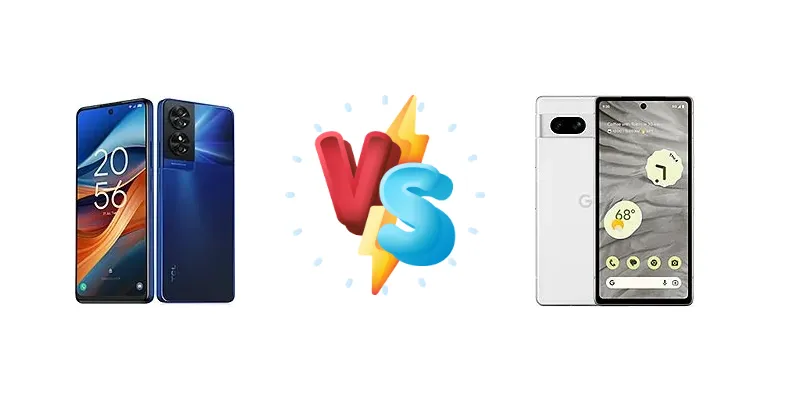
|
🏆 Quick Verdict
For most users, the Google Pixel 7a is the superior choice, offering a significantly better camera experience and smoother performance thanks to the Tensor G2 chipset. However, the TCL 50 SE provides compelling value for budget-conscious buyers who prioritize screen size and basic functionality over advanced features.
| PHONES | ||
|---|---|---|
| Phone Names | TCL 50 SE | Google Pixel 7a |
| Network | ||
|---|---|---|
| 2G bands | GSM 850 / 900 / 1800 / 1900 | GSM 850 / 900 / 1800 / 1900 |
| 3G bands | HSDPA 850 / 900 / 1700(AWS) / 1900 / 2100 | HSDPA 800 / 850 / 900 / 1700(AWS) / 1900 / 2100 |
| 4G bands | 1, 2, 3, 4, 5, 7, 8, 12, 13, 17, 20, 26, 28, 38, 40, 41, 66 | 1, 2, 3, 4, 5, 7, 8, 12, 13, 14, 17, 20, 25, 26, 28, 29, 30, 38, 40, 41, 48, 66, 71 - GWKK3, G0DZQ |
| 5G bands | - | 1, 2, 3, 5, 7, 8, 12, 14, 20, 25, 28, 30, 38, 41, 48, 66, 71, 77, 78 SA/NSA/Sub6 - GWKK3 |
| Speed | HSPA, LTE | HSPA, LTE, 5G |
| Technology | GSM / HSPA / LTE | GSM / HSPA / LTE / 5G |
| - | 1, 2, 3, 5, 7, 8, 12, 20, 25, 28, 38, 40, 41, 66, 75, 76, 77, 78, 79 SA/NSA/Sub6 - GHL1X, G82U8 | |
| Launch | ||
|---|---|---|
| Announced | 2024, February 26 | 2023, May 10 |
| Status | Available. Released 2024, April 08 | Available. Released 2023, May 10 |
| Body | ||
|---|---|---|
| Build | Glass front, plastic frame, plastic back | Glass front (Gorilla Glass 3), aluminum frame, plastic back |
| Dimensions | 168.2 x 75.5 x 8.1 mm (6.62 x 2.97 x 0.32 in) | 152 x 72.9 x 9 mm (5.98 x 2.87 x 0.35 in) |
| SIM | · Nano-SIM· Nano-SIM + Nano-SIM | Nano-SIM + eSIM |
| Weight | 195 g (6.88 oz) | 193.5 g (6.84 oz) |
| - | IP67 dust/water resistant (up to 1m for 30 min) | |
| Display | ||
|---|---|---|
| Protection | - | Corning Gorilla Glass 3 |
| Resolution | 1080 x 2460 pixels (~396 ppi density) | 1080 x 2400 pixels, 20:9 ratio (~429 ppi density) |
| Size | 6.78 inches, 109.2 cm2 (~86.0% screen-to-body ratio) | 6.1 inches, 90.7 cm2 (~81.8% screen-to-body ratio) |
| Type | IPS LCD, 90Hz, 550 nits (typ) | OLED, HDR, 90Hz |
| - | Always-on display | |
| Platform | ||
|---|---|---|
| CPU | Octa-core (2x2.0 GHz Cortex-A75 & 6x1.8 GHz Cortex-A55) | Octa-core (2x2.85 GHz Cortex-X1 & 2x2.35 GHz Cortex-A78 & 4x1.80 GHz Cortex-A55) |
| Chipset | Mediatek Helio G88 (12 nm) | Google Tensor G2 (5 nm) |
| GPU | Mali-G52 MC2 | Mali-G710 MP7 |
| OS | Android 14, planned upgrade to Android 15 | Android 13, upgradable to Android 15, up to 5 major Android upgrades |
| Memory | ||
|---|---|---|
| Card slot | microSDXC (dedicated slot) | No |
| Internal | 128GB 4GB RAM, 256GB 6GB RAM | 128GB 8GB RAM |
| - | UFS 3.1 | |
| Main Camera | ||
|---|---|---|
| Dual | 50 MP, f/1.8, (wide), 1/2.76", 0.64µm, PDAF 2 MP (macro) | 64 MP, f/1.9, 26mm (wide), 1/1.73", 0.8µm, dual pixel PDAF, OIS 13 MP, f/2.2, 120˚ (ultrawide), 1.12µm |
| Features | LED flash, HDR, panorama | Dual-LED flash, Pixel Shift, Auto-HDR, panorama |
| Video | 1080p@30fps | 4K@30/60fps, 1080p@30/60/120/240fps, OIS |
| Selfie camera | ||
|---|---|---|
| Features | HDR | HDR, panorama |
| Single | 8 MP, f/2.0, (wide), 1/4.0", 1.12µm | 13 MP, f/2.2, 20mm (ultrawide), 1.12µm |
| Video | 1080p@30fps | 4K@30fps, 1080p@30fps |
| Sound | ||
|---|---|---|
| 3.5mm jack | - | No |
| 35mm jack | Yes | No |
| Loudspeaker | Yes, with stereo speakers | Yes, with stereo speakers |
| Comms | ||
|---|---|---|
| Bluetooth | 5.1, A2DP, LE | 5.3, A2DP, LE |
| NFC | Yes (market/region dependent) | Yes |
| Positioning | GPS, GLONASS, GALILEO, BDS | GPS, GLONASS, GALILEO, BDS, QZSS, NavIC |
| Radio | Unspecified | No |
| USB | USB Type-C 2.0 | USB Type-C 3.2 |
| WLAN | Wi-Fi 802.11 a/b/g/n/ac, dual-band, Wi-Fi Direct | Wi-Fi 802.11 a/b/g/n/ac/6e, tri-band |
| Features | ||
|---|---|---|
| Sensors | Fingerprint (side-mounted), accelerometer, proximity, compass | Fingerprint (under display, optical), accelerometer, gyro, proximity, compass, barometer |
| Battery | ||
|---|---|---|
| Charging | 33W wired, 50% in 30 min | 18W wired, PD3.0 7.5W wireless |
| Type | 5010 mAh | Li-Po 4385 mAh |
| Misc | ||
|---|---|---|
| Colors | Midnight Blue, Space Gray | Charcoal, Snow, Sea, Coral |
| Models | T611B | GWKK3, GHL1X, G0DZQ, G82U8 |
| Price | About 150 EUR | € 179.90 / $ 150.00 / £ 170.00 / ₹ 25,980 |
TCL 50 SE
- Excellent camera performance with Google’s computational photography.
- Powerful Google Tensor G2 chipset for smooth performance.
- Bright and vibrant display with high peak brightness.
- Guaranteed software updates and long-term support.
- Slower charging speed compared to TCL 50 SE.
- Higher price point than the TCL 50 SE.
Google Pixel 7a
- Very affordable price point.
- Fast 33W wired charging.
- Large display size for immersive media consumption.
- Potentially larger battery capacity (unconfirmed).
- Significantly less powerful processor.
- Inferior camera performance.
- Limited software updates and support.
Display Comparison
The TCL 50 SE lacks specific display details beyond its size, but typically employs an IPS LCD panel common in its price bracket. Conversely, the Google Pixel 7a boasts a significantly brighter display, reaching a measured peak of 1070 nits. This higher brightness translates to improved visibility in direct sunlight. While the TCL 50 SE likely offers a larger viewing area due to its size, the Pixel 7a’s superior brightness and likely better color accuracy provide a more enjoyable visual experience. The Pixel 7a’s display technology is also likely to have a higher contrast ratio, enhancing image depth.
Camera Comparison
The Pixel 7a’s camera system is its standout feature. While specific sensor details are missing for the TCL 50 SE, it’s reasonable to expect a more basic setup. The Pixel 7a leverages Google’s renowned computational photography algorithms, delivering exceptional image quality, particularly in challenging lighting conditions. The Tensor G2’s image signal processor (ISP) plays a crucial role in this, enabling features like Super Res Zoom and Magic Eraser. The Pixel 7a’s video capabilities are also likely superior, benefiting from the Tensor G2’s processing power and advanced video codecs. Ignoring the likely presence of low-resolution auxiliary cameras on the TCL 50 SE, the Pixel 7a’s focus on a high-quality main sensor and intelligent software processing provides a far more compelling photographic experience.
Performance
The core difference lies in the chipsets: the TCL 50 SE utilizes the Mediatek Helio G88, a 12nm processor, while the Pixel 7a is powered by Google’s 5nm Tensor G2. This process node difference is critical; 5nm allows for greater transistor density, resulting in improved performance and significantly better power efficiency. The Pixel 7a’s CPU configuration – 2x2.85 GHz Cortex-X1, 2x2.35 GHz Cortex-A78, and 4x1.80 GHz Cortex-A55 – is demonstrably more powerful than the TCL 50 SE’s 2x2.0 GHz Cortex-A75 & 6x1.8 GHz Cortex-A55. This translates to faster app loading times, smoother multitasking, and a more responsive user interface on the Pixel 7a. The Tensor G2 also includes a dedicated TPU for AI tasks, enhancing features like voice recognition and image processing.
Battery Life
The Pixel 7a has an endurance rating of 76 hours, suggesting efficient power management despite its powerful processor. The TCL 50 SE offers 33W wired charging, claiming 50% charge in 30 minutes. The Pixel 7a, with 18W wired charging and 7.5W wireless charging, is slower to charge. However, the Tensor G2’s 5nm efficiency and Google’s software optimizations likely contribute to comparable real-world battery life, despite the TCL 50 SE potentially having a larger battery capacity (unspecified). The Pixel 7a also supports PD3.0, offering more versatile charging options.
Buying Guide
Buy the TCL 50 SE if you need a large screen for media consumption and prioritize affordability above all else, accepting compromises in processing power and camera quality. Buy the Google Pixel 7a if you value a top-tier camera experience, responsive performance for everyday tasks and occasional gaming, and benefit from Google’s software features and long-term support.