
TCL 50 Pro NxtPaper vs. Xiaomi Redmi Note 12 Pro+: A Deep Dive
| Phones Images | |||||
|---|---|---|---|---|---|
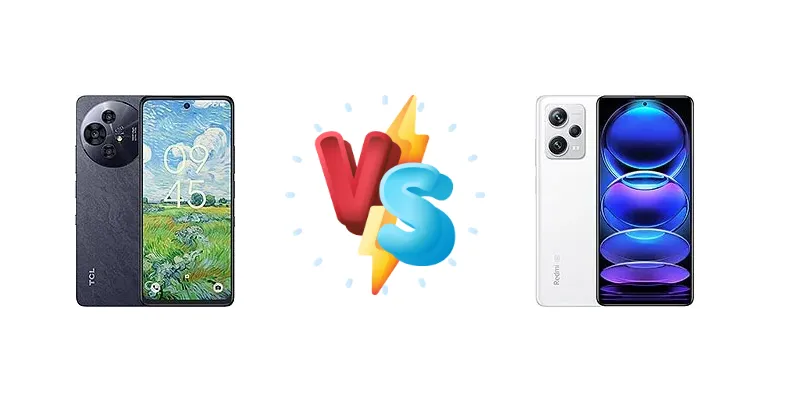
|
🏆 Quick Verdict
For the average user prioritizing longevity and a comfortable reading experience, the TCL 50 Pro NxtPaper is the better choice. Its exceptional 44:33h endurance significantly outweighs the Xiaomi's performance advantage. However, users demanding rapid charging and more demanding gaming will find the Redmi Note 12 Pro+ more appealing.
| PHONES | ||
|---|---|---|
| Phone Names | TCL 50 Pro NxtPaper | Xiaomi Redmi Note 12 Pro+ |
| Network | ||
|---|---|---|
| 2G bands | GSM 850 / 900 / 1800 / 1900 | GSM 850 / 900 / 1800 / 1900 - SIM 1 & SIM 2 |
| 3G bands | HSDPA 850 / 900 / 1700(AWS) / 1900 / 2100 | HSDPA 800 / 850 / 900 / 1900 / 2100 |
| 4G bands | 1, 2, 3, 4, 5, 7, 8, 12, 13, 17, 20, 25, 26, 28, 38, 40, 41, 42, 48, 66 - T803E | 1, 3, 5, 8, 19, 34, 38, 39, 40, 41 - International, China |
| 5G bands | 1, 3, 5, 7, 8, 20, 26, 28, 38, 40, 41, 48, 77, 78 SA/NSA - T803D | 1, 3, 5, 8, 28, 38, 40, 41, 77, 78 SA/NSA - International |
| Speed | HSPA, LTE, 5G | HSPA, LTE-A (CA), 5G |
| Technology | GSM / HSPA / LTE / 5G | GSM / CDMA / HSPA / EVDO / LTE / 5G |
| - | 1, 3, 5, 8, 28, 38, 41, 77, 78 SA/NSA - China | |
| Launch | ||
|---|---|---|
| Announced | 2024, September 04 | 2022, October 27 |
| Status | Available. Released 2024, September | Available. Released 2022, November 01 |
| Body | ||
|---|---|---|
| Build | - | Glass front (Gorilla Glass 5), glass back |
| Dimensions | 167.6 x 75.5 x 8 mm (6.60 x 2.97 x 0.31 in) | 162.9 x 76 x 8.9 mm (6.41 x 2.99 x 0.35 in) |
| SIM | · Nano-SIM + eSIM· Nano-SIM + Nano-SIM | Dual SIM (Nano-SIM, dual stand-by) |
| Weight | 196 g (6.91 oz) | 208.4 g (7.34 oz) |
| - | IP53, dust and splash resistant | |
| Display | ||
|---|---|---|
| Protection | Mohs level 7 | Corning Gorilla Glass 5 |
| Resolution | 1080 x 2460 pixels (~395 ppi density) | 1080 x 2400 pixels, 20:9 ratio (~395 ppi density) |
| Size | 6.8 inches, 109.8 cm2 (~86.8% screen-to-body ratio) | 6.67 inches, 107.4 cm2 (~86.8% screen-to-body ratio) |
| Type | IPS LCD, 120Hz | OLED, 1B colors, 120Hz, Dolby Vision, HDR10+, 500 nits (typ), 900 nits (HBM) |
| Platform | ||
|---|---|---|
| CPU | Octa-core (2x2.4 GHz Cortex-A76 & 6x2.0 GHz Cortex-A55) | Octa-core (2x2.6 GHz Cortex-A78 & 6x2.0 GHz Cortex-A55) |
| Chipset | Mediatek Dimensity 6300 (6 nm) | Mediatek MT6877V Dimensity 1080 (6 nm) |
| GPU | Mali-G57 MC2 | Mali-G68 MC4 |
| OS | Android 14, up to 2 major Android upgrades | Android 12, MIUI 13 |
| Memory | ||
|---|---|---|
| Card slot | microSDXC (uses shared SIM slot) | No |
| Internal | 512GB 8GB RAM | 256GB 8GB RAM, 256GB 12GB RAM |
| - | UFS 2.2 | |
| Main Camera | ||
|---|---|---|
| Features | LED flash, HDR | Dual-LED dual-tone flash, HDR, panorama |
| Triple | 108 MP, f/1.8, (wide), 1/1.67", 0.64µm, PDAF 8 MP, f/2.2, 120˚ (ultrawide), 1/4.0", 1.12µm 2 MP (macro) | 200 MP, f/1.7, 24mm (wide), 1/1.4", 0.56µm, PDAF, OIS 8 MP, f/2.2, 120˚ (ultrawide), 1/4", 1.12µm 2 MP, f/2.4, (macro) |
| Video | 1080p@30fps | 4K@30fps, 1080p@30/60/120fps, 720p@960fps |
| Selfie camera | ||
|---|---|---|
| Features | HDR | HDR |
| Single | 32 MP, f/2.0, (wide), 1/3.45", 0.64µm | 16 MP, f/2.5, (wide), 1/3.06", 1.0µm |
| Video | 1080p@30fps | 1080p@30/60fps |
| Sound | ||
|---|---|---|
| 3.5mm jack | - | Yes |
| 35mm jack | Yes | - |
| Loudspeaker | Yes, with stereo speakers | Yes, with stereo speakers |
| - | 24-bit/192kHz audio | |
| Comms | ||
|---|---|---|
| Bluetooth | 5.3, A2DP, LE | 5.2, A2DP, LE |
| Infrared port | - | Yes |
| NFC | Yes | Yes (market/region dependent) |
| Positioning | GPS, GLONASS, BDS, GALILEO | GPS (L1), GLONASS (G1), BDS (B1I+B1c), GALILEO (E1), QZSS (L1) |
| Radio | Unspecified | No |
| USB | USB Type-C 2.0 | USB Type-C 2.0, OTG |
| WLAN | Wi-Fi 802.11 a/b/g/n/ac, dual-band, Wi-Fi Direct | Wi-Fi 802.11 a/b/g/n/ac/6, dual-band, Wi-Fi Direct |
| Features | ||
|---|---|---|
| Sensors | Fingerprint (side-mounted), gyro, accelerometer, proximity, compass, barometer (T803D only) | Fingerprint (side-mounted), accelerometer, proximity, gyro, compass |
| Battery | ||
|---|---|---|
| Charging | 33W wired | 120W wired, PD3.0, 100% in 19 min (advertised) |
| Type | 5010 mAh | Li-Po 5000 mAh, non-removable |
| Misc | ||
|---|---|---|
| Colors | Moon Gray, Midnight Blue, Alps White, Pale Gold, Rosy Purple | Arctic White, Iceberg Blue, Obsidian Black, Trend edition |
| Models | T803E, T803D | 22101316UCP, 22101316UG |
| Price | About 300 EUR | $ 348.00 / £ 439.00 / € 399.00 / ₹ 29,949 |
| Tests | ||
|---|---|---|
| Battery life | - | Endurance rating 88h |
| Camera | - | Photo / Video |
| Display | - | Contrast ratio: Infinite (nominal) |
| Loudspeaker | - | -26.7 LUFS (Good) |
| Performance | - | AnTuTu: 498710 (v9) GeekBench: 2208 (v5.1), 2372 (v6) GFXBench: 22fps (ES 3.1 onscreen) |
| EU LABEL | ||
|---|---|---|
| Battery | 44:33h endurance, 1000 cycles | - |
| Energy | Class B | - |
| Free fall | Class B (180 falls) | - |
| Repairability | Class B | - |
TCL 50 Pro NxtPaper
- Exceptional battery life (44:33h endurance)
- Unique NxtPaper display for comfortable reading
- Long-term battery health with 1000 charge cycles
- Potentially slower performance compared to the Xiaomi
- Slower charging speed (33W)
Xiaomi Redmi Note 12 Pro+
- Faster processor (Dimensity 1080)
- Ultra-fast 120W charging (19 min to 100%)
- Likely more versatile camera system
- Significantly shorter battery life (88h endurance)
- Potentially faster battery degradation
Display Comparison
The TCL 50 Pro NxtPaper’s defining feature is its NxtPaper display, designed to mimic the texture of paper for reduced eye strain. While the context data lacks specific brightness figures, the focus on paper-like qualities suggests a matte finish, potentially sacrificing peak brightness compared to the Xiaomi Redmi Note 12 Pro+. The Xiaomi boasts an 'Infinite' (nominal) contrast ratio, indicating a typical AMOLED panel known for vibrant colors and deep blacks. The absence of refresh rate data for the TCL suggests a standard 60Hz panel, while the Xiaomi’s chipset suggests it could support a higher refresh rate, though this isn’t confirmed. Bezels are not specified, but the Xiaomi, being positioned as a more premium device, likely features slimmer bezels.
Camera Comparison
The Xiaomi Redmi Note 12 Pro+ is expected to have a more sophisticated camera system, though specific details are lacking. The context data only mentions 'Photo / Video' capabilities. Given Xiaomi’s history, it likely features a high-resolution main sensor (potentially 200MP, as advertised in some markets) with Optical Image Stabilization (OIS). The TCL’s camera specifications are entirely absent, suggesting a more basic setup. While the Xiaomi may include multiple lenses, including an ultra-wide and macro, the TCL likely focuses on a simpler dual-camera configuration. Image processing algorithms will also differ, with Xiaomi typically favoring vibrant, saturated colors, while TCL may aim for a more natural look.
Performance
The Xiaomi Redmi Note 12 Pro+ clearly holds a performance advantage with its Mediatek Dimensity 1080 chipset. Its octa-core CPU, featuring 2x2.6 GHz Cortex-A78 cores, outperforms the TCL’s Dimensity 6300, which utilizes 2x2.4 GHz Cortex-A76 cores. The A78 cores are architecturally superior, offering better single-core performance. Both chipsets are fabricated on a 6nm process, suggesting similar efficiency, but the Xiaomi’s more powerful CPU will translate to faster app loading times and smoother multitasking. RAM specifications are missing, but the Xiaomi, being the higher-tier device, likely benefits from faster LPDDR5x RAM, further enhancing performance. Thermal management is unknown for both, but the Xiaomi’s more powerful chipset will require more robust cooling.
Battery Life
Battery life is where the TCL 50 Pro NxtPaper truly shines. Its impressive 44:33h endurance rating dwarfs the Xiaomi Redmi Note 12 Pro+'s 88h rating. This suggests the TCL’s power efficiency, combined with a potentially larger battery capacity (not specified), allows for significantly longer usage between charges. However, the Xiaomi compensates with its incredibly fast 120W wired charging, capable of reaching 100% in just 19 minutes (advertised). The TCL’s 33W charging is considerably slower. The TCL also boasts a 1000 charge cycle lifespan, indicating a focus on long-term battery health, while the Xiaomi’s battery degradation over time is not specified.
Buying Guide
Buy the TCL 50 Pro NxtPaper if you need a phone that lasts for days on a single charge, value a comfortable, eye-friendly display for reading, and prioritize battery health with its 1000 charge cycle rating. Buy the Xiaomi Redmi Note 12 Pro+ if you prefer a phone that can fully recharge in under 20 minutes, require more processing power for gaming or demanding apps, and want a potentially more versatile camera system.