
TCL 50 Pro NxtPaper vs. Nothing Phone (2): A Detailed Comparison of Battery Life and Performance
| Phones Images | |||||
|---|---|---|---|---|---|
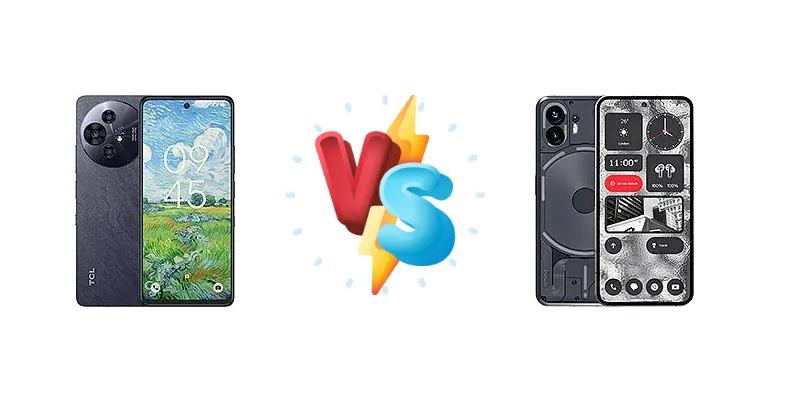
|
🏆 Quick Verdict
For the average user prioritizing longevity and value, the TCL 50 Pro NxtPaper emerges as the winner. Its remarkable 44:33h battery endurance significantly outpaces the Nothing Phone (2)'s 14:21h active use score. However, users demanding raw performance and a premium experience will find the Nothing Phone (2) a more compelling choice.
| PHONES | ||
|---|---|---|
| Phone Names | TCL 50 Pro NxtPaper | Nothing Phone (2) |
| Network | ||
|---|---|---|
| 2G bands | GSM 850 / 900 / 1800 / 1900 | GSM 850 / 900 / 1800 / 1900 |
| 3G bands | HSDPA 850 / 900 / 1700(AWS) / 1900 / 2100 | HSDPA 800 / 850 / 900 / 1700(AWS) / 1900 / 2100 |
| 4G bands | 1, 2, 3, 4, 5, 7, 8, 12, 13, 17, 20, 25, 26, 28, 38, 40, 41, 42, 48, 66 - T803E | 1, 2, 3, 4, 5, 7, 8, 12, 17, 18, 19, 20, 25, 26, 28, 30, 32, 34, 38, 39, 40, 41, 42, 48, 66, 71 |
| 5G bands | 1, 3, 5, 7, 8, 20, 26, 28, 38, 40, 41, 48, 77, 78 SA/NSA - T803D | 1, 2, 3, 5, 7, 8, 12, 20, 25, 28, 30, 38, 40, 41, 66, 71, 75, 77, 78 SA/NSA |
| Speed | HSPA, LTE, 5G | HSPA, LTE, 5G |
| Technology | GSM / HSPA / LTE / 5G | GSM / HSPA / LTE / 5G |
| Launch | ||
|---|---|---|
| Announced | 2024, September 04 | 2023, July 11 |
| Status | Available. Released 2024, September | Available. Released 2023, July 17 |
| Body | ||
|---|---|---|
| Build | - | Glass front (Gorilla Glass 5), glass back (Gorilla Glass 5), aluminum frame |
| Dimensions | 167.6 x 75.5 x 8 mm (6.60 x 2.97 x 0.31 in) | 162.1 x 76.4 x 8.6 mm (6.38 x 3.01 x 0.34 in) |
| SIM | · Nano-SIM + eSIM· Nano-SIM + Nano-SIM | Nano-SIM + Nano-SIM |
| Weight | 196 g (6.91 oz) | 201.2 g (7.09 oz) |
| Display | ||
|---|---|---|
| Protection | Mohs level 7 | Corning Gorilla Glass 5 |
| Resolution | 1080 x 2460 pixels (~395 ppi density) | 1080 x 2412 pixels, 20:9 ratio (~394 ppi density) |
| Size | 6.8 inches, 109.8 cm2 (~86.8% screen-to-body ratio) | 6.7 inches, 108.0 cm2 (~87.2% screen-to-body ratio) |
| Type | IPS LCD, 120Hz | LTPO OLED, 1B colors, 120Hz, 1920Hz PWM, HDR10+, 1600 nits (HBM), 1600 nits (peak) |
| Platform | ||
|---|---|---|
| CPU | Octa-core (2x2.4 GHz Cortex-A76 & 6x2.0 GHz Cortex-A55) | Octa-core (1x3.0 GHz Cortex-X2 & 3x2.5 GHz Cortex-A710 & 4x1.80 GHz Cortex-A510) |
| Chipset | Mediatek Dimensity 6300 (6 nm) | Qualcomm SM8475 Snapdragon 8+ Gen 1 (4 nm) |
| GPU | Mali-G57 MC2 | Adreno 730 |
| OS | Android 14, up to 2 major Android upgrades | Android 13, upgradable to Android 15, up to 3 major Android upgrades, Nothing OS 3.0 |
| Memory | ||
|---|---|---|
| Card slot | microSDXC (uses shared SIM slot) | No |
| Internal | 512GB 8GB RAM | 128GB 8GB RAM, 256GB 12GB RAM, 512GB 12GB RAM |
| Main Camera | ||
|---|---|---|
| Dual | - | 50 MP, f/1.9, 24mm (wide), 1/1.56", 1.0µm, PDAF, OIS 50 MP, f/2.2, 114˚ (ultrawide), 1/2.76", 0.64µm, AF |
| Features | LED flash, HDR | LED flash, panorama, HDR |
| Triple | 108 MP, f/1.8, (wide), 1/1.67", 0.64µm, PDAF 8 MP, f/2.2, 120˚ (ultrawide), 1/4.0", 1.12µm 2 MP (macro) | - |
| Video | 1080p@30fps | 4K@30/60fps, 1080p@30/60fps, gyro-EIS, live HDR, OIS |
| Selfie camera | ||
|---|---|---|
| Features | HDR | HDR |
| Single | 32 MP, f/2.0, (wide), 1/3.45", 0.64µm | 32 MP, f/2.5, (wide), 1/2.74", 0.8µm |
| Video | 1080p@30fps | 1080p@30fps |
| Sound | ||
|---|---|---|
| 35mm jack | Yes | No |
| Loudspeaker | Yes, with stereo speakers | Yes, with stereo speakers |
| Comms | ||
|---|---|---|
| Bluetooth | 5.3, A2DP, LE | 5.3, A2DP, LE, aptX HD, aptX Adaptive |
| NFC | Yes | Yes |
| Positioning | GPS, GLONASS, BDS, GALILEO | GPS (L1+L5), GLONASS (L1), BDS (B1I+B1c), GALILEO (E1), QZSS (L1), NavIC |
| Radio | Unspecified | No |
| USB | USB Type-C 2.0 | USB Type-C 2.0, OTG |
| WLAN | Wi-Fi 802.11 a/b/g/n/ac, dual-band, Wi-Fi Direct | Wi-Fi 802.11 a/b/g/n/ac/6, dual-band, Wi-Fi Direct |
| Features | ||
|---|---|---|
| Sensors | Fingerprint (side-mounted), gyro, accelerometer, proximity, compass, barometer (T803D only) | Fingerprint (under display, optical), accelerometer, proximity, gyro, compass |
| Battery | ||
|---|---|---|
| Charging | 33W wired | 45W wired, PD3.0, PPS, QC4, 100% in 55 min 15W wireless, 100% in 130 min 5W reverse wireless |
| Type | 5010 mAh | Li-Ion 4700 mAh |
| Misc | ||
|---|---|---|
| Colors | Moon Gray, Midnight Blue, Alps White, Pale Gold, Rosy Purple | White, Dark Gray |
| Models | T803E, T803D | A065 |
| Price | About 300 EUR | $ 379.99 / £ 370.00 |
| EU LABEL | ||
|---|---|---|
| Battery | 44:33h endurance, 1000 cycles | - |
| Energy | Class B | - |
| Free fall | Class B (180 falls) | - |
| Repairability | Class B | - |
TCL 50 Pro NxtPaper
- Exceptional battery life (44:33h endurance)
- Unique NxtPaper display for reduced eye strain
- Potentially excellent value for money
- Less powerful processor compared to the Nothing Phone (2)
- Camera specifications are unknown, potentially lagging behind
Nothing Phone (2)
- Flagship-level performance with Snapdragon 8+ Gen 1
- Bright and vibrant display (998 nits)
- Fast 45W wired and 15W wireless charging
- Significantly shorter battery life (14:21h active use)
- Higher price point compared to the TCL 50 Pro NxtPaper
Display Comparison
The Nothing Phone (2) boasts a brighter display, peaking at 998 nits, offering superior visibility in direct sunlight. While the TCL 50 Pro NxtPaper’s display specs are not provided, its ‘NxtPaper’ technology focuses on a matte, paper-like texture designed to reduce eye strain. This is a key differentiator, potentially benefiting users who spend extended periods reading or consuming content. The Nothing Phone (2)'s higher brightness is advantageous for outdoor use, but the TCL's NxtPaper tech addresses a different, equally important aspect of display quality – comfort.
Camera Comparison
The context data for the TCL 50 Pro NxtPaper lacks specific camera details, making a direct comparison challenging. However, the Nothing Phone (2) is known for its capable dual-camera system, focusing on both photo and video quality. The Snapdragon 8+ Gen 1’s image signal processor (ISP) provides advanced image processing capabilities. Without knowing the sensor sizes or apertures of the TCL’s camera, it’s difficult to assess its performance, but the Nothing Phone (2) likely holds an advantage in image quality and features, particularly in low-light conditions.
Performance
The Nothing Phone (2) is equipped with the Qualcomm Snapdragon 8+ Gen 1 (4nm), a significantly more powerful chipset than the TCL 50 Pro NxtPaper’s MediaTek Dimensity 6300 (6nm). The Snapdragon 8+ Gen 1’s octa-core CPU, featuring a Cortex-X2 prime core clocked at 3.0 GHz, delivers substantially faster processing speeds for gaming, multitasking, and demanding applications. The Dimensity 6300, while efficient, is geared towards everyday tasks. The 4nm process node of the Snapdragon 8+ Gen 1 also contributes to better thermal efficiency, reducing the likelihood of performance throttling under sustained load. This translates to a smoother, more consistent experience for power users on the Nothing Phone (2).
Battery Life
The TCL 50 Pro NxtPaper’s standout feature is its exceptional battery endurance, achieving 44:33h in testing, and a claimed 1000 charge cycles. This is a massive advantage over the Nothing Phone (2)'s 14:21h active use score and older 103h endurance rating. While the Nothing Phone (2) offers faster charging at 45W (with PD3.0, PPS, and QC4 support, reaching 100% in 55 minutes) and even 15W wireless charging, the TCL’s longevity minimizes the need for frequent top-ups. The Nothing Phone (2)'s charging versatility is a plus, but the TCL’s sheer battery capacity is a game-changer for users who prioritize minimizing charging frequency.
Buying Guide
Buy the TCL 50 Pro NxtPaper if you need a phone that can reliably last through multiple days of moderate use, appreciate a unique, eye-friendly display, and prioritize value for money. Buy the Nothing Phone (2) if you prefer a faster, more responsive experience for demanding tasks like gaming and video editing, value a sleek design and refined software experience, and are willing to compromise on battery life for performance.