
TCL 50 Pro NxtPaper vs. Motorola Edge 40 Neo: A Deep Dive into Battery, Performance, and Value
| Phones Images | |||||
|---|---|---|---|---|---|
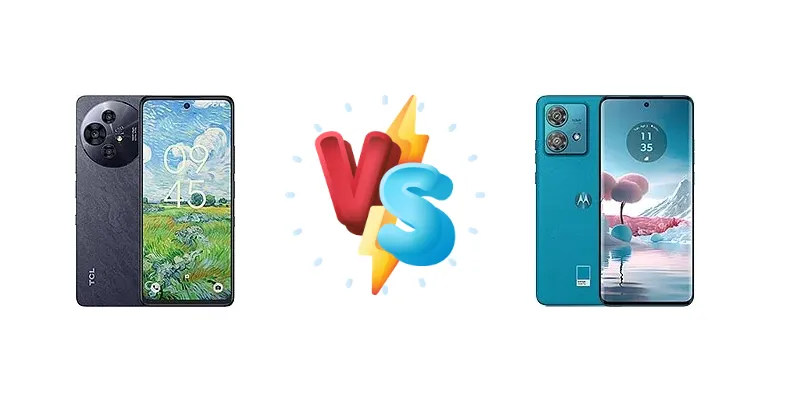
|
🏆 Quick Verdict
For the average user prioritizing all-day (and then some) battery life, the TCL 50 Pro NxtPaper is the clear winner. Its impressive 44:33h endurance rating significantly outpaces the Motorola Edge 40 Neo’s active use score of 10:28h. However, if rapid charging and a brighter screen are paramount, the Motorola Edge 40 Neo offers a compelling alternative.
| PHONES | ||
|---|---|---|
| Phone Names | TCL 50 Pro NxtPaper | Motorola Edge 40 Neo |
| Network | ||
|---|---|---|
| 2G bands | GSM 850 / 900 / 1800 / 1900 | GSM 850 / 900 / 1800 / 1900 |
| 3G bands | HSDPA 850 / 900 / 1700(AWS) / 1900 / 2100 | HSDPA 800 / 850 / 900 / 1700(AWS) / 1900 / 2100 |
| 4G bands | 1, 2, 3, 4, 5, 7, 8, 12, 13, 17, 20, 25, 26, 28, 38, 40, 41, 42, 48, 66 - T803E | 1, 2, 3, 4, 5, 7, 8, 12, 13, 17, 18, 19, 20, 25, 26, 28, 32, 38, 38, 39, 40, 41, 42, 43, 48, 66 |
| 5G bands | 1, 3, 5, 7, 8, 20, 26, 28, 38, 40, 41, 48, 77, 78 SA/NSA - T803D | 1, 2, 3, 5, 7, 8, 20, 28, 38, 40, 41, 66, 77, 78 SA/NSA |
| Speed | HSPA, LTE, 5G | HSPA, LTE, 5G |
| Technology | GSM / HSPA / LTE / 5G | GSM / HSPA / LTE / 5G |
| Launch | ||
|---|---|---|
| Announced | 2024, September 04 | 2023, September 14 |
| Status | Available. Released 2024, September | Available. Released 2023, September 14 |
| Body | ||
|---|---|---|
| Build | - | Glass front (Gorilla Glass 3), plastic frame, plastic back |
| Dimensions | 167.6 x 75.5 x 8 mm (6.60 x 2.97 x 0.31 in) | 159.6 x 72 x 7.9 mm (6.28 x 2.83 x 0.31 in) |
| SIM | · Nano-SIM + eSIM· Nano-SIM + Nano-SIM | · Nano-SIM + eSIM· Nano-SIM + Nano-SIM |
| Weight | 196 g (6.91 oz) | 170 g or 172 g (6.00 oz) |
| Display | ||
|---|---|---|
| Protection | Mohs level 7 | Corning Gorilla Glass 3 |
| Resolution | 1080 x 2460 pixels (~395 ppi density) | 1080 x 2400 pixels, 20:9 ratio (~402 ppi density) |
| Size | 6.8 inches, 109.8 cm2 (~86.8% screen-to-body ratio) | 6.55 inches, 103.6 cm2 (~90.1% screen-to-body ratio) |
| Type | IPS LCD, 120Hz | P-OLED, 1B colors, 144Hz, HDR10+, 1300 nits (peak) |
| Platform | ||
|---|---|---|
| CPU | Octa-core (2x2.4 GHz Cortex-A76 & 6x2.0 GHz Cortex-A55) | Octa-core (2x2.5 GHz Cortex-A78 & 6x2.0 GHz Cortex-A55) |
| Chipset | Mediatek Dimensity 6300 (6 nm) | MediaTek Dimensity 7030 (6 nm) |
| GPU | Mali-G57 MC2 | Mali-G610 MC3 |
| OS | Android 14, up to 2 major Android upgrades | Android 13, up to 2 major Android upgrades |
| Memory | ||
|---|---|---|
| Card slot | microSDXC (uses shared SIM slot) | No |
| Internal | 512GB 8GB RAM | 128GB 8GB RAM, 256GB 8GB RAM, 256GB 12GB RAM |
| Main Camera | ||
|---|---|---|
| Dual | - | 50 MP, f/1.8, (wide), 1/1.55", 1.0µm, multi-directional PDAF, OIS 13 MP, f/2.2, 120˚ (ultrawide), 1/3.0", 1.12µm, PDAF |
| Features | LED flash, HDR | LED flash, HDR, panorama |
| Triple | 108 MP, f/1.8, (wide), 1/1.67", 0.64µm, PDAF 8 MP, f/2.2, 120˚ (ultrawide), 1/4.0", 1.12µm 2 MP (macro) | - |
| Video | 1080p@30fps | 4K@30fps, 1080p@30/60/120/240fps, gyro-EIS |
| Selfie camera | ||
|---|---|---|
| Features | HDR | HDR |
| Single | 32 MP, f/2.0, (wide), 1/3.45", 0.64µm | 32 MP, f/2.4, (wide), 1/3.0", 0.7µm |
| Video | 1080p@30fps | 4K@30fps, 1080p@30fps |
| Sound | ||
|---|---|---|
| 35mm jack | Yes | No |
| Loudspeaker | Yes, with stereo speakers | Yes, with stereo speakers |
| Comms | ||
|---|---|---|
| Bluetooth | 5.3, A2DP, LE | 5.4, A2DP, LE |
| NFC | Yes | Yes |
| Positioning | GPS, GLONASS, BDS, GALILEO | GPS, GLONASS, GALILEO |
| Radio | Unspecified | No |
| USB | USB Type-C 2.0 | USB Type-C 2.0, OTG |
| WLAN | Wi-Fi 802.11 a/b/g/n/ac, dual-band, Wi-Fi Direct | Wi-Fi 802.11 a/b/g/n/ac/6e, tri-band, Wi-Fi Direct |
| Features | ||
|---|---|---|
| Sensors | Fingerprint (side-mounted), gyro, accelerometer, proximity, compass, barometer (T803D only) | Fingerprint (under display, optical), accelerometer, gyro, proximity, compass |
| Battery | ||
|---|---|---|
| Charging | 33W wired | 68W wired, 50% in 15 min |
| Type | 5010 mAh | Li-Po 5000 mAh |
| Misc | ||
|---|---|---|
| Colors | Moon Gray, Midnight Blue, Alps White, Pale Gold, Rosy Purple | Black, Soothing Sea, Caneel Bay, Peach Fuzz |
| Models | T803E, T803D | XT2307-1 |
| Price | About 300 EUR | $ 299.00 / € 168.73 / ₹ 19,900 |
| EU LABEL | ||
|---|---|---|
| Battery | 44:33h endurance, 1000 cycles | - |
| Energy | Class B | - |
| Free fall | Class B (180 falls) | - |
| Repairability | Class B | - |
TCL 50 Pro NxtPaper
- Exceptional battery life (44:33h endurance)
- NxtPaper display reduces eye strain
- 1000 charge cycles promise long-term reliability
- Slower charging speed (33W)
- Display likely less bright than the competition
Motorola Edge 40 Neo
- Very fast 68W charging (50% in 15 min)
- Bright 1073 nit display for outdoor visibility
- Slightly more powerful CPU (Dimensity 7030)
- Significantly shorter battery life (10:28h active use)
- May require more frequent charging
Display Comparison
The Motorola Edge 40 Neo boasts a significantly brighter display, reaching a measured peak of 1073 nits. This is a substantial advantage for outdoor visibility. While the TCL 50 Pro NxtPaper’s brightness isn’t specified, its NxtPaper technology focuses on mimicking the texture of paper, reducing glare and blue light – a benefit for prolonged reading. The NxtPaper display is likely to have a lower peak brightness, but excels in eye comfort. Bezels are not specified for either device, but the focus is clearly on different display priorities: brightness and vibrancy versus eye strain reduction.
Camera Comparison
Camera details are limited, but the Motorola Edge 40 Neo is marketed with a focus on photo and video capabilities. Without specific sensor sizes or aperture information, it’s difficult to make a direct comparison. The TCL 50 Pro NxtPaper’s camera specs are not detailed, making it hard to assess its imaging performance. It’s safe to assume the Motorola will offer more versatile camera features, while the TCL may prioritize simplicity and ease of use. We can safely ignore any mention of 2MP macro lenses on either device, as their utility is limited.
Performance
Both phones utilize 6nm MediaTek Dimensity chipsets, but the Motorola Edge 40 Neo’s Dimensity 7030, with its 2x2.5 GHz Cortex-A78 cores, offers a slight CPU performance edge over the TCL 50 Pro NxtPaper’s Dimensity 6300 (2x2.4 GHz Cortex-A76). This translates to marginally faster app loading and smoother multitasking. However, the real-world difference will likely be minimal for most users. Both devices share the same Cortex-A55 efficiency cores, suggesting similar power efficiency during less demanding tasks. RAM configurations are not specified, but LPDDR5x would be expected in this price bracket for both.
Battery Life
The TCL 50 Pro NxtPaper’s standout feature is its exceptional battery endurance, rated at 44:33h. This is a remarkable figure, suggesting it can easily last two full days on a single charge. The Motorola Edge 40 Neo, with an active use score of 10:28h and an older endurance rating of 80h, falls significantly short. However, the Motorola compensates with 68W wired charging, capable of reaching 50% charge in just 15 minutes. The TCL’s 33W charging is considerably slower. This creates a clear trade-off: longevity versus convenience.
Buying Guide
Buy the TCL 50 Pro NxtPaper if you need a phone that can reliably last through two full days of moderate use, and value a display designed for extended reading and reduced eye strain. Buy the Motorola Edge 40 Neo if you prefer a brighter, more vibrant display for media consumption and prioritize the convenience of extremely fast 68W charging, even if it means more frequent top-ups.