
TCL 50 Pro NxtPaper vs Honor X9b: Which Mid-Range Phone Reigns Supreme?
| Phones Images | |||||
|---|---|---|---|---|---|
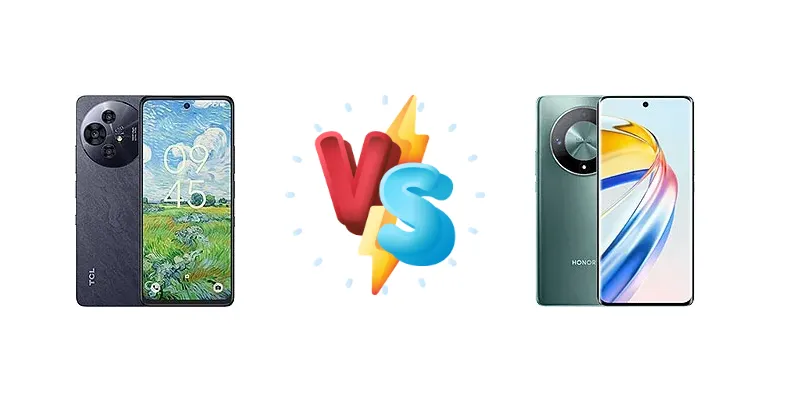
|
🏆 Quick Verdict
For the average user prioritizing all-day battery life and a unique, eye-friendly display, the TCL 50 Pro NxtPaper is the better choice. While the Honor X9b boasts a newer chipset and faster charging, the TCL’s exceptional 44:33 hour endurance and NxtPaper technology offer a distinct advantage for content consumption and prolonged use.
| PHONES | ||
|---|---|---|
| Phone Names | TCL 50 Pro NxtPaper | Honor X9b |
| Network | ||
|---|---|---|
| 2G bands | GSM 850 / 900 / 1800 / 1900 | GSM 850 / 900 / 1800 / 1900 |
| 3G bands | HSDPA 850 / 900 / 1700(AWS) / 1900 / 2100 | HSDPA 850 / 900 / 1900 / 2100 |
| 4G bands | 1, 2, 3, 4, 5, 7, 8, 12, 13, 17, 20, 25, 26, 28, 38, 40, 41, 42, 48, 66 - T803E | 1, 2, 3, 4, 5, 7, 8, 20, 28, 32, 38, 40, 41 |
| 5G bands | 1, 3, 5, 7, 8, 20, 26, 28, 38, 40, 41, 48, 77, 78 SA/NSA - T803D | 1, 3, 7, 8, 20, 28, 38, 40, 41, 77, 78 SA/NSA |
| Speed | HSPA, LTE, 5G | HSPA, LTE, 5G |
| Technology | GSM / HSPA / LTE / 5G | GSM / HSPA / LTE / 5G |
| Launch | ||
|---|---|---|
| Announced | 2024, September 04 | 2023, October 18 |
| Status | Available. Released 2024, September | Available. Released 2023, October |
| Body | ||
|---|---|---|
| Dimensions | 167.6 x 75.5 x 8 mm (6.60 x 2.97 x 0.31 in) | 163.6 x 75.5 x 8 mm (6.44 x 2.97 x 0.31 in) |
| SIM | · Nano-SIM + eSIM· Nano-SIM + Nano-SIM | Nano-SIM + Nano-SIM |
| Weight | 196 g (6.91 oz) | 185 g (6.53 oz) |
| Display | ||
|---|---|---|
| Protection | Mohs level 7 | - |
| Resolution | 1080 x 2460 pixels (~395 ppi density) | 1220 x 2652 pixels, 19.5:9 ratio (~431 ppi density) |
| Size | 6.8 inches, 109.8 cm2 (~86.8% screen-to-body ratio) | 6.78 inches, 112.6 cm2 (~91.2% screen-to-body ratio) |
| Type | IPS LCD, 120Hz | AMOLED, 1B colors, 120Hz, 1200 nits (peak) |
| Platform | ||
|---|---|---|
| CPU | Octa-core (2x2.4 GHz Cortex-A76 & 6x2.0 GHz Cortex-A55) | Octa-core (4x2.2 GHz Cortex-A78 & 4x1.8 GHz Cortex-A55) |
| Chipset | Mediatek Dimensity 6300 (6 nm) | Qualcomm SM6450 Snapdragon 6 Gen 1 (4 nm) |
| GPU | Mali-G57 MC2 | Adreno 710 |
| OS | Android 14, up to 2 major Android upgrades | Android 13, Magic OS 7.2 |
| Memory | ||
|---|---|---|
| Card slot | microSDXC (uses shared SIM slot) | No |
| Internal | 512GB 8GB RAM | 256GB 8GB RAM, 256GB 12GB RAM, 512GB 8GB RAM, 512GB 12GB RAM |
| Main Camera | ||
|---|---|---|
| Features | LED flash, HDR | LED flash, panorama, HDR |
| Triple | 108 MP, f/1.8, (wide), 1/1.67", 0.64µm, PDAF 8 MP, f/2.2, 120˚ (ultrawide), 1/4.0", 1.12µm 2 MP (macro) | 108 MP, f/1.8, (wide), 1/1.67", PDAF 5 MP, f/2.2, (ultrawide) 2 MP (macro) |
| Video | 1080p@30fps | 4K@30fps, 1080p@30fps |
| Selfie camera | ||
|---|---|---|
| Features | HDR | - |
| Single | 32 MP, f/2.0, (wide), 1/3.45", 0.64µm | 16 MP, f/2.5, (wide) |
| Video | 1080p@30fps | 1080p@30fps |
| Sound | ||
|---|---|---|
| 35mm jack | Yes | No |
| Loudspeaker | Yes, with stereo speakers | Yes |
| Comms | ||
|---|---|---|
| Bluetooth | 5.3, A2DP, LE | 5.1, A2DP, LE |
| Infrared port | - | Yes |
| NFC | Yes | Yes (market/region dependent) |
| Positioning | GPS, GLONASS, BDS, GALILEO | GPS, GLONASS, GALILEO, BDS |
| Radio | Unspecified | No |
| USB | USB Type-C 2.0 | USB Type-C 2.0, OTG |
| WLAN | Wi-Fi 802.11 a/b/g/n/ac, dual-band, Wi-Fi Direct | Wi-Fi 802.11 a/b/g/n/ac, dual-band, Wi-Fi Direct |
| Features | ||
|---|---|---|
| Sensors | Fingerprint (side-mounted), gyro, accelerometer, proximity, compass, barometer (T803D only) | Fingerprint (under display, optical), accelerometer, gyro, proximity, compass |
| Battery | ||
|---|---|---|
| Charging | 33W wired | 35W wired Reverse wired |
| Type | 5010 mAh | Li-Po 5800 mAh |
| Misc | ||
|---|---|---|
| Colors | Moon Gray, Midnight Blue, Alps White, Pale Gold, Rosy Purple | Sunrise Orange, Midnight Black, Emerald Green |
| Models | T803E, T803D | ALI-NX1 |
| Price | About 300 EUR | About 970 EUR |
| EU LABEL | ||
|---|---|---|
| Battery | 44:33h endurance, 1000 cycles | - |
| Energy | Class B | - |
| Free fall | Class B (180 falls) | - |
| Repairability | Class B | - |
TCL 50 Pro NxtPaper
- Exceptional 44:33 hour battery endurance
- Unique NxtPaper display for eye comfort
- 1000-cycle battery lifespan for long-term reliability
- Potentially less powerful processor than the competition
- Slower charging speed compared to the Honor X9b
Honor X9b
- More powerful Snapdragon 6 Gen 1 chipset
- Faster 35W wired charging
- Reverse wired charging for accessories
- Likely shorter battery life compared to the TCL
- No specialized display technology like NxtPaper
Display Comparison
Neither device boasts a flagship-level display, but they diverge in approach. The TCL 50 Pro NxtPaper’s defining feature is its NxtPaper display, designed to mimic the texture of paper for reduced eye strain. While specific brightness nits aren't provided, the focus is on a matte finish and blue light reduction. The Honor X9b, lacking this specialized tech, likely offers a more conventional LCD or AMOLED experience. The TCL’s emphasis on readability and reduced glare will appeal to users who spend hours reading or browsing, while the Honor X9b may offer more vibrant colors, assuming it utilizes an AMOLED panel (not specified).
Camera Comparison
Without detailed camera specs, a direct comparison is limited. Both phones likely target the mid-range camera experience. The absence of information regarding sensor sizes and OIS suggests neither device will excel in low-light photography. The focus will likely be on software processing to enhance image quality. Given the market segment, expect both to include a standard wide, ultrawide, and potentially a macro lens, though the usefulness of a 2MP macro lens is questionable. The image processing style will likely differentiate the two, with TCL potentially leaning towards a more natural look and Honor aiming for more vibrant, social media-ready images.
Performance
The core difference lies in the chipsets. The TCL 50 Pro NxtPaper utilizes the Mediatek Dimensity 6300 (6nm), featuring a dual-core Cortex-A76 setup alongside six Cortex-A55 cores. The Honor X9b counters with the Qualcomm Snapdragon 6 Gen 1 (4nm), employing a quad-core Cortex-A78 configuration and four Cortex-A55 cores. The Snapdragon 6 Gen 1’s 4nm process offers a theoretical efficiency advantage over the Dimensity 6300’s 6nm node, potentially leading to better thermal management and sustained performance. However, the Cortex-A78 cores in the Snapdragon offer a performance uplift over the A76 cores in the Dimensity, making the Honor X9b more suitable for graphically intensive tasks. Both devices benefit from an octa-core configuration, but the architectural differences favor the Honor X9b in raw processing power.
Battery Life
Battery life is a key differentiator. The TCL 50 Pro NxtPaper boasts an impressive 44:33 hour endurance rating, suggesting exceptional longevity. Coupled with a 1000-cycle battery lifespan claim, it’s designed for long-term reliability. The Honor X9b, while not providing endurance data, compensates with 35W wired charging, faster than the TCL’s 33W. The Honor X9b also adds reverse wired charging, a convenient feature for topping up accessories. While the Honor X9b’s faster charging is appealing, the TCL’s significantly longer endurance and battery health promise are more impactful for most users.
Buying Guide
Buy the TCL 50 Pro NxtPaper if you need exceptional battery life, prioritize eye comfort with its NxtPaper display, and value long-term battery health with its 1000-cycle rating. Buy the Honor X9b if you prefer a slightly more powerful processor for demanding apps and games, and benefit from the convenience of 35W fast charging and reverse wired charging capabilities.