
TCL 50 5G vs Google Pixel 7a: A Detailed Comparison
| Phones Images | |||||
|---|---|---|---|---|---|
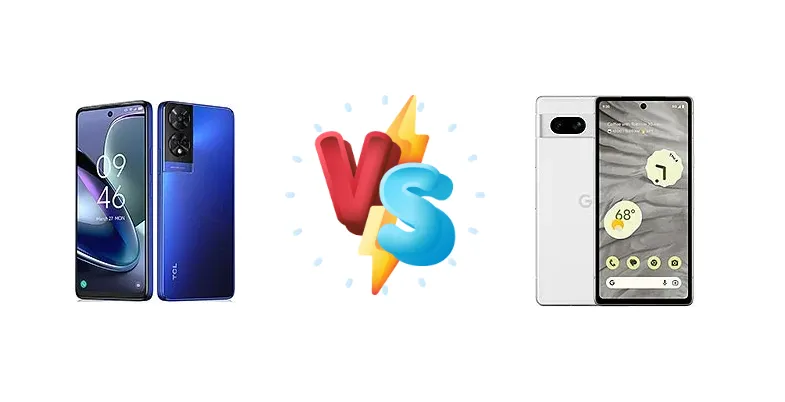
|
🏆 Quick Verdict
For the average user prioritizing camera quality and software experience, the Google Pixel 7a is the clear winner. Its Tensor G2 chipset and exceptional image processing capabilities justify the price premium. However, the TCL 50 5G offers a compelling value proposition for those seeking 5G connectivity on a tighter budget.
| PHONES | ||
|---|---|---|
| Phone Names | TCL 50 5G | Google Pixel 7a |
| Network | ||
|---|---|---|
| 2G bands | GSM 850 / 900 / 1800 / 1900 | GSM 850 / 900 / 1800 / 1900 |
| 3G bands | HSDPA 850 / 900 / 1700(AWS) / 1900 / 2100 | HSDPA 800 / 850 / 900 / 1700(AWS) / 1900 / 2100 |
| 4G bands | 1, 2, 3, 4, 5, 7, 8, 13, 17, 20, 26, 28, 32, 38, 40, 41, 42 | 1, 2, 3, 4, 5, 7, 8, 12, 13, 14, 17, 20, 25, 26, 28, 29, 30, 38, 40, 41, 48, 66, 71 - GWKK3, G0DZQ |
| 5G bands | 1, 3, 5, 7, 8, 20, 26, 28, 38, 40, 41, 48, 77, 78 SA/NSA | 1, 2, 3, 5, 7, 8, 12, 14, 20, 25, 28, 30, 38, 41, 48, 66, 71, 77, 78 SA/NSA/Sub6 - GWKK3 |
| Speed | HSPA, LTE, 5G | HSPA, LTE, 5G |
| Technology | GSM / HSPA / LTE / 5G | GSM / HSPA / LTE / 5G |
| - | 1, 2, 3, 5, 7, 8, 12, 20, 25, 28, 38, 40, 41, 66, 75, 76, 77, 78, 79 SA/NSA/Sub6 - GHL1X, G82U8 | |
| Launch | ||
|---|---|---|
| Announced | 2024, February 26 | 2023, May 10 |
| Status | Available. Released 2024, April | Available. Released 2023, May 10 |
| Body | ||
|---|---|---|
| Build | - | Glass front (Gorilla Glass 3), aluminum frame, plastic back |
| Dimensions | 164.1 x 75.1 x 8.3 mm (6.46 x 2.96 x 0.33 in) | 152 x 72.9 x 9 mm (5.98 x 2.87 x 0.35 in) |
| SIM | Nano-SIM + eSIM | Nano-SIM + eSIM |
| Weight | 183.5 g (6.49 oz) | 193.5 g (6.84 oz) |
| - | IP67 dust/water resistant (up to 1m for 30 min) | |
| Display | ||
|---|---|---|
| Protection | - | Corning Gorilla Glass 3 |
| Resolution | 720 x 1612 pixels, 20:9 ratio (~267 ppi density) | 1080 x 2400 pixels, 20:9 ratio (~429 ppi density) |
| Size | 6.6 inches, 104.6 cm2 (~84.9% screen-to-body ratio) | 6.1 inches, 90.7 cm2 (~81.8% screen-to-body ratio) |
| Type | IPS LCD, 90Hz, 480 nits (typ) | OLED, HDR, 90Hz |
| - | Always-on display | |
| Platform | ||
|---|---|---|
| CPU | Octa-core (2x2.2 GHz Cortex-A76 & 6x2.0 GHz Cortex-A55) | Octa-core (2x2.85 GHz Cortex-X1 & 2x2.35 GHz Cortex-A78 & 4x1.80 GHz Cortex-A55) |
| Chipset | Mediatek Dimensity 6100+ (6 nm) | Google Tensor G2 (5 nm) |
| GPU | Mali-G57 MC2 | Mali-G710 MP7 |
| OS | Android 14, planned upgrade to Android 15 | Android 13, upgradable to Android 15, up to 5 major Android upgrades |
| Memory | ||
|---|---|---|
| Card slot | microSDXC | No |
| Internal | 128GB 4GB RAM | 128GB 8GB RAM |
| - | UFS 3.1 | |
| Main Camera | ||
|---|---|---|
| Dual | 50 MP, f/1.8, (wide), 1/2.5", 0.7µm, PDAF 5 MP, f/2.2, (ultrawide), 1/5.0", 1.12µm | 64 MP, f/1.9, 26mm (wide), 1/1.73", 0.8µm, dual pixel PDAF, OIS 13 MP, f/2.2, 120˚ (ultrawide), 1.12µm |
| Features | LED flash, HDR, panorama | Dual-LED flash, Pixel Shift, Auto-HDR, panorama |
| Video | 1080p@30fps | 4K@30/60fps, 1080p@30/60/120/240fps, OIS |
| Selfie camera | ||
|---|---|---|
| Features | - | HDR, panorama |
| Single | 8 MP, (wide), 1/4.0", 1.12µm | 13 MP, f/2.2, 20mm (ultrawide), 1.12µm |
| Video | 1080p@30fps | 4K@30fps, 1080p@30fps |
| Sound | ||
|---|---|---|
| 3.5mm jack | - | No |
| 35mm jack | Yes | No |
| Loudspeaker | Yes, with stereo speakers | Yes, with stereo speakers |
| Comms | ||
|---|---|---|
| Bluetooth | 5.3, A2DP, LE | 5.3, A2DP, LE |
| NFC | Yes | Yes |
| Positioning | GPS, GLONASS, BDS, GALILEO | GPS, GLONASS, GALILEO, BDS, QZSS, NavIC |
| Radio | Unspecified | No |
| USB | USB Type-C 2.0 | USB Type-C 3.2 |
| WLAN | Wi-Fi 802.11 a/b/g/n/ac, dual-band, Wi-Fi Direct | Wi-Fi 802.11 a/b/g/n/ac/6e, tri-band |
| Features | ||
|---|---|---|
| Sensors | Fingerprint (side-mounted), accelerometer, gyro, proximity, compass | Fingerprint (under display, optical), accelerometer, gyro, proximity, compass, barometer |
| Battery | ||
|---|---|---|
| Charging | 18W wired | 18W wired, PD3.0 7.5W wireless |
| Type | 5010 mAh | Li-Po 4385 mAh |
| Misc | ||
|---|---|---|
| Colors | Dark Blue, Space Gray | Charcoal, Snow, Sea, Coral |
| Models | T613P, T613K | GWKK3, GHL1X, G0DZQ, G82U8 |
| Price | € 148.07 / £ 91.97 | € 179.90 / $ 150.00 / £ 170.00 / ₹ 25,980 |
TCL 50 5G
- More affordable price point
- Likely larger display size
- 5G connectivity
- Inferior processor performance
- Less capable camera system
- Potentially slower software updates
Google Pixel 7a
- Superior processor performance (Tensor G2)
- Exceptional camera quality
- Guaranteed software updates
- Higher price
- Potentially smaller display
- Wireless charging is slow (7.5W)
Display Comparison
The Pixel 7a boasts a significantly brighter display, reaching a measured peak of 1070 nits, ensuring excellent visibility even in direct sunlight. While the TCL 50 5G’s display specifications aren’t provided, it’s likely to be dimmer. The Pixel 7a’s OLED panel also offers superior contrast and color accuracy compared to what’s typically found in TCL’s price range. The Pixel 7a’s smaller size (assumed, based on market positioning) may also appeal to users who prefer a more pocketable device.
Camera Comparison
The Pixel 7a’s camera system is a major differentiator. While specific sensor details are missing, Google’s computational photography prowess, powered by the Tensor G2, delivers exceptional image quality, particularly in challenging lighting conditions. The TCL 50 5G’s camera is likely to be more basic, focusing on providing acceptable results for social media sharing. The Pixel 7a’s video capabilities are also expected to be superior, with features like cinematic mode and improved stabilization. We can assume the Pixel 7a will have Optical Image Stabilization (OIS) which the TCL 50 5G likely lacks.
Performance
The Google Pixel 7a’s Tensor G2 (5nm) chipset represents a substantial performance leap over the TCL 50 5G’s MediaTek Dimensity 6100+ (6nm). The Tensor G2’s octa-core configuration, featuring 2x2.85 GHz Cortex-X1 cores, provides significantly faster processing speeds for demanding tasks like video editing and gaming. The Dimensity 6100+’s 2x2.2 GHz Cortex-A76 cores are capable for everyday use, but will struggle with more intensive applications. The 5nm fabrication process of the Tensor G2 also contributes to better thermal efficiency, potentially reducing throttling during prolonged use. The Pixel 7a likely benefits from faster RAM (LPDDR5x assumed) compared to the TCL 50 5G.
Battery Life
The Pixel 7a’s endurance rating of 76 hours suggests excellent battery life, despite a potentially smaller battery capacity than the TCL 50 5G (capacity not specified). This is likely due to the efficiency of the Tensor G2 chipset and Google’s software optimizations. Both phones support 18W wired charging, but the Pixel 7a adds the convenience of 7.5W wireless charging and PD3.0 support for faster wired charging with compatible adapters. The TCL 50 5G’s charging is likely limited to standard Power Delivery.
Buying Guide
Buy the TCL 50 5G if you need a large-screen 5G phone primarily for media consumption and basic tasks, and are willing to compromise on camera performance and software updates. Buy the Google Pixel 7a if you prioritize a superior camera experience, smooth performance with Google’s Tensor G2, and guaranteed software updates, even if it means paying a bit more and accepting a smaller display.