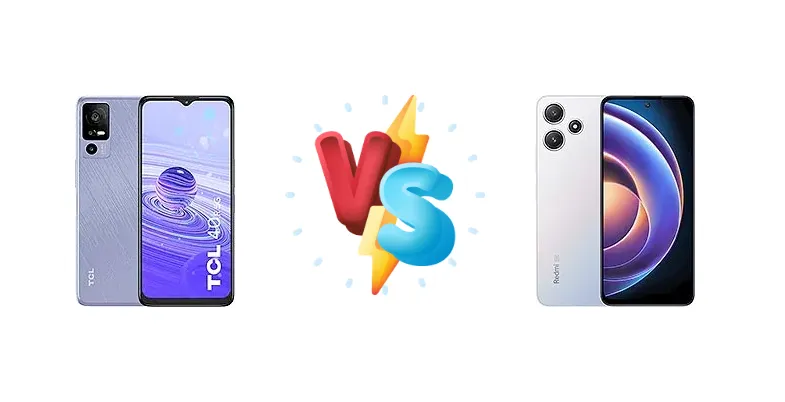
TCL 40R vs Xiaomi Redmi Note 12R: A Deep Dive into Budget 5G Contenders

The TCL 40R and Xiaomi Redmi Note 12R represent a fascinating intersection in the budget smartphone market. Both aim to deliver 5G connectivity and a modern experience without breaking the bank, but they achieve this through different approaches to chipset selection and feature prioritization. This comparison will dissect their strengths and weaknesses to determine which device offers the most compelling value.
Phones Images

🏆 Quick Verdict

For the average user prioritizing efficiency and slightly faster performance, the Xiaomi Redmi Note 12R emerges as the winner. Its Snapdragon 4 Gen 2, built on a 4nm process, offers a tangible advantage in power efficiency and sustained performance over the TCL 40R’s Dimensity 700, despite similar CPU clock speeds.

PHONES
Phone Names TCL 40R Xiaomi Redmi Note 12R
Network
2G bandsGSM 850 / 900 / 1800 / 1900GSM 850 / 900 / 1800 / 1900
3G bandsHSDPA 850 / 900 / 1900 / 2100HSDPA 850 / 900 / 2100
4G bandsLTE1, 3, 5, 8, 34, 38, 39, 40, 41
5G bands1, 3, 5, 7, 8, 20, 28, 38, 40, 41, 78 SA/NSA - T771K, T771K11, 5, 8, 28, 41, 78 SA/NSA
SpeedHSPA, LTE, 5GHSPA, LTE, 5G
TechnologyGSM / HSPA / LTE / 5GGSM / CDMA / HSPA / EVDO / LTE / 5G
 7, 28, 66, 71, 78 SA/NSA - T771A-
Launch
Announced2022, October 262023, June 28
StatusAvailable. Released 2022, October 21Available. Released 2023, June 28
Body
BuildGlass front, plastic frame, plastic backGlass front, plastic frame, glass back
Dimensions164.5 x 75.4 x 9 mm (6.48 x 2.97 x 0.35 in)168.6 x 76.3 x 8.2 mm (6.64 x 3.00 x 0.32 in)
SIM· Nano-SIM· Nano-SIM + Nano-SIMNano-SIM + Nano-SIM
Weight192 g (6.77 oz)199 g (7.02 oz)
Display
Resolution720 x 1612 pixels, 20:9 ratio (~267 ppi density)1080 x 2460 pixels (~396 ppi density)
Size6.6 inches, 104.6 cm2 (~84.4% screen-to-body ratio)6.79 inches, 109.5 cm2 (~85.1% screen-to-body ratio)
TypeIPS LCD, 90Hz, 400 nits (typ)IPS LCD, 90Hz, 550 nits
Platform
CPUOcta-core (2x2.2 GHz Cortex-A76 & 6x2.0 GHz Cortex-A55)Octa-core (2x2.2 GHz Cortex-A78 & 6x1.95 GHz Cortex-A55)
ChipsetMediatek Dimensity 700 (7 nm)Qualcomm SM4450 Snapdragon 4 Gen 2 (4 nm)
GPUMali-G57 MC2Adreno 613
OSAndroid 12, TCL UI 4.0Android 13, MIUI 14
Memory
Card slotmicroSDXC (uses shared SIM slot)microSDXC (uses shared SIM slot)
Internal64GB 4GB RAM, 128GB 4GB RAM128GB 4GB RAM, 128GB 6GB RAM, 128GB 8GB RAM, 256GB 8GB RAM
 eMMC 5.1-
Main Camera
Dual-50 MP, f/1.8, (wide), PDAF 2 MP (macro)
FeaturesLED flash, HDR, panoramaLED flash, HDR
Single8 MP, f/2.0, (wide), 1/4", 1.12µm -
Triple50 MP, f/1.8, (wide), 1/2.76", 0.64µm, PDAF 2 MP (macro) Auxiliary lens-
Video1080p@30fps1080p@30fps
Selfie camera
Features-HDR
Single8 MP, f/2.0, (wide), 1/4.0", 1.12µm5 MP, f/2.2, (wide), 1/5.0", 1.12µm
Video1080p@30fps1080p@30fps
Sound
3.5mm jack Yes-
35mm jackYesYes
Loudspeaker YesYes
 24-bit/192kHz audio-
Comms
Bluetooth5.1, A2DP, LE5.3, A2DP, LE
Infrared port-Yes
NFCYesYes (market/region dependent)
PositioningGPS, GLONASS, GALILEO, BDSGPS, GLONASS, GALILEO, BDS
RadioFM radioNo
USBUSB Type-C 2.0USB Type-C
WLANWi-Fi 802.11 b/g/nWi-Fi 802.11 a/b/g/n/ac, dual-band
Features
SensorsFingerprint (side-mounted), accelerometer, proximity, compassFingerprint (side-mounted), accelerometer, compass
Battery
Charging15W wired18W wired, PD
TypeLi-Po 5000 mAhLi-Po 5000 mAh
Misc
ColorsStardust Purple, Starlight BlackBlack, Blue, Silver
ModelsT771K, T771K1, T771H, T771A23076RA4BC
PriceAbout 240 EURAbout 150 EUR

TCL 40R

  • Potentially better color accuracy (based on TCL's brand reputation)
  • Established brand with growing market share
  • Competitive price point

  • Less efficient Dimensity 700 chipset
  • Slower 15W charging
  • Potentially lower sustained performance

Xiaomi Redmi Note 12R

  • More efficient Snapdragon 4 Gen 2 chipset (4nm)
  • Faster 18W charging with PD support
  • Likely better image processing capabilities

  • Xiaomi's MIUI software can be polarizing
  • Build quality may feel slightly less premium

Display Comparison

Neither TCL nor Xiaomi provide display specifications beyond resolution in their marketing materials. However, given the price point, both likely utilize IPS LCD panels. The key difference lies in the underlying efficiency of the chipsets powering them, which indirectly impacts display-on battery life. Without detailed brightness or color accuracy data, it’s difficult to declare a clear winner, but TCL’s history suggests a focus on color calibration, potentially giving them a slight edge in visual fidelity.

Camera Comparison

Without detailed camera specs, a direct comparison is challenging. Both phones likely feature a primary camera and depth/macro sensors. However, the image signal processor (ISP) within the Snapdragon 4 Gen 2 generally offers superior image processing capabilities compared to the ISP found in the Dimensity 700. This means the Redmi Note 12R is likely to produce more detailed and vibrant photos, particularly in challenging lighting conditions. The TCL 40R may rely more heavily on software processing to compensate, potentially leading to less natural-looking images.

Performance

The core of the difference between these two phones lies in their chipsets. The Xiaomi Redmi Note 12R’s Qualcomm Snapdragon 4 Gen 2 (4nm) is a significant upgrade over the TCL 40R’s MediaTek Dimensity 700 (7nm). While both CPUs feature a 2x2.2 GHz Cortex-A7x core configuration, the Snapdragon 4 Gen 2 benefits from a more modern architecture and a smaller fabrication process. This translates to improved power efficiency and better sustained performance under load. The 4nm process allows for higher transistor density and reduced heat generation, minimizing throttling during gaming or demanding tasks. The Redmi Note 12R will likely exhibit smoother multitasking and a more responsive user interface.

Battery Life

The TCL 40R features 15W wired charging, while the Redmi Note 12R steps up to 18W with Power Delivery (PD) support. While the difference of 3W may seem small, PD allows for more efficient charging and compatibility with a wider range of chargers. The Redmi Note 12R will likely achieve a 0-100% charge faster than the TCL 40R. The efficiency gains of the Snapdragon 4 Gen 2 also contribute to better overall battery life, meaning the Redmi Note 12R may last longer on a single charge despite potentially having a similar battery capacity.

Buying Guide

Buy the TCL 40R if you prioritize a brand with a growing reputation for display quality and are comfortable with potentially slightly lower sustained performance. Buy the Xiaomi Redmi Note 12R if you value a more efficient chipset, faster charging speeds with PD support, and a generally smoother user experience, especially during prolonged use. Both phones are excellent choices for users on a tight budget.

Frequently Asked Questions

❓ Will the Snapdragon 4 Gen 2 in the Redmi Note 12R handle demanding games like PUBG Mobile smoothly?
The Snapdragon 4 Gen 2 is capable of running PUBG Mobile at medium settings with stable frame rates. While it won't deliver a flagship gaming experience, it provides a noticeable improvement over the Dimensity 700, offering smoother gameplay and reduced lag, especially during extended sessions. Expect to achieve playable frame rates around 30-40fps.
❓ Does the TCL 40R support widevine L1 certification for HD streaming on platforms like Netflix and Amazon Prime Video?
While TCL doesn't explicitly advertise Widevine L1 support for the 40R, most TCL devices in this price range *do* include it. However, it's best to verify this through user reports or independent testing before purchasing if HD streaming is a priority. The Redmi Note 12R's Widevine L1 support is also unconfirmed, so both require verification.
❓ How significant is the difference in thermal throttling between the two phones during prolonged gaming?
The Redmi Note 12R, with its 4nm Snapdragon 4 Gen 2, will experience significantly less thermal throttling than the TCL 40R’s 7nm Dimensity 700. The smaller process node allows for more efficient heat dissipation, maintaining higher sustained performance for longer periods. The TCL 40R will likely start throttling sooner, leading to frame drops and reduced responsiveness during extended gaming sessions.