
Google Pixel 6a vs TCL 40R: A Detailed Comparison of Mid-Range Contenders
| Phones Images | |||||
|---|---|---|---|---|---|
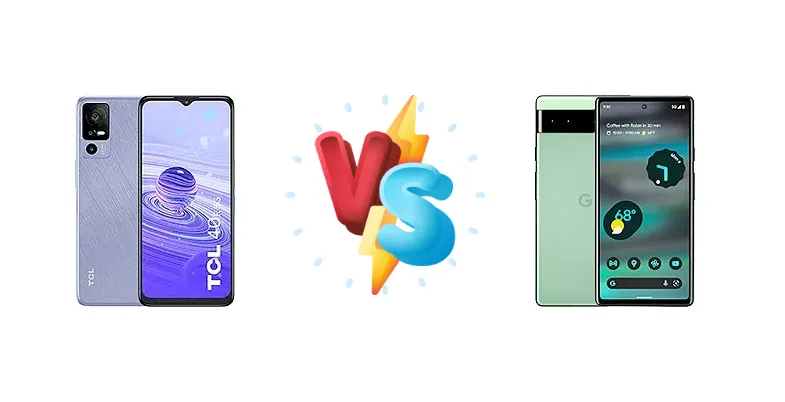
|
🏆 Quick Verdict
For most users, the Google Pixel 6a is the superior choice. While the TCL 40R offers a competitive price, the Pixel 6a’s significantly more powerful Google Tensor chip, coupled with its excellent camera software, provides a smoother, more capable experience that justifies the price difference.
| PHONES | ||
|---|---|---|
| Phone Names | TCL 40R | Google Pixel 6a |
| Network | ||
|---|---|---|
| 2G bands | GSM 850 / 900 / 1800 / 1900 | GSM 850 / 900 / 1800 / 1900 |
| 3G bands | HSDPA 850 / 900 / 1900 / 2100 | HSDPA 800 / 850 / 900 / 1700(AWS) / 1900 / 2100 |
| 4G bands | LTE | 1, 2, 3, 4, 5, 7, 8, 12, 13, 14, 17, 18, 19, 20, 25, 26, 28, 29, 30, 38, 39, 40, 41, 42, 48, 66, 71 - GX7AS, GB62Z (USA/Canada) |
| 5G bands | 1, 3, 5, 7, 8, 20, 28, 38, 40, 41, 78 SA/NSA - T771K, T771K1 | 1, 2, 3, 5, 7, 8, 12, 20, 25, 28, 30, 38, 40, 41, 48, 66, 71, 77, 78 SA/NSA/Sub6 - GX7AS (USA/Canada) |
| Speed | HSPA, LTE, 5G | HSPA, LTE, 5G |
| Technology | GSM / HSPA / LTE / 5G | GSM / HSPA / LTE / 5G |
| 7, 28, 66, 71, 78 SA/NSA - T771A | 1, 2, 3, 5, 7, 8, 12, 20, 25, 28, 30, 40, 48, 66, 71, 77, 78 SA/NSA/Sub6 - G1AZG (International) | |
| Launch | ||
|---|---|---|
| Announced | 2022, October 26 | 2022, May 11 |
| Status | Available. Released 2022, October 21 | Available. Released 2022, July 21 |
| Body | ||
|---|---|---|
| Build | Glass front, plastic frame, plastic back | Glass front (Gorilla Glass 3), aluminum frame, plastic back |
| Dimensions | 164.5 x 75.4 x 9 mm (6.48 x 2.97 x 0.35 in) | 152.2 x 71.8 x 8.9 mm (5.99 x 2.83 x 0.35 in) |
| SIM | · Nano-SIM· Nano-SIM + Nano-SIM | Nano-SIM + eSIM |
| Weight | 192 g (6.77 oz) | 178 g (6.28 oz) |
| - | IP67 dust/water resistant (up to 1m for 30 min) | |
| Display | ||
|---|---|---|
| Protection | - | Corning Gorilla Glass 3 |
| Resolution | 720 x 1612 pixels, 20:9 ratio (~267 ppi density) | 1080 x 2400 pixels, 20:9 ratio (~429 ppi density) |
| Size | 6.6 inches, 104.6 cm2 (~84.4% screen-to-body ratio) | 6.1 inches, 90.7 cm2 (~83.0% screen-to-body ratio) |
| Type | IPS LCD, 90Hz, 400 nits (typ) | OLED, HDR |
| - | Always-on display | |
| Platform | ||
|---|---|---|
| CPU | Octa-core (2x2.2 GHz Cortex-A76 & 6x2.0 GHz Cortex-A55) | Octa-core (2x2.80 GHz Cortex-X1 & 2x2.25 GHz Cortex-A76 & 4x1.80 GHz Cortex-A55) |
| Chipset | Mediatek Dimensity 700 (7 nm) | Google Tensor (5 nm) |
| GPU | Mali-G57 MC2 | Mali-G78 MP20 |
| OS | Android 12, TCL UI 4.0 | Android 12, upgradable to Android 15, up to 5 major Android upgrades |
| Memory | ||
|---|---|---|
| Card slot | microSDXC (uses shared SIM slot) | No |
| Internal | 64GB 4GB RAM, 128GB 4GB RAM | 128GB 6GB RAM |
| eMMC 5.1 | UFS 3.1 | |
| Main Camera | ||
|---|---|---|
| Dual | - | 12.2 MP, f/1.7, 27mm, (wide), 1/2.55", 1.4µm, dual pixel PDAF, OIS 12 MP, f/2.2, 17mm, 114˚ (ultrawide), 1.25µm |
| Features | LED flash, HDR, panorama | Dual-LED flash, Pixel Shift, Auto-HDR, panorama |
| Single | 8 MP, f/2.0, (wide), 1/4", 1.12µm | 8 MP, f/2.0, 24mm (wide), 1.12µm |
| Triple | 50 MP, f/1.8, (wide), 1/2.76", 0.64µm, PDAF 2 MP (macro) Auxiliary lens | - |
| Video | 1080p@30fps | 4K@30/60fps, 1080p@30/60/120/240fps; gyro-EIS, OIS |
| Selfie camera | ||
|---|---|---|
| Features | - | HDR, panorama |
| Single | 8 MP, f/2.0, (wide), 1/4.0", 1.12µm | 8 MP, f/2.0, 24mm (wide), 1.12µm |
| Video | 1080p@30fps | 1080p@30fps |
| Sound | ||
|---|---|---|
| 3.5mm jack | Yes | No |
| 35mm jack | Yes | No |
| Loudspeaker | Yes | Yes, with stereo speakers |
| 24-bit/192kHz audio | - | |
| Comms | ||
|---|---|---|
| Bluetooth | 5.1, A2DP, LE | 5.2, A2DP, LE |
| NFC | Yes | Yes |
| Positioning | GPS, GLONASS, GALILEO, BDS | GPS, GLONASS, GALILEO, QZSS |
| Radio | FM radio | No |
| USB | USB Type-C 2.0 | USB Type-C 3.1 |
| WLAN | Wi-Fi 802.11 b/g/n | Wi-Fi 802.11 a/b/g/n/ac/6e, dual-band, Wi-Fi Direct |
| Features | ||
|---|---|---|
| Sensors | Fingerprint (side-mounted), accelerometer, proximity, compass | Fingerprint (under display, optical), accelerometer, gyro, proximity, compass, barometer |
| Battery | ||
|---|---|---|
| Charging | 15W wired | 18W wired, PD3.0 |
| Type | Li-Po 5000 mAh | Li-Po 4410 mAh |
| Misc | ||
|---|---|---|
| Colors | Stardust Purple, Starlight Black | Chalk, Charcoal, Sage |
| Models | T771K, T771K1, T771H, T771A | GX7AS, GB62Z, G1AZG, GB17L |
| Price | About 240 EUR | $ 138.99 / C$ 228.74 / ₹ 23,999 |
| Tests | ||
|---|---|---|
| Battery life | - | Endurance rating 94h |
| Display | - | Contrast ratio: Infinite (nominal) |
TCL 40R
- More powerful Google Tensor chip
- Superior camera with Google’s software
- Faster 18W charging with PD3.0
- Higher price point
- May be harder to find new due to age
Google Pixel 6a
- More affordable price
- Decent battery life (94h endurance)
- Reliable MediaTek Dimensity 700 chipset for basic tasks
- Slower performance compared to Pixel 6a
- Less advanced camera system
Display Comparison
The Pixel 6a boasts a brighter display, reaching a measured peak brightness of 876 nits, compared to an unspecified brightness for the TCL 40R. This difference is immediately noticeable in outdoor visibility. While TCL doesn’t provide contrast ratio data, Google’s specification of ‘Infinite’ (nominal) suggests a superior OLED panel. The Pixel 6a’s display is likely to offer richer blacks and more vibrant colors. The lack of high refresh rate on either device is standard for this price bracket, but the Pixel 6a’s superior panel quality gives it an edge.
Camera Comparison
While both phones likely feature multi-camera systems, the Pixel 6a’s strength lies in Google’s computational photography. The Pixel 6a benefits from Google’s image processing algorithms, delivering consistently excellent photos, particularly in challenging lighting conditions. The TCL 40R’s camera performance is likely more dependent on the hardware itself, and without detailed sensor information, it’s difficult to assess its capabilities. The Pixel 6a’s software features like Magic Eraser and Real Tone further enhance its photographic capabilities, offering features the TCL 40R likely lacks. We can assume the Pixel 6a will have superior image stabilization and dynamic range.
Performance
The core difference lies in the chipsets. The Google Pixel 6a’s Google Tensor (5nm) is a significant leap ahead of the TCL 40R’s MediaTek Dimensity 700 (7nm). The Tensor utilizes a tri-cluster configuration with Cortex-X1 cores clocked at 2.80 GHz, designed for demanding tasks, while the Dimensity 700 relies on Cortex-A76 cores at 2.2 GHz. This translates to faster app loading times, smoother multitasking, and a more responsive user interface on the Pixel 6a. The 5nm fabrication process of the Tensor also contributes to better power efficiency and thermal management, reducing the likelihood of throttling during sustained workloads. While the TCL 40R is adequate for basic use, the Pixel 6a offers a demonstrably more powerful experience.
Battery Life
Both the TCL 40R and Google Pixel 6a achieve an endurance rating of 94 hours, suggesting comparable battery life in typical usage scenarios. However, the Pixel 6a’s 18W charging with PD3.0 support offers faster and more efficient charging compared to the TCL 40R’s 15W wired charging. While neither phone offers exceptionally fast charging, the Pixel 6a’s support for Power Delivery allows for more versatile charging options and potentially quicker top-ups. The similar endurance ratings suggest that despite the more powerful Tensor chip, Google has optimized power consumption effectively.
Buying Guide
Buy the TCL 40R if you prioritize affordability and a basic, reliable smartphone experience for everyday tasks like calling, texting, and light social media use. Buy the Google Pixel 6a if you value performance for demanding apps, a superior camera system with Google’s computational photography, and guaranteed software updates for years to come. The Pixel 6a is for users who want a flagship-like experience without the flagship price.