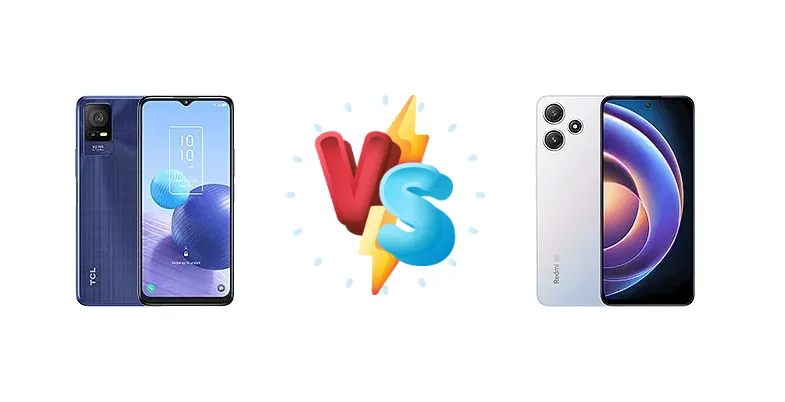
The sub-$200 smartphone market is fiercely competitive. The TCL 408 and Xiaomi Redmi Note 12R represent compelling options for budget-conscious buyers, but they take drastically different approaches to achieving affordability. The TCL 408 relies on a tried-and-true, if aging, MediaTek chipset, while the Redmi Note 12R leverages Qualcomm’s newer, more efficient Snapdragon 4 Gen 2. This comparison will dissect the key differences to determine which device offers the best value.
🏆 Quick Verdict
For the average user, the Xiaomi Redmi Note 12R is the superior choice. Its Snapdragon 4 Gen 2 chipset delivers significantly better performance and efficiency than the TCL 408’s Helio G25, justifying the slight price premium. The faster 18W charging with PD support is another key advantage.
| Network |
|---|
| 2G bands | GSM 850 / 900 / 1800 / 1900 | GSM 850 / 900 / 1800 / 1900 |
| 3G bands | HSDPA 850 / 900 / 1700(AWS) / 1900 / 2100 - T507A, T507U, T507U1, T507U2, T507J | HSDPA 850 / 900 / 2100 |
| 4G bands | 1, 3, 5, 7, 8, 13, 20, 28, 38, 40, 41 - T507U, T507U1, T507U2 | 1, 3, 5, 8, 34, 38, 39, 40, 41 |
| 5G bands | - | 1, 5, 8, 28, 41, 78 SA/NSA |
| Speed | HSPA 42.2/11.5 Mbps, LTE Cat4 150/75 Mbps | HSPA, LTE, 5G |
| Technology | GSM / HSPA / LTE | GSM / CDMA / HSPA / EVDO / LTE / 5G |
| | 1, 3, 5, 7, 8, 20, 28 - T507D1 | - |
| Launch |
|---|
| Announced | 2023, January 05 | 2023, June 28 |
| Status | Available. Released 2023, March 31 | Available. Released 2023, June 28 |
| Body |
|---|
| Build | - | Glass front, plastic frame, glass back |
| Dimensions | 164.7 x 75.4 x 9 mm (6.48 x 2.97 x 0.35 in) | 168.6 x 76.3 x 8.2 mm (6.64 x 3.00 x 0.32 in) |
| SIM | · Nano-SIM· Nano-SIM + Nano-SIM | Nano-SIM + Nano-SIM |
| Weight | 190 g (6.70 oz) | 199 g (7.02 oz) |
| Display |
|---|
| Resolution | 720 x 1612 pixels, 20:9 ratio (~267 ppi density) | 1080 x 2460 pixels (~396 ppi density) |
| Size | 6.6 inches, 104.6 cm2 (~84.3% screen-to-body ratio) | 6.79 inches, 109.5 cm2 (~85.1% screen-to-body ratio) |
| Type | IPS LCD, 400 nits (typ) | IPS LCD, 90Hz, 550 nits |
| Platform |
|---|
| CPU | Octa-core (4x2.0 GHz Cortex-A53 & 4x1.5 GHz Cortex-A53) | Octa-core (2x2.2 GHz Cortex-A78 & 6x1.95 GHz Cortex-A55) |
| Chipset | Mediatek MT6762G Helio G25 (12 nm) | Qualcomm SM4450 Snapdragon 4 Gen 2 (4 nm) |
| GPU | PowerVR GE8320 | Adreno 613 |
| OS | Android 12 | Android 13, MIUI 14 |
| Memory |
|---|
| Card slot | microSDXC (dedicated slot) | microSDXC (uses shared SIM slot) |
| Internal | 64GB 4GB RAM, 64GB 6GB RAM, 128GB 4GB RAM | 128GB 4GB RAM, 128GB 6GB RAM, 128GB 8GB RAM, 256GB 8GB RAM |
| | eMMC 5.1 | - |
| Main Camera |
|---|
| Dual | 50 MP, f/1.8, 26mm (wide), 1/2.55", 0.7µm, PDAF
Auxiliary lens | 50 MP, f/1.8, (wide), PDAF
2 MP (macro) |
| Features | LED flash | LED flash, HDR |
| Single | 8 MP, f/2.0, 27mm (wide), 1/4", 1.12µm | - |
| Video | 1080p@30fps | 1080p@30fps |
| Selfie camera |
|---|
| Features | - | HDR |
| Single | 8 MP, f/2.0, 27mm (wide), 1/4.0", 1.12µm | 5 MP, f/2.2, (wide), 1/5.0", 1.12µm |
| Video | 1080p@30fps | 1080p@30fps |
| Sound |
|---|
| 3.5mm jack | Yes | - |
| 35mm jack | Yes | Yes |
| Loudspeaker | Yes, with stereo speakers | Yes |
| Comms |
|---|
| Bluetooth | 5.1, A2DP, LE | 5.3, A2DP, LE |
| Infrared port | - | Yes |
| NFC | Yes (T507U only) | Yes (market/region dependent) |
| Positioning | GPS, GLONASS, GALILEO, BDS | GPS, GLONASS, GALILEO, BDS |
| Radio | FM radio | No |
| USB | USB Type-C 2.0, OTG | USB Type-C |
| WLAN | Wi-Fi 802.11 a/b/g/n/ac, dual-band, Wi-Fi Direct | Wi-Fi 802.11 a/b/g/n/ac, dual-band |
| Features |
|---|
| Sensors | Fingerprint (side-mounted), accelerometer | Fingerprint (side-mounted), accelerometer, compass |
| | Virtual proximity sensing | - |
| Battery |
|---|
| Charging | 10W wired | 18W wired, PD |
| Type | Li-Po 5000 mAh | Li-Po 5000 mAh |
| Misc |
|---|
| Colors | Gravity Grey, Midnight Blue | Black, Blue, Silver |
| Models | T507D1, T507A, T507U, T507U1, T507U2, T507J | 23076RA4BC |
| Price | About 130 EUR | About 150 EUR |
TCL 408
- Lowest possible price point
- Functional for basic tasks
- Simple and straightforward software experience
- Outdated and slow processor
- Extremely slow charging
- Limited multitasking capabilities
Xiaomi Redmi Note 12R
- Significantly faster processor
- Faster charging with PD support
- More efficient chipset for longer battery life
- Slightly higher price
- May still struggle with very demanding games
- Software experience can be cluttered with Xiaomi bloatware
Display Comparison
Neither TCL nor Xiaomi provide display specs beyond resolution. However, the core difference lies beneath the surface. Both likely utilize LCD panels given the price point. The TCL 408’s Helio G25 lacks the processing power to efficiently drive high refresh rate displays, suggesting a standard 60Hz panel. The Redmi Note 12R, with its more capable Snapdragon 4 Gen 2, *could* support a higher refresh rate, though this isn't confirmed. The real-world impact is smoother scrolling and animations on the Redmi Note 12R if it includes a higher refresh rate.
Camera Comparison
Without detailed camera specifications, a direct comparison is difficult. However, the chipset plays a role. The Snapdragon 4 Gen 2 includes a more advanced ISP (Image Signal Processor) than the Helio G25, enabling better image processing, noise reduction, and dynamic range. While both phones likely feature similar primary sensor resolutions, the Redmi Note 12R will likely produce superior image quality, especially in challenging lighting conditions. The TCL 408 will likely rely more heavily on software processing to compensate for the limitations of its ISP.
Performance
The performance gap is the most significant differentiator. The Xiaomi Redmi Note 12R’s Qualcomm Snapdragon 4 Gen 2 (4nm) is a substantial upgrade over the TCL 408’s MediaTek Helio G25 (12nm). The Snapdragon 4 Gen 2 features two Cortex-A78 cores clocked at 2.2 GHz, providing a noticeable boost in single-core performance for app launch speeds and responsiveness. The Helio G25 relies on four older Cortex-A53 cores at 2.0 GHz, which will struggle with demanding applications. The 4nm process node of the Snapdragon 4 Gen 2 also translates to better thermal efficiency, reducing throttling during sustained workloads. This means the Redmi Note 12R will maintain higher performance for longer periods, particularly in gaming.
Battery Life
Battery capacity isn't specified, but the charging capabilities reveal a key advantage for the Redmi Note 12R. Its 18W wired charging with Power Delivery (PD) support will significantly reduce charging times compared to the TCL 408’s slow 10W charging. While a larger battery on the TCL 408 could partially offset this, the faster charging of the Redmi Note 12R provides a more convenient user experience. Expect a full charge on the Redmi Note 12R in approximately 1.5-2 hours, while the TCL 408 could take upwards of 3 hours.
Buying Guide
Buy the TCL 408 if your primary need is a basic smartphone for essential tasks like calls, messaging, and light social media use, and you prioritize minimizing upfront cost above all else. Buy the Xiaomi Redmi Note 12R if you want a smoother, more responsive experience for everyday tasks, occasional gaming, and appreciate faster charging speeds and a more future-proof chipset.
Frequently Asked Questions
❓ Will the Redmi Note 12R handle popular games like PUBG Mobile or Call of Duty?
The Snapdragon 4 Gen 2 in the Redmi Note 12R is capable of running PUBG Mobile and Call of Duty, but you’ll likely need to lower the graphics settings to medium or low to achieve a smooth frame rate. The TCL 408’s Helio G25 will struggle with these titles, even on the lowest settings.
❓ Does the Xiaomi Redmi Note 12R support fast charging accessories from other brands?
Yes, the Redmi Note 12R supports Power Delivery (PD) charging, which is a widely adopted standard. This means you can use PD-compatible chargers from brands like Anker, Aukey, or even many laptop chargers to charge the phone quickly.
❓ Is the TCL 408 a good option for elderly users who primarily need a phone for calls and texts?
Yes, the TCL 408 is a suitable option for elderly users with basic needs. Its simplicity and low cost make it a practical choice for those who primarily use a phone for calls, texts, and occasional photos. However, the slow performance may be frustrating for some.
❓ How much bloatware is pre-installed on the Xiaomi Redmi Note 12R?
Xiaomi phones are known for including pre-installed apps (bloatware). The Redmi Note 12R is no exception. While most of these apps can be uninstalled, it requires some effort. Expect to find apps from Xiaomi and potentially some third-party partners.