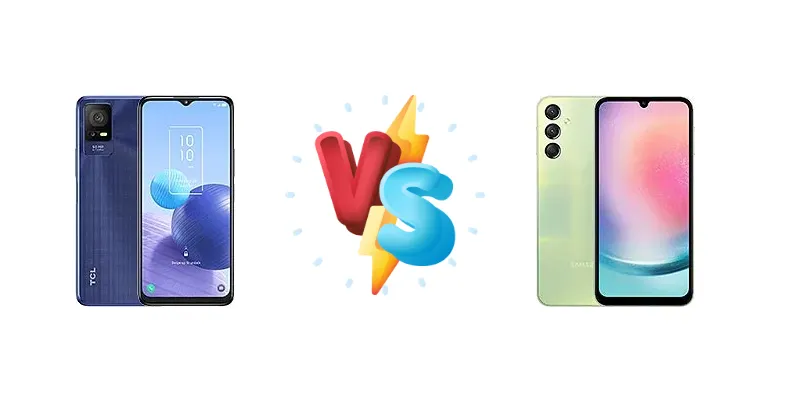
The TCL 408 and Samsung Galaxy A24 4G represent compelling options in the crowded sub-$200 smartphone market. While both aim to deliver essential features at an accessible price, they diverge significantly in their internal hardware, impacting performance and user experience. This comparison dissects these differences to help you choose the right device for your needs.
🏆 Quick Verdict
For most users, the Samsung Galaxy A24 4G is the superior choice. Its Mediatek Helio G99 chipset, built on a more efficient 6nm process, delivers noticeably better performance than the TCL 408’s Helio G25. While the TCL 408 is more affordable, the A24’s brighter display and faster charging justify the price difference.
| Network |
|---|
| 2G bands | GSM 850 / 900 / 1800 / 1900 | GSM 850 / 900 / 1800 / 1900 |
| 3G bands | HSDPA 850 / 900 / 1700(AWS) / 1900 / 2100 - T507A, T507U, T507U1, T507U2, T507J | HSDPA 850 / 900 / 2100 |
| 4G bands | 1, 3, 5, 7, 8, 13, 20, 28, 38, 40, 41 - T507U, T507U1, T507U2 | 1, 3, 5, 7, 8, 20, 28, 38, 40, 41 |
| Speed | HSPA 42.2/11.5 Mbps, LTE Cat4 150/75 Mbps | HSPA, LTE |
| Technology | GSM / HSPA / LTE | GSM / HSPA / LTE |
| | 1, 3, 5, 7, 8, 20, 28 - T507D1 | - |
| Launch |
|---|
| Announced | 2023, January 05 | 2023, April 19 |
| Status | Available. Released 2023, March 31 | Available. Released 2023, May 05 |
| Body |
|---|
| Build | - | Glass front, plastic frame, plastic back |
| Dimensions | 164.7 x 75.4 x 9 mm (6.48 x 2.97 x 0.35 in) | 162.1 x 77.6 x 8.3 mm (6.38 x 3.06 x 0.33 in) |
| SIM | · Nano-SIM· Nano-SIM + Nano-SIM | · Nano-SIM· Nano-SIM + Nano-SIM |
| Weight | 190 g (6.70 oz) | 195 g (6.88 oz) |
| Display |
|---|
| Resolution | 720 x 1612 pixels, 20:9 ratio (~267 ppi density) | 1080 x 2340 pixels, 19.5:9 ratio (~396 ppi density) |
| Size | 6.6 inches, 104.6 cm2 (~84.3% screen-to-body ratio) | 6.5 inches, 103.7 cm2 (~82.4% screen-to-body ratio) |
| Type | IPS LCD, 400 nits (typ) | Super AMOLED, 90Hz, 1000 nits (peak) |
| Platform |
|---|
| CPU | Octa-core (4x2.0 GHz Cortex-A53 & 4x1.5 GHz Cortex-A53) | Octa-core (2x2.2 GHz Cortex-A76 & 6x2.0 GHz Cortex-A55) |
| Chipset | Mediatek MT6762G Helio G25 (12 nm) | Mediatek Helio G99 (6 nm) |
| GPU | PowerVR GE8320 | Mali-G57 MC2 |
| OS | Android 12 | Android 13, up to 4 major Android upgrades, One UI 6 |
| Memory |
|---|
| Card slot | microSDXC (dedicated slot) | microSDXC (dedicated slot) |
| Internal | 64GB 4GB RAM, 64GB 6GB RAM, 128GB 4GB RAM | 128GB 4GB RAM, 128GB 6GB RAM, 128GB 8GB RAM |
| | eMMC 5.1 | - |
| Main Camera |
|---|
| Dual | 50 MP, f/1.8, 26mm (wide), 1/2.55", 0.7µm, PDAF
Auxiliary lens | - |
| Features | LED flash | LED flash, panorama, HDR |
| Single | 8 MP, f/2.0, 27mm (wide), 1/4", 1.12µm | - |
| Triple | - | 50 MP, f/1.8, 27mm (wide), 1/2.76", 0.64µm, PDAF, OIS
5 MP, f/2.2, 17mm, 123˚ (ultrawide), 1/5.0", 1.12µm
2 MP (macro) |
| Video | 1080p@30fps | 1080p@30fps, gyro-EIS |
| Selfie camera |
|---|
| Single | 8 MP, f/2.0, 27mm (wide), 1/4.0", 1.12µm | 13 MP, f/2.2, 25mm (wide), 1/3.06", 1.12µm |
| Video | 1080p@30fps | 1080p@30fps |
| Sound |
|---|
| 3.5mm jack | Yes | - |
| 35mm jack | Yes | Yes |
| Loudspeaker | Yes, with stereo speakers | Yes |
| Comms |
|---|
| Bluetooth | 5.1, A2DP, LE | 5.3, A2DP, LE |
| NFC | Yes (T507U only) | Yes (market/region dependent) |
| Positioning | GPS, GLONASS, GALILEO, BDS | GPS, GLONASS, GALILEO, BDS, QZSS |
| Radio | FM radio | Unspecified |
| USB | USB Type-C 2.0, OTG | USB Type-C 2.0 |
| WLAN | Wi-Fi 802.11 a/b/g/n/ac, dual-band, Wi-Fi Direct | Wi-Fi 802.11 a/b/g/n/ac, dual-band, Wi-Fi Direct |
| Features |
|---|
| Sensors | Fingerprint (side-mounted), accelerometer | Fingerprint (side-mounted), accelerometer, gyro, compass |
| | Virtual proximity sensing | - |
| Battery |
|---|
| Charging | 10W wired | 25W wired |
| Type | Li-Po 5000 mAh | Li-Po 5000 mAh |
| Misc |
|---|
| Colors | Gravity Grey, Midnight Blue | Black, Lime Green, Blue gradient, Dark red |
| Models | T507D1, T507A, T507U, T507U1, T507U2, T507J | SM-A245F, SM-A245F/DS, SM-A245F/DSN, SM-A245M, SM-A245M/DS, SM-A245N |
| Price | About 130 EUR | About 150 EUR |
| SAR EU | - | 0.41 W/kg (head) 1.30 W/kg (body) |
TCL 408
- Lower price point makes it very accessible.
- Likely lighter and more compact due to simpler hardware.
- Sufficient for basic smartphone tasks.
- Significantly weaker performance compared to the A24.
- Slower charging speed (10W).
- Display likely lacks brightness and vibrancy.
Samsung Galaxy A24 4G
- Faster and more efficient Mediatek Helio G99 chipset.
- Brighter and more vibrant display (1012 nits).
- Faster 25W wired charging.
- Higher price compared to the TCL 408.
- May be slightly larger and heavier.
- Still a budget device with limitations in camera quality.
Display Comparison
The Samsung Galaxy A24 4G boasts a significantly brighter display, reaching a measured peak brightness of 1012 nits. This is a substantial advantage over what we’d expect from the TCL 408, making the A24 far more usable outdoors in direct sunlight. While the TCL 408’s panel specifications aren’t available, it’s likely to be considerably dimmer. The A24’s brightness isn’t just about visibility; it contributes to a more vibrant and engaging viewing experience. We can assume both use IPS LCD panels, but the A24’s superior brightness is the key differentiator.
Camera Comparison
Both phones likely feature a multi-camera setup, but detailed specifications are limited for the TCL 408. The Samsung Galaxy A24 4G’s camera system, while not flagship-level, benefits from the processing power of the Helio G99. While sensor sizes and apertures aren’t specified, the A24’s image processing capabilities will likely outperform the TCL 408, especially in challenging lighting conditions. It’s reasonable to assume both will include a standard wide lens and potentially depth/macro sensors, but the A24’s overall image quality will be superior due to its more powerful chipset.
Performance
The core difference between these two phones lies in their chipsets. The Samsung Galaxy A24 4G utilizes the Mediatek Helio G99, a 6nm processor with a more modern CPU configuration – 2x2.2 GHz Cortex-A76 cores and 6x2.0 GHz Cortex-A55 cores. This contrasts with the TCL 408’s Mediatek Helio G25, a 12nm chip with 4x2.0 GHz Cortex-A53 and 4x1.5 GHz Cortex-A53 cores. The G99’s newer architecture and smaller fabrication process translate to significantly improved CPU and GPU performance, resulting in smoother app launches, faster multitasking, and a better gaming experience. The G99’s efficiency also means less heat generation under load.
Battery Life
The Samsung Galaxy A24 4G has an endurance rating of 141 hours, indicating solid battery life. While the TCL 408’s battery capacity isn’t specified, the A24’s more efficient chipset and 25W wired charging offer a significant advantage. The TCL 408 is limited to 10W charging, meaning a full charge will take considerably longer. The A24’s faster charging allows for quicker top-ups, minimizing downtime and maximizing usability.
Buying Guide
Buy the TCL 408 if your primary need is a basic smartphone for essential tasks like calls, messaging, and light social media use, and you are prioritizing the absolute lowest price. Buy the Samsung Galaxy A24 4G if you value smoother multitasking, a brighter and more vibrant display for media consumption, and faster charging speeds, even if it means spending a bit more.
Frequently Asked Questions
❓ Is the Mediatek Helio G99 in the Samsung Galaxy A24 4G capable of handling demanding games like PUBG Mobile?
Yes, the Helio G99 is a capable chipset for gaming. While it won’t deliver flagship-level performance, it can run PUBG Mobile at medium settings with reasonable frame rates. The 6nm process also helps to manage thermals, preventing excessive throttling during extended gaming sessions.
❓ How long will it take to fully charge the Samsung Galaxy A24 4G with the 25W charger?
With the included 25W charger, the Samsung Galaxy A24 4G should fully charge from 0% to 100% in approximately 1 hour and 30 minutes to 2 hours, depending on usage during charging. This is significantly faster than the TCL 408’s 10W charging, which could take over 3 hours.
❓ Does the TCL 408 support fast charging, and if so, what standard?
The TCL 408 only supports 10W wired charging, which is a relatively slow charging speed. It does not support any fast charging standards like Quick Charge or Power Delivery.
❓ What type of display technology does the Samsung Galaxy A24 4G use, and is it prone to flicker?
The Samsung Galaxy A24 4G utilizes an IPS LCD display. While IPS LCDs generally have good viewing angles, PWM dimming rates can vary. While specific PWM frequency data isn't available, Samsung typically uses relatively high PWM frequencies, minimizing the risk of flicker-induced eye strain for most users.