
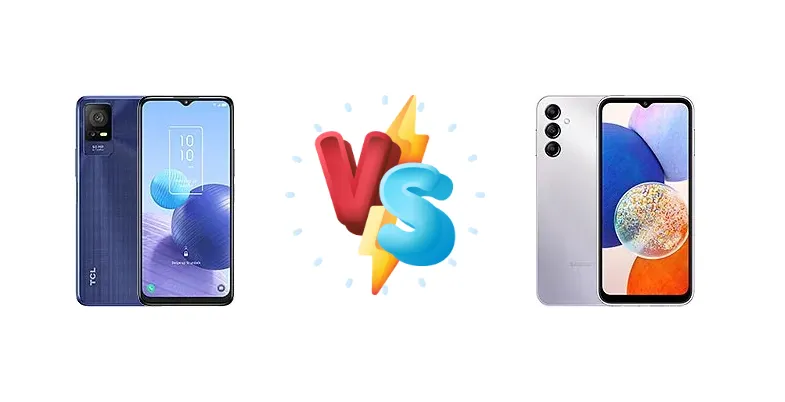
TCL 408 vs Samsung Galaxy A14 5G: A Deep Dive into Budget 5G
| Phones Images | |||||
|---|---|---|---|---|---|
|
🏆 Quick Verdict
For the average user prioritizing a smoother overall experience and better future-proofing, the Samsung Galaxy A14 5G is the stronger choice. Its Exynos 1330 (or Dimensity 700 depending on region) offers significantly improved CPU and GPU performance compared to the TCL 408’s Helio G25, justifying the slight price premium.
| PHONES | ||
|---|---|---|
| Phone Names | TCL 408 | Samsung Galaxy A14 5G |
| Network | ||
|---|---|---|
| 2G bands | GSM 850 / 900 / 1800 / 1900 | GSM 850 / 900 / 1800 / 1900 |
| 3G bands | HSDPA 850 / 900 / 1700(AWS) / 1900 / 2100 - T507A, T507U, T507U1, T507U2, T507J | HSDPA 850 / 900 / 1700(AWS) / 1900 / 2100 |
| 4G bands | 1, 3, 5, 7, 8, 13, 20, 28, 38, 40, 41 - T507U, T507U1, T507U2 | 1, 2, 3, 4, 5, 7, 8, 12, 17, 20, 26, 28, 38, 40, 41, 66 - International |
| 5G bands | - | 2, 5, 66, 77 Sub6/mmWave - USA |
| Speed | HSPA 42.2/11.5 Mbps, LTE Cat4 150/75 Mbps | HSPA, LTE, 5G |
| Technology | GSM / HSPA / LTE | GSM / HSPA / LTE / 5G |
| 1, 3, 5, 7, 8, 20, 28 - T507D1 | 1, 3, 5, 7, 8, 20, 28, 40, 41, 78 SA/NSA/Sub6 - India | |
| Launch | ||
|---|---|---|
| Announced | 2023, January 05 | 2023, January 04 |
| Status | Available. Released 2023, March 31 | Available. Released 2023, January 12 |
| Body | ||
|---|---|---|
| Build | - | Glass front, plastic back, plastic frame |
| Dimensions | 164.7 x 75.4 x 9 mm (6.48 x 2.97 x 0.35 in) | 167.7 x 78 x 9.1 mm (6.60 x 3.07 x 0.36 in) |
| SIM | · Nano-SIM· Nano-SIM + Nano-SIM | · Nano-SIM· Nano-SIM + Nano-SIM |
| Weight | 190 g (6.70 oz) | 202 g (7.13 oz) |
| Display | ||
|---|---|---|
| Resolution | 720 x 1612 pixels, 20:9 ratio (~267 ppi density) | 1080 x 2408 pixels, 20:9 ratio (~400 ppi density) |
| Size | 6.6 inches, 104.6 cm2 (~84.3% screen-to-body ratio) | 6.6 inches, 104.9 cm2 (~80.2% screen-to-body ratio) |
| Type | IPS LCD, 400 nits (typ) | PLS LCD, 90Hz |
| Platform | ||
|---|---|---|
| CPU | Octa-core (4x2.0 GHz Cortex-A53 & 4x1.5 GHz Cortex-A53) | Octa-core (2x2.4 GHz Cortex-A78 & 6x2.0 GHz Cortex-A55) - SM-A146BOcta-core (2x2.2 GHz Cortex-A76 & 6x2.0 GHz Cortex-A55) - SM-A146P |
| Chipset | Mediatek MT6762G Helio G25 (12 nm) | Exynos 1330 (5 nm) - SM-A146BMediatek Dimensity 700 (7 nm) - SM-A146P |
| GPU | PowerVR GE8320 | Mali-G68 MP2 - SM-A146BMali-G57 MC2 - SM-A146P |
| OS | Android 12 | Android 13, upgradable to Android 15, One UI Core 7 |
| Memory | ||
|---|---|---|
| Card slot | microSDXC (dedicated slot) | microSDXC (uses shared SIM slot) - USA onlymicroSDXC (dedicated slot) - International |
| Internal | 64GB 4GB RAM, 64GB 6GB RAM, 128GB 4GB RAM | 64GB 4GB RAM, 128GB 4GB RAM, 128GB 6GB RAM, 128GB 8GB RAM |
| eMMC 5.1 | - | |
| Main Camera | ||
|---|---|---|
| Dual | 50 MP, f/1.8, 26mm (wide), 1/2.55", 0.7µm, PDAF Auxiliary lens | - |
| Features | LED flash | LED flash, panorama, HDR |
| Single | 8 MP, f/2.0, 27mm (wide), 1/4", 1.12µm | 13 MP, f/2.0, (wide) |
| Triple | - | 50 MP, f/1.8, 26mm (wide), 1/2.76", 0.64µm, PDAF 2 MP (macro) Auxiliary lens |
| Video | 1080p@30fps | 1080p@30fps |
| Selfie camera | ||
|---|---|---|
| Single | 8 MP, f/2.0, 27mm (wide), 1/4.0", 1.12µm | 13 MP, f/2.0, 26mm (wide), 1.12µm |
| Video | 1080p@30fps | 1080p@30fps |
| Sound | ||
|---|---|---|
| 3.5mm jack | Yes | Yes |
| 35mm jack | Yes | Yes |
| Loudspeaker | Yes, with stereo speakers | Yes |
| Comms | ||
|---|---|---|
| Bluetooth | 5.1, A2DP, LE | 5.2, A2DP, LE |
| NFC | Yes (T507U only) | Yes |
| Positioning | GPS, GLONASS, GALILEO, BDS | GPS, GLONASS, GALILEO |
| Radio | FM radio | FM radio (Exynos 1330 chipset only), recording |
| USB | USB Type-C 2.0, OTG | USB Type-C 2.0 |
| WLAN | Wi-Fi 802.11 a/b/g/n/ac, dual-band, Wi-Fi Direct | Wi-Fi 802.11 a/b/g/n/ac, dual-band, Wi-Fi Direct |
| Features | ||
|---|---|---|
| Sensors | Fingerprint (side-mounted), accelerometer | Fingerprint (side-mounted), accelerometer, gyro, proximity, compass, barometer (USA only) |
| Virtual proximity sensing | - | |
| Battery | ||
|---|---|---|
| Charging | 10W wired | 15W wired |
| Type | Li-Po 5000 mAh | Li-Po 5000 mAh |
| Misc | ||
|---|---|---|
| Colors | Gravity Grey, Midnight Blue | Black, Light Green, Dark Red, Silver |
| Models | T507D1, T507A, T507U, T507U1, T507U2, T507J | SM-A146B, SM-A146B/DS, SM-A146P, SM-A146P/DS, SM-A146U, SM-A146U1, SM-A146U1/DS, SM-A146W, SM-A146P/N, SM-A146P/DSN, SM-S146VL, SM-A146M |
| Price | About 130 EUR | $ 77.63 / C$ 151.00 / £ 97.00 / € 159.79 / ₹ 14,990 |
| SAR | - | 1.00 W/kg (head) 1.00 W/kg (body) |
| SAR EU | - | 0.56 W/kg (head) 1.28 W/kg (body) |
| Tests | ||
|---|---|---|
| Battery life | - | Endurance rating 130h |
| Camera | - | Photo / Video |
| Display | - | Contrast ratio: 1334:1 (nominal) |
| Loudspeaker | - | -26.8 LUFS (Good) |
| Performance | - | AnTuTu: 307886 (v9) GeekBench: 1727 (v5.1) GFXBench: 12fps (ES 3.1 onscreen) |
TCL 408
- Lower price point
- Acceptable battery life
- Functional for basic tasks
- Weak processor performance
- Slow charging speed
- Limited display brightness
Samsung Galaxy A14 5G
- Significantly faster processor
- Brighter display
- Faster charging (15W)
- Slightly higher price
- Potential regional chipset variation (Exynos vs Dimensity)
- Basic camera system
Display Comparison
The Samsung Galaxy A14 5G boasts a brighter display, measured at 519 nits, compared to the TCL 408’s unspecified brightness. Both share a 1334:1 contrast ratio, suggesting similar color reproduction quality. However, the brighter panel on the A14 5G will be noticeably more usable outdoors under direct sunlight. While neither phone is expected to feature high refresh rates, the A14 5G’s larger screen size (6.6 inches vs. 6.56 inches) provides a more immersive viewing experience. The TCL 408’s display specifications are minimal, suggesting a focus on cost reduction rather than visual fidelity.
Camera Comparison
Both phones offer a 'Photo / Video' camera experience, but details are sparse. The TCL 408’s camera specifications are largely unknown, suggesting a basic camera setup. The Samsung Galaxy A14 5G likely features a more capable main sensor, though resolution details are missing. It’s important to note that the inclusion of a 2MP macro camera on either device is largely a marketing tactic, offering minimal practical benefit due to the low resolution and lack of optical image stabilization (OIS). Image processing will likely be a key differentiator, with Samsung’s software generally providing more refined results.
Performance
This is where the most significant difference lies. The Samsung Galaxy A14 5G utilizes either the Exynos 1330 (SM-A146B) or the Mediatek Dimensity 700 (SM-A146P), both built on more advanced process nodes (5nm and 7nm respectively) than the TCL 408’s 12nm Mediatek Helio G25. The Exynos 1330 features a more modern CPU architecture with 2x Cortex-A78 cores alongside 6x Cortex-A55 cores, offering a substantial performance uplift over the TCL 408’s 4x Cortex-A53 and 4x Cortex-A53 configuration. This translates to faster app loading times, smoother multitasking, and improved gaming performance on the A14 5G. The Dimensity 700, while less powerful than the Exynos, still provides a significant advantage over the Helio G25. The TCL 408’s Helio G25 is geared towards basic functionality and will struggle with demanding applications.
Battery Life
Both the TCL 408 and Samsung Galaxy A14 5G achieve an endurance rating of 130 hours, indicating similar battery life under typical usage. However, the Samsung Galaxy A14 5G supports 15W wired charging, compared to the TCL 408’s slower 10W charging. This means the A14 5G will recharge from 0-100% significantly faster, a crucial advantage for users who rely heavily on their smartphones throughout the day. While the battery capacity isn’t specified for either device, the more efficient chipset in the A14 5G likely contributes to comparable endurance despite potentially having a smaller battery.
Buying Guide
Buy the TCL 408 if you need a basic, functional smartphone for essential tasks like calls, texts, and light social media browsing, and are extremely budget-constrained. Buy the Samsung Galaxy A14 5G if you prefer a more responsive device capable of handling moderate multitasking, occasional gaming, and benefit from a brighter display and potentially faster 5G speeds depending on the variant.