
TCL 408 vs. Motorola Moto G Stylus (2023): A Deep Dive into Budget Smartphone Choices
| Phones Images | |||||
|---|---|---|---|---|---|
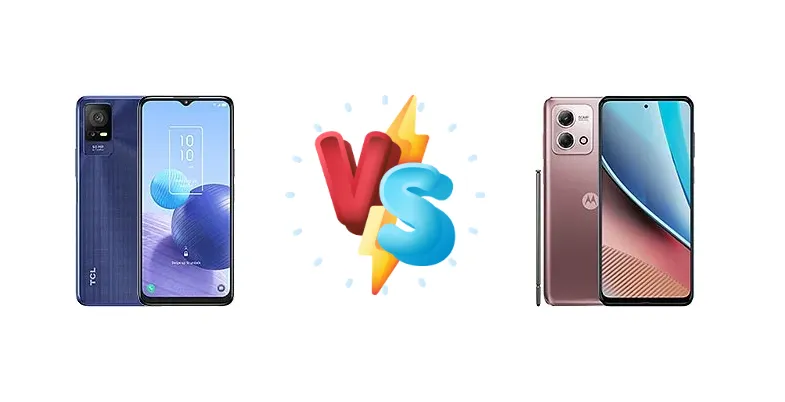
|
🏆 Quick Verdict
For most users, the Motorola Moto G Stylus (2023) is the better choice. Its Helio G85 chipset provides a noticeable performance uplift over the TCL 408’s Helio G25, translating to smoother multitasking and gaming. While the TCL 408 is more affordable, the Moto G Stylus’s extra processing power and faster charging justify the slight price premium.
| PHONES | ||
|---|---|---|
| Phone Names | TCL 408 | Motorola Moto G Stylus (2023) |
| Network | ||
|---|---|---|
| 2G bands | GSM 850 / 900 / 1800 / 1900 | GSM 850 / 900 / 1800 / 1900 |
| 3G bands | HSDPA 850 / 900 / 1700(AWS) / 1900 / 2100 - T507A, T507U, T507U1, T507U2, T507J | HSDPA 850 / 900 / 1700(AWS) / 1900 / 2100 |
| 4G bands | 1, 3, 5, 7, 8, 13, 20, 28, 38, 40, 41 - T507U, T507U1, T507U2 | 1, 2, 3, 4, 5, 7, 8, 12, 13, 14, 17, 25, 26, 29, 30, 38, 41, 66, 71 |
| Speed | HSPA 42.2/11.5 Mbps, LTE Cat4 150/75 Mbps | HSPA, LTE |
| Technology | GSM / HSPA / LTE | GSM / HSPA / LTE |
| 1, 3, 5, 7, 8, 20, 28 - T507D1 | - | |
| Launch | ||
|---|---|---|
| Announced | 2023, January 05 | 2023, May 02 |
| Status | Available. Released 2023, March 31 | Available. Released 2023, May 05 |
| Body | ||
|---|---|---|
| Build | - | Glass front, plastic frame, plastic back |
| Dimensions | 164.7 x 75.4 x 9 mm (6.48 x 2.97 x 0.35 in) | 162.9 x 74.1 x 9.2 mm (6.41 x 2.92 x 0.36 in) |
| SIM | · Nano-SIM· Nano-SIM + Nano-SIM | Nano-SIM |
| Weight | 190 g (6.70 oz) | 195 g (6.88 oz) |
| - | Stylus Water-repellent design | |
| Display | ||
|---|---|---|
| Resolution | 720 x 1612 pixels, 20:9 ratio (~267 ppi density) | 720 x 1600 pixels, 20:9 ratio (~270 ppi density) |
| Size | 6.6 inches, 104.6 cm2 (~84.3% screen-to-body ratio) | 6.5 inches, 102.0 cm2 (~84.5% screen-to-body ratio) |
| Type | IPS LCD, 400 nits (typ) | IPS LCD, 90Hz |
| Platform | ||
|---|---|---|
| CPU | Octa-core (4x2.0 GHz Cortex-A53 & 4x1.5 GHz Cortex-A53) | Octa-core (2x2.0 GHz Cortex-A75 & 6x1.8 GHz Cortex-A55) |
| Chipset | Mediatek MT6762G Helio G25 (12 nm) | Mediatek MT6769 Helio G85 (12 nm) |
| GPU | PowerVR GE8320 | Mali-G52 MC2 |
| OS | Android 12 | Android 13, planned upgrade to Android 14 |
| Memory | ||
|---|---|---|
| Card slot | microSDXC (dedicated slot) | microSDXC (dedicated slot) |
| Internal | 64GB 4GB RAM, 64GB 6GB RAM, 128GB 4GB RAM | 64GB 4GB RAM |
| eMMC 5.1 | - | |
| Main Camera | ||
|---|---|---|
| Dual | 50 MP, f/1.8, 26mm (wide), 1/2.55", 0.7µm, PDAF Auxiliary lens | 50 MP, f/1.8, (wide), 0.64µm, PDAF 2 MP (macro) |
| Features | LED flash | LED flash, HDR, panorama |
| Single | 8 MP, f/2.0, 27mm (wide), 1/4", 1.12µm | - |
| Triple | - | 50 MP, f/1.8, (wide), 0.64µm, PDAF 2 MP, f/2.4, (macro) |
| Video | 1080p@30fps | 1080p@30/60fps |
| Selfie camera | ||
|---|---|---|
| Features | - | HDR |
| Single | 8 MP, f/2.0, 27mm (wide), 1/4.0", 1.12µm | 8 MP, f/2.0, (wide), 1/4.0", 1.12µm |
| Video | 1080p@30fps | 1080p@30fps |
| Sound | ||
|---|---|---|
| 3.5mm jack | Yes | Yes |
| 35mm jack | Yes | Yes |
| Loudspeaker | Yes, with stereo speakers | Yes, with stereo speakers |
| Comms | ||
|---|---|---|
| Bluetooth | 5.1, A2DP, LE | 5.0, A2DP, LE |
| NFC | Yes (T507U only) | No |
| Positioning | GPS, GLONASS, GALILEO, BDS | GPS, GLONASS, GALILEO |
| Radio | FM radio | No |
| USB | USB Type-C 2.0, OTG | USB Type-C 2.0 |
| WLAN | Wi-Fi 802.11 a/b/g/n/ac, dual-band, Wi-Fi Direct | Wi-Fi 802.11 a/b/g/n/ac, dual-band, Wi-Fi Direct |
| Features | ||
|---|---|---|
| Sensors | Fingerprint (side-mounted), accelerometer | Fingerprint (side-mounted), accelerometer, gyro, proximity, compass, barometer |
| Virtual proximity sensing | - | |
| Battery | ||
|---|---|---|
| Charging | 10W wired | 15W wired |
| Type | Li-Po 5000 mAh | Li-Po 5000 mAh |
| Misc | ||
|---|---|---|
| Colors | Gravity Grey, Midnight Blue | Blue, Rose Gold |
| Models | T507D1, T507A, T507U, T507U1, T507U2, T507J | - |
| Price | About 130 EUR | About 200 EUR |
TCL 408
- Lower price point makes it highly accessible.
- Simple and straightforward user experience.
- Decent battery life for basic usage.
- Significantly weaker performance compared to the Moto G Stylus.
- Slower charging speed.
- Likely limited software updates.
Motorola Moto G Stylus (2023)
- More powerful Helio G85 chipset for smoother performance.
- Faster 15W wired charging.
- Integrated stylus for note-taking and creative tasks.
- Slightly higher price.
- May still struggle with graphically intensive games.
- Software bloatware is common on Motorola devices.
Display Comparison
Neither device boasts a standout display. Both likely utilize LCD panels, common in this price bracket. The key difference lies under the hood: processing power impacts UI responsiveness, which indirectly affects perceived display smoothness. We lack specific display specs like brightness (nits) or color gamut coverage, but given the price point, expect standard performance. Bezels are likely comparable, prioritizing cost savings over premium aesthetics.
Camera Comparison
Camera performance is likely similar, relying heavily on software processing. Both phones likely feature a primary camera and depth sensor. Without specific sensor size or aperture information, it’s difficult to make a definitive judgment. However, the G85’s image signal processor (ISP) is more advanced, potentially leading to better image quality in challenging lighting conditions. The TCL 408’s camera will likely suffice for casual snapshots, but the Moto G Stylus offers a slight edge in overall image processing capabilities. We can assume both will include a 2MP macro camera, which is often of limited practical use.
Performance
The Motorola Moto G Stylus (2023) holds a clear advantage in performance. Its Mediatek Helio G85 chipset, featuring 2x Cortex-A75 cores clocked at 2.0 GHz and 6x Cortex-A55 cores at 1.8 GHz, is significantly more powerful than the TCL 408’s Helio G25 (4x Cortex-A53 at 2.0 GHz & 4x Cortex-A53 at 1.5 GHz). The G85’s newer architecture and higher clock speeds will result in faster app loading times, smoother multitasking, and a more enjoyable gaming experience. The TCL 408’s older Cortex-A53 cores will struggle with demanding applications. While both use 12nm process technology, the architectural improvements of the G85 outweigh this similarity.
Battery Life
Battery life will depend heavily on usage patterns. While the exact battery capacities are unknown, the Motorola Moto G Stylus (2023) benefits from 15W wired charging, compared to the TCL 408’s slower 10W charging. This translates to significantly faster top-up times, reducing downtime. A 15W charger will replenish the battery much quicker, making it more convenient for users who frequently need to charge their phones throughout the day. The TCL 408’s slower charging speed will require a longer connection to the wall.
Buying Guide
Buy the TCL 408 if you prioritize absolute affordability and only need a phone for basic tasks like calls, texts, and light social media. It’s a solid option for first-time smartphone users or those on a very tight budget. Buy the Motorola Moto G Stylus (2023) if you value performance, enjoy taking notes or sketching with a stylus, and appreciate faster charging speeds. It’s ideal for students, professionals, or anyone who wants a more versatile and responsive smartphone experience.