
Google Pixel 7a vs TCL 408: A Detailed Comparison of Performance, Camera, and Value
| Phones Images | |||||
|---|---|---|---|---|---|
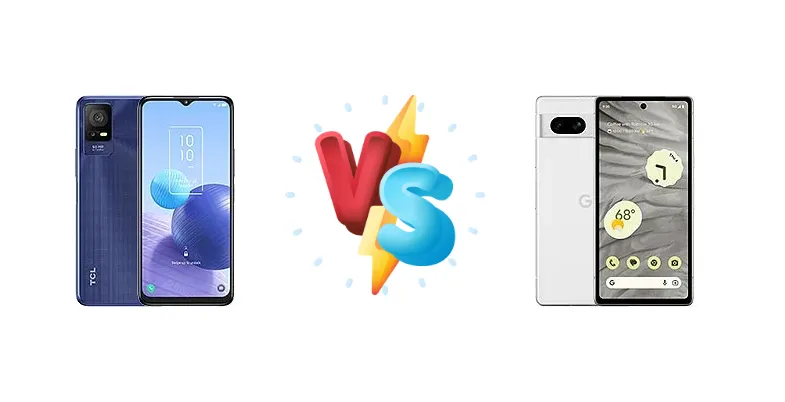
|
🏆 Quick Verdict
For most users, the Google Pixel 7a is the superior choice. Its Tensor G2 chipset provides significantly faster performance and advanced features like on-device AI processing, coupled with a vastly superior camera system. However, the TCL 408 offers a compelling option for those prioritizing extreme affordability and basic smartphone functionality.
| PHONES | ||
|---|---|---|
| Phone Names | TCL 408 | Google Pixel 7a |
| Network | ||
|---|---|---|
| 2G bands | GSM 850 / 900 / 1800 / 1900 | GSM 850 / 900 / 1800 / 1900 |
| 3G bands | HSDPA 850 / 900 / 1700(AWS) / 1900 / 2100 - T507A, T507U, T507U1, T507U2, T507J | HSDPA 800 / 850 / 900 / 1700(AWS) / 1900 / 2100 |
| 4G bands | 1, 3, 5, 7, 8, 13, 20, 28, 38, 40, 41 - T507U, T507U1, T507U2 | 1, 2, 3, 4, 5, 7, 8, 12, 13, 14, 17, 20, 25, 26, 28, 29, 30, 38, 40, 41, 48, 66, 71 - GWKK3, G0DZQ |
| 5G bands | - | 1, 2, 3, 5, 7, 8, 12, 14, 20, 25, 28, 30, 38, 41, 48, 66, 71, 77, 78 SA/NSA/Sub6 - GWKK3 |
| Speed | HSPA 42.2/11.5 Mbps, LTE Cat4 150/75 Mbps | HSPA, LTE, 5G |
| Technology | GSM / HSPA / LTE | GSM / HSPA / LTE / 5G |
| 1, 3, 5, 7, 8, 20, 28 - T507D1 | 1, 2, 3, 5, 7, 8, 12, 20, 25, 28, 38, 40, 41, 66, 75, 76, 77, 78, 79 SA/NSA/Sub6 - GHL1X, G82U8 | |
| Launch | ||
|---|---|---|
| Announced | 2023, January 05 | 2023, May 10 |
| Status | Available. Released 2023, March 31 | Available. Released 2023, May 10 |
| Body | ||
|---|---|---|
| Build | - | Glass front (Gorilla Glass 3), aluminum frame, plastic back |
| Dimensions | 164.7 x 75.4 x 9 mm (6.48 x 2.97 x 0.35 in) | 152 x 72.9 x 9 mm (5.98 x 2.87 x 0.35 in) |
| SIM | · Nano-SIM· Nano-SIM + Nano-SIM | Nano-SIM + eSIM |
| Weight | 190 g (6.70 oz) | 193.5 g (6.84 oz) |
| - | IP67 dust/water resistant (up to 1m for 30 min) | |
| Display | ||
|---|---|---|
| Protection | - | Corning Gorilla Glass 3 |
| Resolution | 720 x 1612 pixels, 20:9 ratio (~267 ppi density) | 1080 x 2400 pixels, 20:9 ratio (~429 ppi density) |
| Size | 6.6 inches, 104.6 cm2 (~84.3% screen-to-body ratio) | 6.1 inches, 90.7 cm2 (~81.8% screen-to-body ratio) |
| Type | IPS LCD, 400 nits (typ) | OLED, HDR, 90Hz |
| - | Always-on display | |
| Platform | ||
|---|---|---|
| CPU | Octa-core (4x2.0 GHz Cortex-A53 & 4x1.5 GHz Cortex-A53) | Octa-core (2x2.85 GHz Cortex-X1 & 2x2.35 GHz Cortex-A78 & 4x1.80 GHz Cortex-A55) |
| Chipset | Mediatek MT6762G Helio G25 (12 nm) | Google Tensor G2 (5 nm) |
| GPU | PowerVR GE8320 | Mali-G710 MP7 |
| OS | Android 12 | Android 13, upgradable to Android 15, up to 5 major Android upgrades |
| Memory | ||
|---|---|---|
| Card slot | microSDXC (dedicated slot) | No |
| Internal | 64GB 4GB RAM, 64GB 6GB RAM, 128GB 4GB RAM | 128GB 8GB RAM |
| eMMC 5.1 | UFS 3.1 | |
| Main Camera | ||
|---|---|---|
| Dual | 50 MP, f/1.8, 26mm (wide), 1/2.55", 0.7µm, PDAF Auxiliary lens | 64 MP, f/1.9, 26mm (wide), 1/1.73", 0.8µm, dual pixel PDAF, OIS 13 MP, f/2.2, 120˚ (ultrawide), 1.12µm |
| Features | LED flash | Dual-LED flash, Pixel Shift, Auto-HDR, panorama |
| Single | 8 MP, f/2.0, 27mm (wide), 1/4", 1.12µm | - |
| Video | 1080p@30fps | 4K@30/60fps, 1080p@30/60/120/240fps, OIS |
| Selfie camera | ||
|---|---|---|
| Features | - | HDR, panorama |
| Single | 8 MP, f/2.0, 27mm (wide), 1/4.0", 1.12µm | 13 MP, f/2.2, 20mm (ultrawide), 1.12µm |
| Video | 1080p@30fps | 4K@30fps, 1080p@30fps |
| Sound | ||
|---|---|---|
| 3.5mm jack | Yes | No |
| 35mm jack | Yes | No |
| Loudspeaker | Yes, with stereo speakers | Yes, with stereo speakers |
| Comms | ||
|---|---|---|
| Bluetooth | 5.1, A2DP, LE | 5.3, A2DP, LE |
| NFC | Yes (T507U only) | Yes |
| Positioning | GPS, GLONASS, GALILEO, BDS | GPS, GLONASS, GALILEO, BDS, QZSS, NavIC |
| Radio | FM radio | No |
| USB | USB Type-C 2.0, OTG | USB Type-C 3.2 |
| WLAN | Wi-Fi 802.11 a/b/g/n/ac, dual-band, Wi-Fi Direct | Wi-Fi 802.11 a/b/g/n/ac/6e, tri-band |
| Features | ||
|---|---|---|
| Sensors | Fingerprint (side-mounted), accelerometer | Fingerprint (under display, optical), accelerometer, gyro, proximity, compass, barometer |
| Virtual proximity sensing | - | |
| Battery | ||
|---|---|---|
| Charging | 10W wired | 18W wired, PD3.0 7.5W wireless |
| Type | Li-Po 5000 mAh | Li-Po 4385 mAh |
| Misc | ||
|---|---|---|
| Colors | Gravity Grey, Midnight Blue | Charcoal, Snow, Sea, Coral |
| Models | T507D1, T507A, T507U, T507U1, T507U2, T507J | GWKK3, GHL1X, G0DZQ, G82U8 |
| Price | About 130 EUR | € 179.90 / $ 150.00 / £ 170.00 / ₹ 25,980 |
TCL 408
- Significantly faster performance with the Tensor G2 chip
- Superior camera quality and Google’s computational photography
- Faster charging and wireless charging support
- Higher price point
- May be slightly larger and heavier than the TCL 408
Google Pixel 7a
- Extremely affordable price
- Potentially longer battery life due to lower power consumption
- Lightweight and compact design (assumed)
- Slow performance with the Helio G25 chipset
- Inferior camera quality
- Slow 10W charging
Display Comparison
The Pixel 7a boasts a significantly brighter display, reaching a measured 1070 nits, compared to an assumed lower brightness on the TCL 408 (typical of its price bracket). This translates to better visibility outdoors. While the TCL 408’s panel specifications are not provided, the Pixel 7a’s display is likely to offer superior color accuracy and viewing angles. The Pixel 7a’s 90Hz refresh rate (not specified for the TCL 408) also contributes to a smoother scrolling experience, enhancing overall usability.
Camera Comparison
The Pixel 7a’s camera system is a clear winner. While specific sensor details aren’t provided, Google’s computational photography prowess, powered by the Tensor G2, elevates image quality significantly. The Pixel 7a excels in low-light photography and offers features like Super Res Zoom. The TCL 408, while likely including a standard camera setup, will struggle to match the Pixel 7a’s dynamic range, detail, and overall image quality. Ignoring the likely low-resolution macro lens on the TCL 408, the Pixel 7a’s video capabilities are also expected to be far superior, with features like Cinematic Pan and 4K recording.
Performance
The performance gap between these devices is substantial. The Google Pixel 7a’s Tensor G2, built on a 5nm process, features a tri-cluster architecture with high-performance Cortex-X1 cores, delivering a vastly superior CPU and GPU experience compared to the TCL 408’s MediaTek Helio G25. The Helio G25, fabricated on a 12nm node, relies on older Cortex-A53 cores, resulting in slower application loading times and struggles with demanding tasks. The Tensor G2’s integrated AI capabilities also enable features like Magic Eraser and Photo Unblur, unavailable on the TCL 408. The Pixel 7a also benefits from faster RAM (likely LPDDR5x) compared to the TCL 408, further enhancing multitasking.
Battery Life
The Pixel 7a has an endurance rating of 76 hours, indicating solid battery life despite not having a massive capacity. Its 18W wired charging with PD3.0 support allows for faster charging compared to the TCL 408’s slow 10W charging. While the TCL 408 might offer slightly longer screen-on time due to its less powerful processor and potentially lower-resolution display, the Pixel 7a’s faster charging and overall efficiency make it more convenient for daily use. The addition of 7.5W wireless charging on the Pixel 7a is a feature absent on the TCL 408.
Buying Guide
Buy the TCL 408 if you need a functional smartphone for basic tasks like calls, texts, and light social media use, and your budget is strictly under $150. You’ll accept compromises in performance and camera quality. Buy the Google Pixel 7a if you prioritize a smooth user experience, excellent camera capabilities, and access to Google’s latest software features, even if it means spending considerably more.