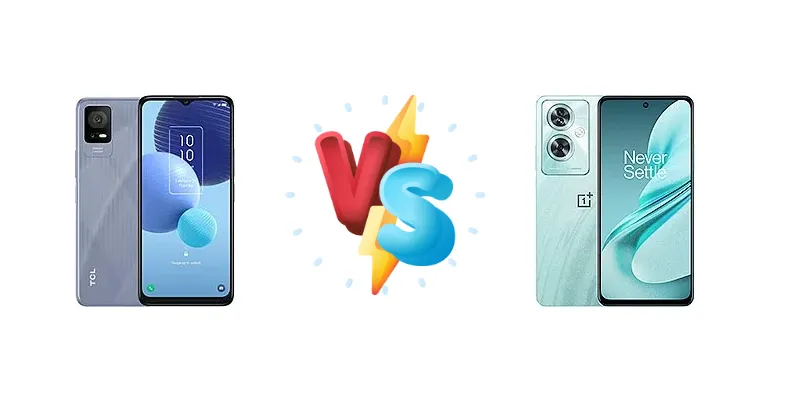
The sub-$200 smartphone market is fiercely competitive. The TCL 406 and OnePlus Nord N30 SE both aim to deliver essential smartphone functionality at an accessible price point, but they take distinctly different approaches to achieving this. The TCL 406 focuses on simplicity, while the Nord N30 SE leverages a more modern chipset for a performance edge.
🏆 Quick Verdict
For most users, the OnePlus Nord N30 SE is the better buy. Its Mediatek Dimensity 6020 chipset provides a significant performance uplift over the TCL 406’s older Cortex-A53 based processor, and the 33W charging dramatically reduces downtime. While the TCL 406 offers a functional experience, the N30 SE delivers a smoother, more responsive user experience.
| Network |
|---|
| 2G bands | GSM 850 / 900 / 1800 / 1900 | GSM 850 / 900 / 1800 / 1900 |
| 3G bands | HSDPA 850 / 900 / 1900 / 2100 | HSDPA 850 / 900 / 1700(AWS) / 1900 / 2100 |
| 4G bands | 1, 3, 5, 7, 8, 20, 28, 38, 40, 41 | 1, 2, 3, 4, 5, 7, 8, 12, 13, 17, 18, 19, 20, 26, 28, 38, 39, 40, 41, 66 |
| 5G bands | - | 1, 3, 5, 7, 8, 20, 28, 38, 40, 41, 66, 77, 78 SA/NSA |
| Speed | HSPA, LTE | HSPA, LTE, 5G |
| Technology | GSM / HSPA / LTE | GSM / HSPA / LTE / 5G |
| | HSDPA 850 / 900 / 1900 / 2100 | - |
| Launch |
|---|
| Announced | 2023, February 26 | 2024, January 29 |
| Status | Available. Released 2023, February 26 | Available. Released 2024, January 31 |
| Body |
|---|
| Build | - | Glass front, plastic frame, plastic back |
| Dimensions | 164.7 x 75.4 x 9 mm (6.48 x 2.97 x 0.35 in) | 165.6 x 76 x 8 mm (6.52 x 2.99 x 0.31 in) |
| SIM | · Nano-SIM· Nano-SIM + Nano-SIM | Nano-SIM + Nano-SIM |
| Weight | 190 g (6.70 oz) | 193 g (6.81 oz) |
| Display |
|---|
| Resolution | 720 x 1612 pixels, 20:9 ratio (~267 ppi density) | 1080 x 2400 pixels, 20:9 ratio (~392 ppi density) |
| Size | 6.6 inches, 104.6 cm2 (~84.3% screen-to-body ratio) | 6.72 inches, 109.0 cm2 (~86.6% screen-to-body ratio) |
| Type | IPS LCD, 400 nits (typ) | IPS LCD |
| Platform |
|---|
| CPU | Octa-core (4x2.0 GHz Cortex-A53 & 4x1.5 GHz Cortex-A53) | Octa-core (2x2.2 GHz Cortex-A76 & 6x2.0 GHz Cortex-A55) |
| Chipset | - | Mediatek Dimensity 6020 (7 nm) |
| GPU | PowerVR GE8320 | Mali-G57 MC2 |
| OS | Android 13 | Android 13, OxygenOS 13.1 |
| Memory |
|---|
| Card slot | microSDXC (dedicated slot) | No |
| Internal | 32GB 3GB RAM | 128GB 4GB RAM |
| Main Camera |
|---|
| Dual | 13 MP, f/2.2, (wide), 1/3.0", 1.12µm, PDAF
Auxiliary lens | 50 MP, f/1.8, (wide), 1/2.76", 0.64µm, PDAF
Auxiliary lens |
| Features | LED flash | LED flash, HDR, panorama |
| Single | 8 MP, f/2.0, 27mm (wide), 1/4", 1.12µm | - |
| Video | 1080p@30fps | 1080p@30fps |
| Selfie camera |
|---|
| Single | 5 MP, f/2.2, (wide), 1/5.0", 1.12µm | 8 MP, f/2.0, (wide), 1/4.0", 1.12µm |
| Video | 1080p@30fps | 1080p@30fps |
| Sound |
|---|
| 3.5mm jack | Yes | - |
| 35mm jack | Yes | Yes |
| Loudspeaker | Yes, with stereo speakers | Yes, with stereo speakers |
| Comms |
|---|
| Bluetooth | 5.1, A2DP, LE | 5.3, A2DP, LE |
| NFC | Yes (market/region dependent) | Yes |
| Positioning | GPS, GLONASS, GALILEO, BDS | GPS, GALILEO, GLONASS, BDS |
| Radio | FM radio | No |
| USB | USB Type-C 2.0, OTG | USB Type-C 2.0, OTG |
| WLAN | Wi-Fi 802.11 a/b/g/n/ac, dual-band, Wi-Fi Direct | Wi-Fi 802.11 a/b/g/n/ac, dual-band |
| Features |
|---|
| Sensors | Fingerprint (side-mounted), accelerometer | Fingerprint (side-mounted), accelerometer, gyro, proximity, compass |
| | Virtual proximity sensing | - |
| Battery |
|---|
| Charging | 10W wired | 33W wired, 51% in 30 min |
| Type | Li-Po 5000 mAh | 5000 mAh |
| Misc |
|---|
| Colors | Dark Grey, Lavender Purple | Black Satin, Cyan |
| Models | T506K | CPH2605 |
| Price | About 110 EUR | About 510 EUR |
TCL 406
- Potentially simpler software experience
- Lower price point (likely)
- Functional for basic tasks
- Significantly slower processor
- Slow 10W charging
- Limited multitasking capabilities
OnePlus Nord N30 SE
- Faster and more efficient Dimensity 6020 chipset
- 33W fast charging (51% in 30 min)
- Smoother user experience
- May have more bloatware
- Slightly higher price (likely)
Display Comparison
Neither TCL nor OnePlus provide display specifications beyond the basic resolution. However, the overall user experience will be impacted by the processing power needed to drive the display. The TCL 406’s older CPU will likely struggle with smoother animations and faster refresh rates, should the display support them. We can assume both utilize LCD panels given the price point, and neither is likely to offer high peak brightness or wide color gamut coverage.
Camera Comparison
Without detailed camera specs, a direct comparison is difficult. However, the processing power of the Dimensity 6020 in the Nord N30 SE will likely translate to better image processing capabilities, including improved noise reduction and dynamic range. The TCL 406’s older processor may struggle with complex computational photography tasks. It’s reasonable to assume both phones feature a primary camera and depth sensor, but the N30 SE’s ISP (Image Signal Processor) will be more advanced.
Performance
The core difference lies in the chipsets. The OnePlus Nord N30 SE’s Mediatek Dimensity 6020, fabricated on a 7nm process, represents a substantial leap forward. Its octa-core configuration, featuring 2x2.2 GHz Cortex-A76 and 6x2.0 GHz Cortex-A55 cores, offers significantly improved single-core and multi-core performance compared to the TCL 406’s Octa-core (4x2.0 GHz Cortex-A53 & 4x1.5 GHz Cortex-A53). The Cortex-A76 cores are architecturally superior to the A53, resulting in faster app loading times and smoother multitasking. The 7nm process also contributes to better power efficiency, potentially offsetting the faster clock speeds.
Battery Life
While battery capacity isn’t specified, the charging speeds are a clear differentiator. The OnePlus Nord N30 SE’s 33W wired charging, capable of delivering 51% charge in 30 minutes, is a game-changer in this price segment. The TCL 406’s 10W charging is comparatively slow, requiring significantly longer to reach a full charge. This means less time tethered to an outlet and more time using the phone, making the N30 SE more convenient for users on the go.
Buying Guide
Buy the TCL 406 if you prioritize extreme simplicity and minimal software overhead, and your smartphone usage is limited to basic tasks like calls, texts, and light social media. Buy the OnePlus Nord N30 SE if you value a more responsive user experience, faster charging, and the ability to handle more demanding apps and occasional gaming. The N30 SE is the better choice for anyone who wants a phone that feels modern and capable.
Frequently Asked Questions
❓ Is the Mediatek Dimensity 6020 in the Nord N30 SE powerful enough for casual gaming?
Yes, the Dimensity 6020 is a capable chipset for casual gaming. While it won't deliver flagship-level performance, it can comfortably handle popular titles like PUBG Mobile and Call of Duty Mobile at medium settings. The TCL 406’s older processor would likely struggle with these games.
❓ How much faster is the 33W charging on the Nord N30 SE compared to the 10W charging on the TCL 406 in real-world use?
The difference is substantial. The Nord N30 SE can gain a significant charge in a short amount of time – 51% in 30 minutes. The TCL 406’s 10W charging will take considerably longer, potentially over 2 hours for a full charge. This makes the N30 SE much more convenient for users who need to quickly top up their battery.
❓ Will I notice a significant difference in app loading times between the two phones?
Yes, you will. The Nord N30 SE’s Dimensity 6020 chipset, with its more modern CPU cores, will load apps much faster than the TCL 406’s older processor. This difference will be noticeable in everyday use, making the N30 SE feel more responsive.