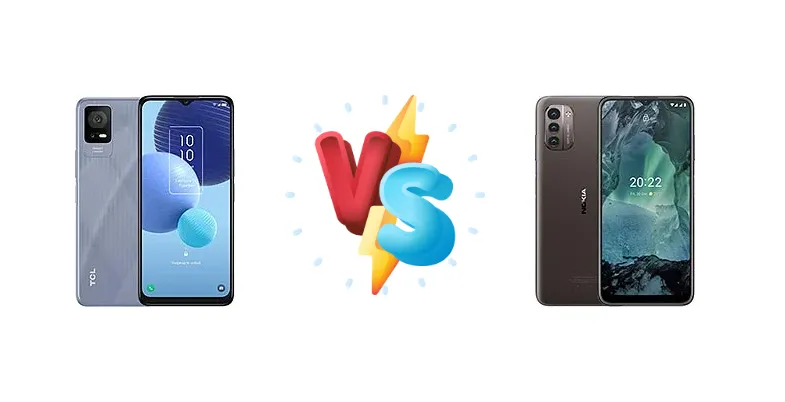
The TCL 406 and Nokia G21 represent compelling options in the ultra-budget smartphone space, but cater to slightly different priorities. The Nokia G21 emphasizes longevity with its advertised 126-hour endurance rating, while the TCL 406 aims for a balance of affordability and basic functionality. This comparison dissects their key specifications to determine which device delivers the best value.
🏆 Quick Verdict
For most users, the Nokia G21 emerges as the stronger choice. Its Unisoc T606 chipset, while not a powerhouse, offers a more modern architecture than the TCL 406’s older Cortex-A53 cores, and the 18W charging with PD3.0 support significantly reduces recharge times. The shared display quality and similar camera capabilities further solidify the Nokia G21’s advantage.
| Network |
|---|
| 2G bands | GSM 850 / 900 / 1800 / 1900 | GSM 850 / 900 / 1800 / 1900 |
| 3G bands | HSDPA 850 / 900 / 1900 / 2100 | HSDPA 850 / 900 / 2100 - International |
| 4G bands | 1, 3, 5, 7, 8, 20, 28, 38, 40, 41 | 1, 3, 5, 7, 8, 20, 28, 38, 40, 41 - International |
| Speed | HSPA, LTE | HSPA 42.2/5.76 Mbps, LTE Cat4 150/50 Mbps |
| Technology | GSM / HSPA / LTE | GSM / HSPA / LTE |
| | HSDPA 850 / 900 / 1900 / 2100 | 1, 2, 3, 4, 5, 7, 8, 12, 17, 28, 40, 66 - LATAM |
| Launch |
|---|
| Announced | 2023, February 26 | 2022, February 14 |
| Status | Available. Released 2023, February 26 | Available. Released 2022, February 15 |
| Body |
|---|
| Build | - | Glass front, plastic frame, plastic back |
| Dimensions | 164.7 x 75.4 x 9 mm (6.48 x 2.97 x 0.35 in) | 164.6 x 75.9 x 8.5 mm (6.48 x 2.99 x 0.33 in) |
| SIM | · Nano-SIM· Nano-SIM + Nano-SIM | · Nano-SIM· Nano-SIM + Nano-SIM |
| Weight | 190 g (6.70 oz) | 190 g (6.70 oz) |
| Display |
|---|
| Resolution | 720 x 1612 pixels, 20:9 ratio (~267 ppi density) | 720 x 1600 pixels, 20:9 ratio (~270 ppi density) |
| Size | 6.6 inches, 104.6 cm2 (~84.3% screen-to-body ratio) | 6.5 inches, 102.0 cm2 (~81.6% screen-to-body ratio) |
| Type | IPS LCD, 400 nits (typ) | IPS LCD, 90Hz, 400 nits (typ) |
| Platform |
|---|
| CPU | Octa-core (4x2.0 GHz Cortex-A53 & 4x1.5 GHz Cortex-A53) | Octa-core (2x1.6 GHz Cortex-A75 & 6x1.6 GHz Cortex-A55) |
| Chipset | - | Unisoc T606 (12 nm) |
| GPU | PowerVR GE8320 | Mali-G57 MP1 |
| OS | Android 13 | Android 11, upgradable to Android 13 |
| Memory |
|---|
| Card slot | microSDXC (dedicated slot) | microSDXC (dedicated slot) |
| Internal | 32GB 3GB RAM | 64GB 3GB RAM, 64GB 4GB RAM, 128GB 4GB RAM, 128GB 6GB RAM |
| | - | eMMC 5.1 |
| Main Camera |
|---|
| Dual | 13 MP, f/2.2, (wide), 1/3.0", 1.12µm, PDAF
Auxiliary lens | - |
| Features | LED flash | LED flash, HDR, panorama |
| Single | 8 MP, f/2.0, 27mm (wide), 1/4", 1.12µm | 8 MP, f/2.0, (wide) |
| Triple | - | 50 MP, f/1.8, 28mm (wide), 1/2.76", 0.64µm, PDAF
2 MP (macro)
Auxiliary lens |
| Video | 1080p@30fps | 1080p@30fps |
| Selfie camera |
|---|
| Single | 5 MP, f/2.2, (wide), 1/5.0", 1.12µm | 8 MP, f/2.0, (wide) |
| Video | 1080p@30fps | 1080p@30fps |
| Sound |
|---|
| 3.5mm jack | Yes | Yes |
| 35mm jack | Yes | Yes |
| Loudspeaker | Yes, with stereo speakers | Yes |
| Comms |
|---|
| Bluetooth | 5.1, A2DP, LE | 5.0, A2DP, LE |
| NFC | Yes (market/region dependent) | Yes (market/region dependent) |
| Positioning | GPS, GLONASS, GALILEO, BDS | GPS, GLONASS, GALILEO |
| Radio | FM radio | FM radio, RDS |
| USB | USB Type-C 2.0, OTG | USB Type-C 2.0, OTG |
| WLAN | Wi-Fi 802.11 a/b/g/n/ac, dual-band, Wi-Fi Direct | Wi-Fi 802.11 a/b/g/n/ac, dual-band, Wi-Fi Direct |
| Features |
|---|
| Sensors | Fingerprint (side-mounted), accelerometer | Fingerprint (side-mounted), accelerometer, proximity |
| | Virtual proximity sensing | - |
| Battery |
|---|
| Charging | 10W wired | 18W wired, PD3.0 |
| Type | Li-Po 5000 mAh | Li-Po 5050 mAh |
| Misc |
|---|
| Colors | Dark Grey, Lavender Purple | Nordic Blue, Dusk |
| Models | T506K | TA-1418, TA-1477, TA-1415, TA-1405, TA-1404, TA-1412 |
| Price | About 110 EUR | About 90 EUR |
| SAR | - | 1.00 W/kg (head) 1.10 W/kg (body) |
| SAR EU | - | 0.34 W/kg (head) 1.05 W/kg (body) |
| Tests |
|---|
| Battery life | - |
Endurance rating 126h
|
| Camera | - |
Photo / Video |
| Display | - |
Contrast ratio: 1631:1 (nominal) |
| Loudspeaker | - |
-30.7 LUFS (Below average)
|
| Performance | - |
AnTuTu: 171299 (v9)
GeekBench: 1193 (v5.1)
GFXBench: 8.9fps (ES 3.1 onscreen) |
TCL 406
- Extremely affordable price point
- Simple and easy-to-use interface
- Acceptable for basic communication tasks
- Outdated processor architecture
- Slow 10W charging
- Limited performance for multitasking
Nokia G21
- More modern Unisoc T606 chipset
- Faster 18W charging with PD3.0
- Excellent 126-hour endurance rating
- Still a budget device with limitations
- Camera performance likely basic
- May be slightly more expensive than the TCL 406
Display Comparison
Both the TCL 406 and Nokia G21 feature displays with a 1631:1 contrast ratio, suggesting similar visual characteristics in terms of black levels and dynamic range. The Nokia G21 boasts a measured peak brightness of 500 nits, which, while not exceptional, is adequate for outdoor visibility in moderate conditions. The TCL 406’s brightness is not specified, but likely falls within a similar range given its market positioning. Neither device is expected to offer advanced display features like high refresh rates or LTPO technology, focusing instead on cost-effectiveness.
Camera Comparison
Both devices are listed with 'Photo / Video' capabilities, indicating basic camera functionality. However, without specific sensor details or megapixel counts, a direct comparison is difficult. It’s reasonable to assume both phones employ entry-level sensors and image processing algorithms. The absence of details suggests neither device is positioned as a photography powerhouse. Focusing on the core specs, the Nokia G21’s chipset may offer slightly better image signal processing capabilities, potentially resulting in marginally improved image quality, but this is speculative without further information.
Performance
The Nokia G21’s Unisoc T606 (12nm) chipset represents a more modern design than the TCL 406’s octa-core processor comprised of older Cortex-A53 cores (4x2.0 GHz & 4x1.5 GHz). The T606 utilizes a combination of Cortex-A75 and A55 cores, offering improved single-core and multi-core performance, respectively. This translates to snappier app launches and smoother multitasking on the Nokia G21. While both phones likely feature similar RAM configurations, the architectural advantage of the T606 will be noticeable in demanding applications. The TCL 406’s older architecture will likely exhibit more pronounced slowdowns under load.
Battery Life
The Nokia G21’s standout feature is its advertised 126-hour endurance rating, suggesting excellent battery life. Coupled with 18W wired charging and PD3.0 support, it offers a significant advantage over the TCL 406’s 10W charging. PD3.0 allows for more efficient charging and compatibility with a wider range of chargers. While the TCL 406’s battery capacity isn’t specified, the slower charging speed indicates it likely has a smaller capacity or less efficient power management. The Nokia G21 will likely achieve a full charge significantly faster, minimizing downtime.
Buying Guide
Buy the TCL 406 if your primary need is a very basic, extremely affordable smartphone for essential tasks like calls and messaging, and you aren't concerned with performance or fast charging. Buy the Nokia G21 if you prioritize battery life, slightly better performance for multitasking, and the convenience of faster, more versatile charging, even if it means spending a little more.
Frequently Asked Questions
❓ How much faster is the 18W charging on the Nokia G21 compared to the 10W charging on the TCL 406?
While exact charge times depend on the charger and battery capacity, 18W charging is significantly faster. Expect the Nokia G21 to reach a full charge in approximately 2-3 hours, while the TCL 406 could take 4-5 hours or longer. The PD3.0 support on the Nokia G21 also ensures more efficient charging.
❓ Will the Unisoc T606 in the Nokia G21 handle basic gaming like PUBG Mobile or Call of Duty Mobile?
The Unisoc T606 can handle basic gaming, but don't expect high frame rates or ultra settings. PUBG Mobile and Call of Duty Mobile will likely be playable at low to medium settings with moderate frame rates. The TCL 406’s older processor will struggle more with these titles.
❓ Is the 126-hour endurance rating of the Nokia G21 realistic in everyday use?
The 126-hour endurance rating is based on Nokia’s testing methodology, which includes a mix of usage scenarios. Real-world battery life will vary depending on your usage patterns (e.g., screen brightness, app usage, network connectivity). However, it indicates that the Nokia G21 offers significantly longer battery life than most smartphones in this price range.