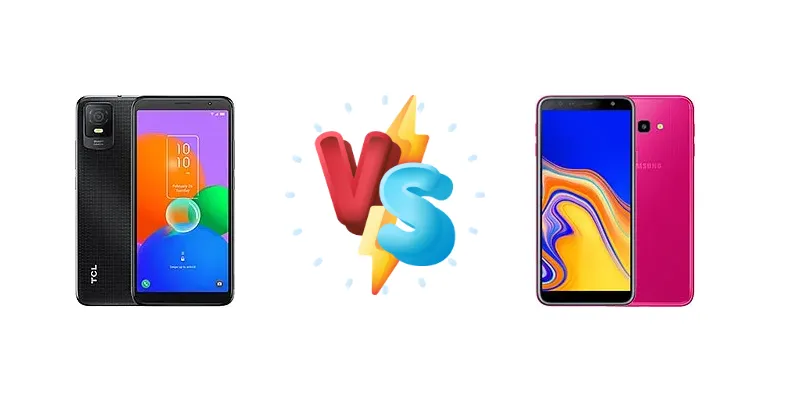
The budget smartphone market is fiercely competitive, offering incredible value for those seeking essential features without breaking the bank. Today, we pit two contenders against each other: the TCL 403 and the Samsung Galaxy J4+. Let's dive into a detailed comparison to see which phone emerges as the winner.
🏆 Quick Verdict
The TCL 403 edges out the Galaxy J4+ thanks to its slightly more powerful chipset and potentially better display. While both are budget options, the TCL 403 offers a bit more performance for the price, making it a more compelling choice for everyday tasks and light gaming.
| Network |
|---|
| 2G bands | GSM 850 / 900 / 1800 / 1900 | GSM 850 / 900 / 1800 / 1900 |
| 3G bands | HSDPA 900 / 2100 - T431D | HSDPA 850 / 900 / 1900 / 2100 - J415F/DS, J415FN/DS |
| 4G bands | 1, 3, 7, 8, 20, 28 - T431D | 1, 3, 5, 7, 8, 20, 38, 40, 41 - J415F/DS, J415FN/DS |
| Speed | HSPA 42.2/11.5 Mbps, LTE Cat4 150/75 Mbps | HSPA 42.2/5.76 Mbps, LTE Cat4 150/50 Mbps |
| Technology | GSM / HSPA / LTE | GSM / HSPA / LTE |
| | 1, 3, 5, 7, 8, 20, 28, 38, 40, 41 - T431Q | 1, 2, 3, 4, 5, 7, 8, 12, 13, 17, 20, 28, 38, 40, 41, 66 - J415G/DS |
| Launch |
|---|
| Announced | 2023, January 05 | 2018, September. Released 2018, October |
| Status | Available. Released 2023, April 04 | Discontinued |
| Body |
|---|
| Build | - | Glass front, plastic back, plastic frame |
| Dimensions | 159.2 x 78.2 x 9.6 mm (6.27 x 3.08 x 0.38 in) | 161.4 x 76.9 x 7.9 mm (6.35 x 3.03 x 0.31 in) |
| SIM | · Nano-SIM· Nano-SIM + Nano-SIM | Nano-SIM + Nano-SIM |
| Weight | 182 g (6.42 oz) | 178 g (6.28 oz) |
| Display |
|---|
| Resolution | 480 x 960 pixels, 18:9 ratio (~179 ppi density) | 720 x 1480 pixels, 18.5:9 ratio (~274 ppi density) |
| Size | 6.0 inches, 92.9 cm2 (~74.6% screen-to-body ratio) | 6.0 inches, 91.4 cm2 (~73.6% screen-to-body ratio) |
| Type | TFT LCD | IPS LCD |
| Platform |
|---|
| CPU | Quad-core 2.0 GHz Cortex-A53 | Quad-core 1.4 GHz Cortex-A53 |
| Chipset | Mediatek MT6761 Helio A22 (12 nm) | Qualcomm MSM8917 Snapdragon 425 (28 nm) |
| GPU | PowerVR GE8320 | Adreno 308 |
| OS | Android 12 (Go edition) | Android 8.1 (Oreo) |
| Memory |
|---|
| Card slot | microSDXC (dedicated slot) | microSDXC (dedicated slot) |
| Internal | 32GB 1GB RAM, 32GB 2GB RAM | 16GB 2GB RAM, 32GB 2GB RAM, 32GB 3GB RAM |
| | - | eMMC 5.1 |
| Main Camera |
|---|
| Features | LED flash, HDR, panorama | LED flash, panorama, HDR |
| Single | 8 MP, f/2.0, 27mm (wide), 1/4.0", 1.12µm, AF
or
5 MP, f/2.4, 27mm (wide), 1/5.0", 1.12µm - T431Q only | 13 MP, f/1.9, 28mm (wide), AF |
| Video | 1080p@30fps or 720p@30fps (T431Q only) | 1080p@30fps |
| Selfie camera |
|---|
| Features | - | LED flash |
| Single | 5 MP, f/2.8
or
2 MP, f/2.8 - T431Q only | 5 MP, f/2.2 |
| Video | 720p@30fps | - |
| Sound |
|---|
| 3.5mm jack | Yes | Yes |
| 35mm jack | Yes | Yes |
| Loudspeaker | Yes | Yes |
| Comms |
|---|
| Bluetooth | 5.0, A2DP, LE | 4.2, A2DP, LE |
| NFC | No | Yes (market dependent) |
| Positioning | GPS, GALILEO, BDS | GPS, GLONASS, BDS |
| Radio | Unspecified | Stereo FM radio, recording |
| USB | microUSB 2.0 | microUSB 2.0, OTG |
| WLAN | Wi-Fi 802.11 b/g/n, Wi-Fi Direct | Wi-Fi 802.11 b/g/n, Wi-Fi Direct |
| Features |
|---|
| Sensors | Accelerometer | Fingerprint (side-mounted), accelerometer, gyro, proximity, compass - North AmericaAccelerometer, proximity - other markets |
| | - | ANT+ |
| Battery |
|---|
| Type | Li-Ion 3000 mAh | Li-Ion 3300 mAh, non-removable |
| Misc |
|---|
| Colors | Prime Black, Mauve Mist | Black, Gold, Pink, Blue |
| Models | T431D, T431U, T431Q, T431P, T431A, T431E | SM-J415F, SM-J415FN, SM-J415G, SM-J415GN, SM-J415N |
| Price | About 80 EUR | About 220 EUR |
| SAR | - | 0.55 W/kg (head) 0.41 W/kg (body) |
| SAR EU | - | 0.32 W/kg (head) 1.46 W/kg (body) |
TCL 403
- Slightly better performance
- More modern chipset
- Potentially better display quality
- Competitive price
- Camera may not be as refined as Samsung's
- Brand recognition less established than Samsung
Samsung Galaxy J4+
- Established brand reputation
- Familiar Samsung UI
- Potentially better image processing
- Older chipset
- Lower performance
- Display quality may be lacking
Display Comparison
Both phones feature HD+ displays, but the TCL 403 likely has slightly better color accuracy and brightness due to more modern panel technology. The Galaxy J4+’s display is adequate but may appear a bit washed out in direct sunlight. Screen sizes are likely similar, around 6.2-6.5 inches.
Camera Comparison
The Samsung Galaxy J4+ typically benefits from Samsung's image processing, potentially delivering slightly more pleasing photos in certain conditions. However, the TCL 403's camera hardware might be marginally better. Expect both to offer decent image quality in good lighting, but struggle in low-light scenarios. Both likely have a single rear camera around 13MP.
Performance
The TCL 403's Mediatek Helio A22 chipset, built on a 12nm process, offers a noticeable performance advantage over the Galaxy J4+'s Snapdragon 425 (28nm). This translates to faster app loading times, smoother multitasking, and a more responsive user experience. While neither is a powerhouse, the TCL 403 holds a clear edge.
Battery Life
Battery capacity is likely similar, around 3000-4000mAh for both devices. However, the TCL 403's more efficient chipset could result in slightly better battery life under moderate usage. Both should comfortably last a full day on a single charge.
Buying Guide
The TCL 403 is ideal for users prioritizing a smoother experience and slightly better performance for basic apps and occasional gaming. The Samsung Galaxy J4+ is a good option for those deeply invested in the Samsung ecosystem and prefer a familiar user interface, even if it means sacrificing a bit of performance.
Frequently Asked Questions
❓ Which phone has better software support?
Samsung generally provides longer software update support than TCL, although both are budget devices and updates may be limited. Expect more timely security patches from Samsung.
❓ Can I play games on these phones?
Both phones can handle basic games, but the TCL 403's slightly more powerful chipset will provide a smoother experience. Demanding games will likely struggle on both devices.