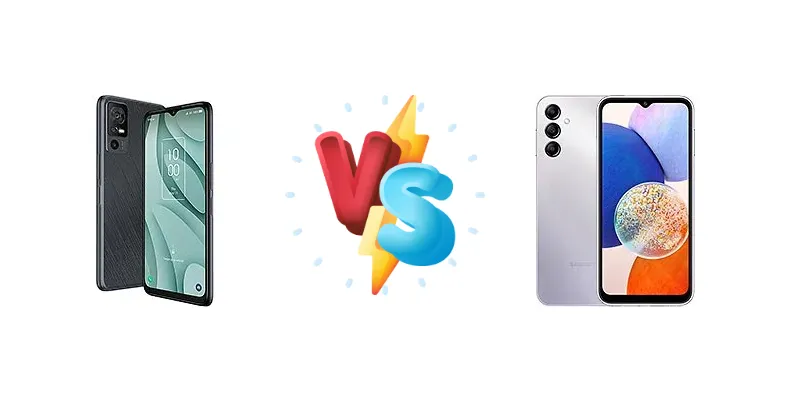
The TCL 40 XE and Samsung Galaxy A14 5G represent the current battleground for affordable 5G connectivity. Both aim to deliver essential smartphone features without breaking the bank, but they take different approaches to achieving this. This comparison dissects their key specifications to determine which device offers the best value for your money.
🏆 Quick Verdict
For most users, the Samsung Galaxy A14 5G emerges as the stronger choice. While the TCL 40 XE offers a slightly more efficient chipset on paper, the A14 5G’s brighter display, and potentially more optimized software experience, provide a more well-rounded user experience.
| Network |
|---|
| 2G bands | GSM 850 / 900 / 1800 / 1900 | GSM 850 / 900 / 1800 / 1900 |
| 3G bands | HSDPA 850 / 1700(AWS) / 1900 - USA | HSDPA 850 / 900 / 1700(AWS) / 1900 / 2100 |
| 4G bands | 2, 4, 5, 12, 13, 25, 26, 41, 66, 71 - USA | 1, 2, 3, 4, 5, 7, 8, 12, 17, 20, 26, 28, 38, 40, 41, 66 - International |
| 5G bands | SA/NSA | 2, 5, 66, 77 Sub6/mmWave - USA |
| Speed | HSPA, LTE, 5G | HSPA, LTE, 5G |
| Technology | GSM / HSPA / LTE / 5G | GSM / HSPA / LTE / 5G |
| | eMMC 5.1 | 1, 3, 5, 7, 8, 20, 28, 40, 41, 78 SA/NSA/Sub6 - India |
| Launch |
|---|
| Announced | 2023, February 26 | 2023, January 04 |
| Status | Available. Released 2023, June | Available. Released 2023, January 12 |
| Body |
|---|
| Build | Glass front, plastic frame, plastic back | Glass front, plastic back, plastic frame |
| Dimensions | 164.5 x 75.4 x 0 mm (6.48 x 2.97 x 0.0 in) | 167.7 x 78 x 9.1 mm (6.60 x 3.07 x 0.36 in) |
| SIM | · Nano-SIM· Nano-SIM + Nano-SIM | · Nano-SIM· Nano-SIM + Nano-SIM |
| Weight | 195 g (6.88 oz) | 202 g (7.13 oz) |
| Display |
|---|
| Resolution | 720 x 1612 pixels, 20:9 ratio (~269 ppi density) | 1080 x 2408 pixels, 20:9 ratio (~400 ppi density) |
| Size | 6.56 inches, 103.4 cm2 (~83.4% screen-to-body ratio) | 6.6 inches, 104.9 cm2 (~80.2% screen-to-body ratio) |
| Type | IPS LCD, 90Hz | PLS LCD, 90Hz |
| Platform |
|---|
| CPU | Octa-core (2x2.2 GHz Cortex-A76 & 6x2.0 GHz Cortex-A55) | Octa-core (2x2.4 GHz Cortex-A78 & 6x2.0 GHz Cortex-A55) - SM-A146BOcta-core (2x2.2 GHz Cortex-A76 & 6x2.0 GHz Cortex-A55) - SM-A146P |
| Chipset | Mediatek Dimensity 700 (7 nm) | Exynos 1330 (5 nm) - SM-A146BMediatek Dimensity 700 (7 nm) - SM-A146P |
| GPU | Mali-G57 MC2 | Mali-G68 MP2 - SM-A146BMali-G57 MC2 - SM-A146P |
| OS | Android 13, TCL UI | Android 13, upgradable to Android 15, One UI Core 7 |
| Memory |
|---|
| Card slot | microSDXC | microSDXC (uses shared SIM slot) - USA onlymicroSDXC (dedicated slot) - International |
| Internal | 64GB 4GB RAM | 64GB 4GB RAM, 128GB 4GB RAM, 128GB 6GB RAM, 128GB 8GB RAM |
| Main Camera |
|---|
| Features | LED flash, HDR, panorama | LED flash, panorama, HDR |
| Single | 8 MP, f/2.0, 26mm (wide) 1/4.0", 1.12µm | 13 MP, f/2.0, (wide) |
| Triple | 13 MP, f/2.2, 27mm (wide) 1/3.0", 1.12µm, PDAF
2 MP (macro)
Auxiliary lens | 50 MP, f/1.8, 26mm (wide), 1/2.76", 0.64µm, PDAF
2 MP (macro)
Auxiliary lens |
| Video | 1080p@30fps | 1080p@30fps |
| Selfie camera |
|---|
| Single | 8 MP, f/2.0, 26mm (wide) 1/4.0", 1.12µm | 13 MP, f/2.0, 26mm (wide), 1.12µm |
| Video | 1080p@30fps | 1080p@30fps |
| Sound |
|---|
| 3.5mm jack | Yes | Yes |
| 35mm jack | Yes | Yes |
| Loudspeaker | Yes | Yes |
| Comms |
|---|
| Bluetooth | 5.1, A2DP, LE | 5.2, A2DP, LE |
| NFC | No | Yes |
| Positioning | GPS, GLONASS, GALILEO, BDS | GPS, GLONASS, GALILEO |
| Radio | FM radio | FM radio (Exynos 1330 chipset only), recording |
| USB | USB Type-C 2.0 | USB Type-C 2.0 |
| WLAN | Wi-Fi 802.11 a/b/g/n/ac, dual-band, Wi-Fi Direct | Wi-Fi 802.11 a/b/g/n/ac, dual-band, Wi-Fi Direct |
| Features |
|---|
| Sensors | Fingerprint (side-mounted), accelerometer, gyro, proximity, compass | Fingerprint (side-mounted), accelerometer, gyro, proximity, compass, barometer (USA only) |
| Battery |
|---|
| Charging | 18W wired | 15W wired |
| Type | Li-Ion 5000 mAh | Li-Po 5000 mAh |
| Misc |
|---|
| Colors | Starlight Black | Black, Light Green, Dark Red, Silver |
| Models | T609SPP | SM-A146B, SM-A146B/DS, SM-A146P, SM-A146P/DS, SM-A146U, SM-A146U1, SM-A146U1/DS, SM-A146W, SM-A146P/N, SM-A146P/DSN, SM-S146VL, SM-A146M |
| Price | About 100 EUR | $ 77.63 / C$ 151.00 / £ 97.00 / € 159.79 / ₹ 14,990 |
| SAR | 1.38 W/kg (head) 1.12 W/kg (body) | 1.00 W/kg (head) 1.00 W/kg (body) |
| SAR EU | - | 0.56 W/kg (head) 1.28 W/kg (body) |
| Tests |
|---|
| Battery life | - |
Endurance rating 130h
|
| Camera | - |
Photo / Video |
| Display | - |
Contrast ratio: 1334:1 (nominal) |
| Loudspeaker | - |
-26.8 LUFS (Good)
|
| Performance | - |
AnTuTu: 307886 (v9)
GeekBench: 1727 (v5.1)
GFXBench: 12fps (ES 3.1 onscreen) |
TCL 40 XE
- Potentially better thermal management due to 7nm Dimensity 700.
- Slightly faster 18W charging.
- Competitive price point.
- Lack of detailed display specifications.
- Older generation chipset compared to the Exynos 1330 variant of the A14 5G.
- Less established brand reputation.
Samsung Galaxy A14 5G
- Brighter display (519 nits) for better outdoor visibility.
- Exynos 1330 (in some variants) offers a performance advantage.
- Established Samsung ecosystem and software support.
- Slower 15W charging.
- Potential for chipset variant confusion (Dimensity 700 in some regions).
- May be slightly more expensive than the TCL 40 XE.
Display Comparison
The Samsung Galaxy A14 5G boasts a measured peak brightness of 519 nits, significantly improving visibility in direct sunlight compared to the TCL 40 XE, which lacks published brightness data. Both share a 1334:1 contrast ratio, suggesting similar black levels and color depth. However, the lack of detailed display specifications for the TCL 40 XE, such as panel type (IPS vs. VA) and color gamut coverage, leaves questions about its overall image quality. The A14 5G’s higher brightness is a clear advantage for outdoor usability.
Camera Comparison
Both devices offer 'Photo / Video' capabilities, but lack specific details regarding sensor size, aperture, or image stabilization. This makes a direct comparison difficult. The absence of information suggests both likely employ budget-oriented camera systems. The TCL 40 XE and Samsung Galaxy A14 5G both likely include a 2MP macro camera, which typically delivers limited usable results due to low resolution and lack of optical image stabilization. Focusing on the main sensor specifications would be crucial for a meaningful camera comparison, but this data is currently unavailable.
Performance
The Samsung Galaxy A14 5G presents a more complex chipset situation. The SM-A146B variant utilizes the Exynos 1330 (5nm), featuring a more modern CPU architecture with 2x2.4 GHz Cortex-A78 cores, offering a performance edge over the TCL 40 XE’s Dimensity 700 (7nm) and its 2x2.2 GHz Cortex-A76 cores. However, the SM-A146P variant uses the same Dimensity 700 as the TCL 40 XE. The 5nm process of the Exynos 1330 generally translates to better power efficiency and thermal performance, potentially reducing throttling during demanding tasks. The TCL 40 XE’s Dimensity 700, while capable, is an older generation chipset. Both phones share 6x2.0 GHz Cortex-A55 efficiency cores, meaning multi-tasking performance will be similar, but the Exynos 1330 has a clear advantage in single-core performance.
Battery Life
Both the TCL 40 XE and Samsung Galaxy A14 5G achieve an Endurance rating of 130 hours, indicating similar overall battery life. The A14 5G supports 15W wired charging, while the TCL 40 XE offers 18W wired charging. While the TCL 40 XE has a slightly faster charging rate, the difference is unlikely to be substantial in real-world usage. The similar endurance ratings suggest that despite potential chipset efficiency differences, both phones offer comparable all-day battery life under typical usage scenarios.
Buying Guide
Buy the TCL 40 XE if you prioritize a potentially cooler-running device under sustained load due to the Dimensity 700’s 7nm process, and are comfortable with a potentially less polished software experience. Buy the Samsung Galaxy A14 5G if you value a brighter, more visible display in outdoor conditions, and prefer the established Samsung ecosystem and software support.
Frequently Asked Questions
❓ Does the Exynos 1330 in the Samsung Galaxy A14 5G overheat during prolonged gaming sessions?
While the Exynos 1330 is a capable chipset, its thermal performance can vary. The 5nm process helps mitigate heat, but sustained gaming at high settings may still lead to some throttling. However, it's generally expected to perform better than the Dimensity 700 under similar conditions due to its more modern architecture.
❓ Is the 2MP macro camera on either phone worth using?
Generally, 2MP macro cameras on budget phones offer limited utility. The low resolution and lack of optical image stabilization result in images that often lack detail and sharpness. They can be fun to experiment with, but don't expect professional-quality macro photography.
❓ Which phone is better for streaming video and browsing the web?
The Samsung Galaxy A14 5G’s brighter display makes it the better choice for streaming video, especially in well-lit environments. Both phones will handle web browsing adequately, but the A14 5G’s potentially faster processor (Exynos 1330 variant) may result in slightly smoother scrolling and page loading.
❓ What chipset does the Samsung Galaxy A14 5G have in my region?
The Samsung Galaxy A14 5G comes in two chipset variants: the SM-A146B model uses the Exynos 1330 (5nm), while the SM-A146P model uses the Mediatek Dimensity 700 (7nm). Checking your device's model number in the settings is crucial to determine which chipset you have.