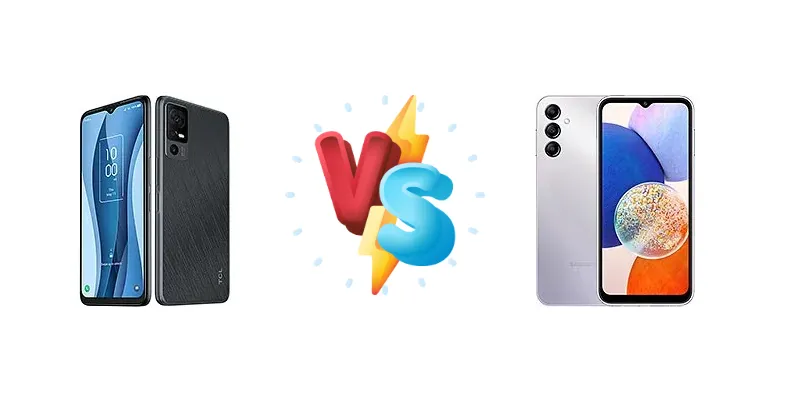
The TCL 40 X and Samsung Galaxy A14 5G represent compelling options in the increasingly competitive sub-$200 5G smartphone market. Both aim to deliver essential features and connectivity without breaking the bank, but they achieve this through different approaches to chipset design and feature prioritization. This comparison dissects their key specifications to determine which device offers the best value for your money.
🏆 Quick Verdict
For most users, the Samsung Galaxy A14 5G emerges as the slightly better choice. While the TCL 40 X offers a respectable Dimensity 700, the A14 5G’s Exynos 1330 (in the SM-A146B variant) provides a noticeable performance uplift, coupled with a comparable battery life and a brighter display.
| Network |
|---|
| 2G bands | GSM 850 / 900 / 1800 / 1900 | GSM 850 / 900 / 1800 / 1900 |
| 3G bands | HSDPA 850 / 1700(AWS) / 1900 - USA | HSDPA 850 / 900 / 1700(AWS) / 1900 / 2100 |
| 4G bands | 2, 4, 5, 12, 13, 25, 26, 41, 66, 71 - USA | 1, 2, 3, 4, 5, 7, 8, 12, 17, 20, 26, 28, 38, 40, 41, 66 - International |
| 5G bands | 2, 5, 66, 77 SA/NSA | 2, 5, 66, 77 Sub6/mmWave - USA |
| Speed | HSPA, LTE, 5G | HSPA, LTE, 5G |
| Technology | GSM / HSPA / LTE / 5G | GSM / HSPA / LTE / 5G |
| | - | 1, 3, 5, 7, 8, 20, 28, 40, 41, 78 SA/NSA/Sub6 - India |
| Launch |
|---|
| Announced | 2023, February 26 | 2023, January 04 |
| Status | Available. Released 2023, June | Available. Released 2023, January 12 |
| Body |
|---|
| Build | Glass front, plastic frame, plastic back | Glass front, plastic back, plastic frame |
| Dimensions | 164.5 x 75.4 x 9 mm (6.48 x 2.97 x 0.35 in) | 167.7 x 78 x 9.1 mm (6.60 x 3.07 x 0.36 in) |
| SIM | · Nano-SIM· Nano-SIM + Nano-SIM | · Nano-SIM· Nano-SIM + Nano-SIM |
| Weight | 195 g (6.88 oz) | 202 g (7.13 oz) |
| Display |
|---|
| Resolution | 720 x 1612 pixels, 20:9 ratio (~269 ppi density) | 1080 x 2408 pixels, 20:9 ratio (~400 ppi density) |
| Size | 6.56 inches, 103.4 cm2 (~83.4% screen-to-body ratio) | 6.6 inches, 104.9 cm2 (~80.2% screen-to-body ratio) |
| Type | IPS LCD, 90Hz | PLS LCD, 90Hz |
| Platform |
|---|
| CPU | Octa-core (2x2.2 GHz Cortex-A76 & 6x2.0 GHz Cortex-A55) | Octa-core (2x2.4 GHz Cortex-A78 & 6x2.0 GHz Cortex-A55) - SM-A146BOcta-core (2x2.2 GHz Cortex-A76 & 6x2.0 GHz Cortex-A55) - SM-A146P |
| Chipset | Mediatek Dimensity 700 (7 nm) | Exynos 1330 (5 nm) - SM-A146BMediatek Dimensity 700 (7 nm) - SM-A146P |
| GPU | Mali-G57 MC2 | Mali-G68 MP2 - SM-A146BMali-G57 MC2 - SM-A146P |
| OS | Android 13, TCL UI | Android 13, upgradable to Android 15, One UI Core 7 |
| Memory |
|---|
| Card slot | microSDXC | microSDXC (uses shared SIM slot) - USA onlymicroSDXC (dedicated slot) - International |
| Internal | 64GB 4GB RAM | 64GB 4GB RAM, 128GB 4GB RAM, 128GB 6GB RAM, 128GB 8GB RAM |
| Main Camera |
|---|
| Features | LED flash, HDR, panorama | LED flash, panorama, HDR |
| Single | 8 MP, (wide) | 13 MP, f/2.0, (wide) |
| Triple | 50 MP, (wide), PDAF
2 MP (macro)
Auxiliary lens | 50 MP, f/1.8, 26mm (wide), 1/2.76", 0.64µm, PDAF
2 MP (macro)
Auxiliary lens |
| Video | 1080p@30fps | 1080p@30fps |
| Selfie camera |
|---|
| Single | 8 MP, (wide) | 13 MP, f/2.0, 26mm (wide), 1.12µm |
| Video | 1080p@30fps | 1080p@30fps |
| Sound |
|---|
| 3.5mm jack | Yes | Yes |
| 35mm jack | Yes | Yes |
| Loudspeaker | Yes, with dual speakers | Yes |
| Comms |
|---|
| Bluetooth | 5.1, A2DP, LE | 5.2, A2DP, LE |
| NFC | No | Yes |
| Positioning | GPS | GPS, GLONASS, GALILEO |
| Radio | Unspecified | FM radio (Exynos 1330 chipset only), recording |
| USB | USB Type-C 2.0 | USB Type-C 2.0 |
| WLAN | Wi-Fi 802.11 a/b/g/n/ac, dual-band | Wi-Fi 802.11 a/b/g/n/ac, dual-band, Wi-Fi Direct |
| Features |
|---|
| Sensors | Fingerprint (side-mounted), accelerometer, gyro, proximity, compass, barometer (USA only) | Fingerprint (side-mounted), accelerometer, gyro, proximity, compass, barometer (USA only) |
| Battery |
|---|
| Charging | 18W wired | 15W wired |
| Type | Li-Ion 5000 mAh | Li-Po 5000 mAh |
| Misc |
|---|
| Colors | Black | Black, Light Green, Dark Red, Silver |
| Models | T609M | SM-A146B, SM-A146B/DS, SM-A146P, SM-A146P/DS, SM-A146U, SM-A146U1, SM-A146U1/DS, SM-A146W, SM-A146P/N, SM-A146P/DSN, SM-S146VL, SM-A146M |
| Price | About 190 EUR | $ 77.63 / C$ 151.00 / £ 97.00 / € 159.79 / ₹ 14,990 |
| SAR | - | 1.00 W/kg (head) 1.00 W/kg (body) |
| SAR EU | - | 0.56 W/kg (head) 1.28 W/kg (body) |
| Tests |
|---|
| Battery life | - |
Endurance rating 130h
|
| Camera | - |
Photo / Video |
| Display | - |
Contrast ratio: 1334:1 (nominal) |
| Loudspeaker | - |
-26.8 LUFS (Good)
|
| Performance | - |
AnTuTu: 307886 (v9)
GeekBench: 1727 (v5.1)
GFXBench: 12fps (ES 3.1 onscreen) |
TCL 40 X
- Slightly faster 18W charging
- Potentially cleaner software experience
- Competitive price point
- Less powerful chipset (Dimensity 700)
- Display brightness data unavailable, likely lower than A14 5G
- Limited performance headroom for demanding apps
Samsung Galaxy A14 5G
- More powerful chipset (Exynos 1330 - SM-A146B)
- Brighter display (519 nits)
- Samsung’s software ecosystem and support
- Slower 15W charging
- Potential for software bloat
- Chipset variant (Dimensity 700 - SM-A146P) reduces performance
Display Comparison
The Samsung Galaxy A14 5G boasts a brighter display, measured at 519 nits, compared to the TCL 40 X, for which peak brightness data is unavailable. Both share a 1334:1 contrast ratio, suggesting similar dynamic range. While both displays are likely LCD panels given the price point, the A14 5G’s higher brightness translates to better readability in direct sunlight. The lack of high refresh rate support on either device is typical for this segment, but the A14 5G’s brightness advantage is a key differentiator.
Camera Comparison
Both devices feature a 'Photo / Video' camera setup, but detailed sensor information is lacking. Given the price bracket, image quality will likely be similar in good lighting conditions. However, the A14 5G’s potential for better image processing, stemming from the more powerful chipset, could result in superior low-light performance and more refined image details. The presence of a 2MP macro camera on both devices is largely a marketing feature, offering limited practical benefit due to the small sensor size and lack of optical image stabilization.
Performance
The core difference lies in the chipsets. The Samsung Galaxy A14 5G utilizes either the Exynos 1330 (SM-A146B) or the Mediatek Dimensity 700 (SM-A146P). The Exynos 1330, with its Cortex-A78 cores clocked at 2.4 GHz, offers a performance advantage over the TCL 40 X’s Dimensity 700 (2.2 GHz Cortex-A76 cores). The 5nm process node of the Exynos 1330 also contributes to improved power efficiency compared to the Dimensity 700’s 7nm node, potentially leading to better sustained performance under load. Both phones feature similar RAM configurations, but the Exynos 1330’s architectural advantages give it the edge in demanding tasks.
Battery Life
Both the TCL 40 X and Samsung Galaxy A14 5G achieve an endurance rating of 130 hours, indicating comparable battery life. The A14 5G has a 15W charging speed, while the TCL 40 X supports 18W wired charging. While the TCL 40 X has a slightly faster charging rate, the difference is unlikely to be significant in real-world usage. The comparable endurance ratings suggest that both phones can comfortably last a full day on a single charge with moderate use.
Buying Guide
Buy the TCL 40 X if you prioritize a streamlined software experience and are comfortable with a slightly less powerful processor. It’s a solid option for basic smartphone tasks and light multitasking. Buy the Samsung Galaxy A14 5G if you need a phone capable of handling more demanding applications, enjoy a brighter display for outdoor visibility, and appreciate Samsung’s established software ecosystem and longer-term support.
Frequently Asked Questions
❓ Does the Exynos 1330 in the Samsung Galaxy A14 5G overheat during prolonged gaming sessions?
While the Exynos 1330 is more powerful than the Dimensity 700, it's still a mid-range chipset. Moderate thermal throttling is possible during extended gaming, but the 5nm process node helps mitigate this compared to older, larger-node chipsets. Expect playable frame rates, but not necessarily sustained peak performance for hours on end.
❓ Is the 2MP macro camera on either phone worth using?
Generally, no. 2MP macro cameras on budget phones suffer from poor image quality due to the small sensor size and lack of autofocus. Images often appear soft and lack detail. They are primarily a marketing feature and offer limited practical benefit compared to using the main camera in close-up mode.
❓ Which phone is better for streaming video and social media?
The Samsung Galaxy A14 5G is better suited for streaming and social media due to its brighter display. The increased brightness makes content more visible in various lighting conditions, enhancing the viewing experience. The more powerful chipset also ensures smoother scrolling and app performance.
❓ What chipset does the Samsung Galaxy A14 5G have? Is there a difference?
The Samsung Galaxy A14 5G comes in two chipset variants: the SM-A146B model uses the Exynos 1330, offering superior performance, while the SM-A146P model uses the Mediatek Dimensity 700. The Exynos 1330 version is significantly more desirable if performance is a priority.