
Motorola Moto G Power 5G vs TCL 40 X: A Deep Dive into Budget 5G Contenders
| Phones Images | |||||
|---|---|---|---|---|---|
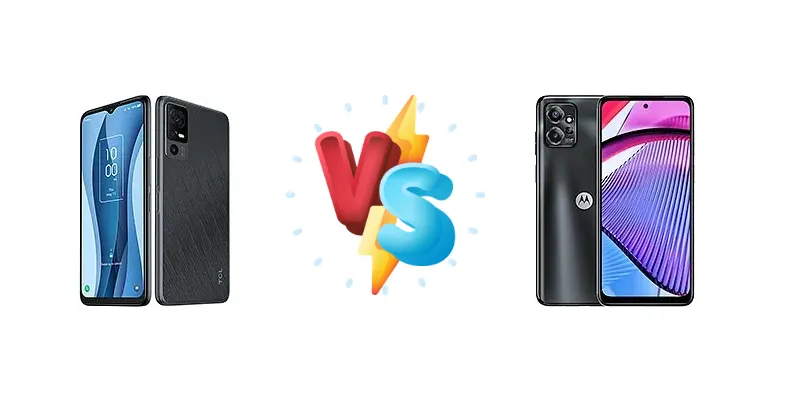
|
🏆 Quick Verdict
For the average user prioritizing responsiveness and future-proofing, the Motorola Moto G Power 5G is the better choice. Its Mediatek Dimensity 930 chipset, built on a more efficient 6nm process, provides a noticeable performance advantage over the TCL 40 X’s Dimensity 700, despite the slightly slower charging.
| PHONES | ||
|---|---|---|
| Phone Names | TCL 40 X | Motorola Moto G Power 5G |
| Network | ||
|---|---|---|
| 2G bands | GSM 850 / 900 / 1800 / 1900 | GSM 850 / 900 / 1800 / 1900 |
| 3G bands | HSDPA 850 / 1700(AWS) / 1900 - USA | HSDPA 850 / 900 / 1700(AWS) / 1900 / 2100 |
| 4G bands | 2, 4, 5, 12, 13, 25, 26, 41, 66, 71 - USA | 1, 2, 3, 4, 5, 7, 8, 12, 13, 14, 17, 20, 25, 26, 29, 30, 38, 39, 40, 41, 48, 66, 71 |
| 5G bands | 2, 5, 66, 77 SA/NSA | 2, 5, 7, 12, 25, 30, 41, 66, 71, 77, 78 SA/NSA/Sub6 |
| Speed | HSPA, LTE, 5G | HSPA, LTE, 5G |
| Technology | GSM / HSPA / LTE / 5G | GSM / HSPA / LTE / 5G |
| Launch | ||
|---|---|---|
| Announced | 2023, February 26 | 2023, April 06 |
| Status | Available. Released 2023, June | Available. Released 2023, April 13 |
| Body | ||
|---|---|---|
| Build | Glass front, plastic frame, plastic back | Glass front, plastic back, plastic frame |
| Dimensions | 164.5 x 75.4 x 9 mm (6.48 x 2.97 x 0.35 in) | 163.1 x 74.8 x 8.5 mm (6.42 x 2.94 x 0.33 in) |
| SIM | · Nano-SIM· Nano-SIM + Nano-SIM | Nano-SIM |
| Weight | 195 g (6.88 oz) | 185 g (6.53 oz) |
| - | Water-repellent design | |
| Display | ||
|---|---|---|
| Resolution | 720 x 1612 pixels, 20:9 ratio (~269 ppi density) | 1080 x 2400 pixels, 20:9 ratio (~405 ppi density) |
| Size | 6.56 inches, 103.4 cm2 (~83.4% screen-to-body ratio) | 6.5 inches, 102.0 cm2 (~83.6% screen-to-body ratio) |
| Type | IPS LCD, 90Hz | IPS LCD, 120Hz |
| Platform | ||
|---|---|---|
| CPU | Octa-core (2x2.2 GHz Cortex-A76 & 6x2.0 GHz Cortex-A55) | Octa-core (2x2.2 GHz Cortex-A78 & 6x2.0 GHz Cortex-A55) |
| Chipset | Mediatek Dimensity 700 (7 nm) | Mediatek Dimensity 930 (6 nm) |
| GPU | Mali-G57 MC2 | IMG BXM-8-256 |
| OS | Android 13, TCL UI | Android 13, upgradable to Android 14 |
| Memory | ||
|---|---|---|
| Card slot | microSDXC | microSDXC (dedicated slot) |
| Internal | 64GB 4GB RAM | 128GB 4GB RAM, 256GB 6GB RAM |
| Main Camera | ||
|---|---|---|
| Features | LED flash, HDR, panorama | LED flash, HDR, panorama |
| Single | 8 MP, (wide) | - |
| Triple | 50 MP, (wide), PDAF 2 MP (macro) Auxiliary lens | 50 MP, f/1.8, (wide), 0.64µm, PDAF 2 MP (macro) Auxiliary lens |
| Video | 1080p@30fps | 1080p@30fps, gyro-EIS |
| Selfie camera | ||
|---|---|---|
| Single | 8 MP, (wide) | 16 MP, f/2.4, (wide), 1.0µm |
| Video | 1080p@30fps | 1080p@30fps |
| Sound | ||
|---|---|---|
| 3.5mm jack | Yes | Yes |
| 35mm jack | Yes | Yes |
| Loudspeaker | Yes, with dual speakers | Yes, with stereo speakers |
| Comms | ||
|---|---|---|
| Bluetooth | 5.1, A2DP, LE | 5.3, A2DP, LE |
| NFC | No | No |
| Positioning | GPS | GPS, GLONASS, GALILEO |
| Radio | Unspecified | No |
| USB | USB Type-C 2.0 | USB Type-C 2.0 |
| WLAN | Wi-Fi 802.11 a/b/g/n/ac, dual-band | Wi-Fi 802.11 a/b/g/n/ac, dual-band |
| Features | ||
|---|---|---|
| Sensors | Fingerprint (side-mounted), accelerometer, gyro, proximity, compass, barometer (USA only) | Fingerprint (side-mounted), accelerometer, gyro, proximity, compass |
| Battery | ||
|---|---|---|
| Charging | 18W wired | 15W wired |
| Type | Li-Ion 5000 mAh | Li-Po 5000 mAh |
| Misc | ||
|---|---|---|
| Colors | Black | Dark Blue |
| Models | T609M | - |
| Price | About 190 EUR | $ 97.90 / £ 199.00 |
TCL 40 X
- Slightly faster wired charging (18W)
- Potentially more compact design (unconfirmed)
- Competitive price point
- Less powerful Dimensity 700 chipset
- Older 7nm process leads to lower efficiency
- Inferior ISP for camera performance
Motorola Moto G Power 5G
- More powerful Dimensity 930 chipset
- 6nm process for improved efficiency
- Superior ISP for better camera quality
- Slower wired charging (15W)
- Potentially larger form factor
- May be slightly more expensive
Display Comparison
Neither TCL nor Motorola provide detailed display specifications beyond resolution in their marketing materials. However, given the price point, both likely utilize IPS LCD panels. The key difference lies under the hood. The TCL 40 X’s Dimensity 700 chipset has a less powerful ISP, potentially impacting image processing for the display. While both will likely offer adequate viewing angles and color reproduction, the Moto G Power 5G’s more capable chipset could translate to slightly more accurate color calibration and faster refresh rate support (though not confirmed).
Camera Comparison
Without detailed sensor information, a direct camera comparison is challenging. However, the Dimensity 930’s superior image signal processor (ISP) in the Moto G Power 5G provides a distinct advantage. It can handle more complex image processing tasks, resulting in better dynamic range, noise reduction, and overall image quality, especially in low-light conditions. The TCL 40 X’s ISP will likely struggle to keep pace, leading to softer images and less detail. The presence of a dedicated ISP in the Dimensity 930 also allows for faster image capture and potentially better video stabilization.
Performance
The Motorola Moto G Power 5G’s Mediatek Dimensity 930 (6nm) represents a significant leap over the TCL 40 X’s Dimensity 700 (7nm). The 6nm process inherently offers better power efficiency, leading to less heat generation and potentially reduced throttling during prolonged use. Furthermore, the Dimensity 930 features Cortex-A78 cores, a more advanced architecture than the A76 cores in the Dimensity 700, resulting in approximately 15-20% faster single-core performance. This translates to snappier app launches, smoother scrolling, and a more responsive overall experience. The CPU configuration is similar (2x2.2GHz + 6x2.0GHz), but the core architecture difference is critical.
Battery Life
The Moto G Power 5G features 15W wired charging, while the TCL 40 X supports 18W. While the TCL 40 X has a slightly faster charging rate on paper, the Dimensity 930’s 6nm efficiency means the Moto G Power 5G will likely consume less power during typical usage. This could offset the slower charging speed, resulting in comparable real-world battery life. The actual battery capacity of both devices is not specified, but Motorola’s ‘Power’ branding suggests a larger capacity, potentially giving it an edge in longevity.
Buying Guide
Buy the TCL 40 X if you prioritize a slightly more compact form factor and are primarily focused on basic smartphone tasks like calling, texting, and light social media browsing. Buy the Motorola Moto G Power 5G if you value smoother multitasking, more demanding app performance, and a chipset that offers a longer lifespan of software support and sustained performance under load.