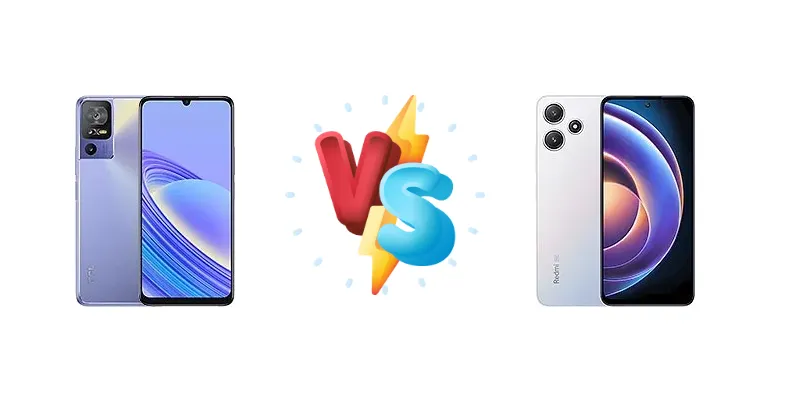
The sub-$200 smartphone market is fiercely competitive. The TCL 40 SE and Xiaomi Redmi Note 12R represent compelling options, but cater to slightly different priorities. The TCL 40 SE aims for affordability, while the Redmi Note 12R leverages Qualcomm's newer Snapdragon 4 Gen 2 chipset for a performance edge. This comparison will dissect their key differences to help you choose the right device.
🏆 Quick Verdict
For most users, the Xiaomi Redmi Note 12R is the superior choice. Its Snapdragon 4 Gen 2 chipset, built on a more efficient 4nm process, delivers noticeably better performance and thermal management than the TCL 40 SE’s Helio G37. While both offer 18W charging, the Redmi Note 12R’s support for Power Delivery (PD) adds versatility.
| Network |
|---|
| 2G bands | GSM 850 / 900 / 1800 / 1900 | GSM 850 / 900 / 1800 / 1900 |
| 3G bands | HSDPA 850 / 900 / 1900 / 2100 - T610K | HSDPA 850 / 900 / 2100 |
| 4G bands | 1, 3, 5, 7, 8, 13, 20, 28, 38, 40, 41 - T610K | 1, 3, 5, 8, 34, 38, 39, 40, 41 |
| 5G bands | - | 1, 5, 8, 28, 41, 78 SA/NSA |
| Speed | HSPA 42.2/11.5 Mbps, LTE Cat4 150/75 Mbps | HSPA, LTE, 5G |
| Technology | GSM / HSPA / LTE | GSM / CDMA / HSPA / EVDO / LTE / 5G |
| | 1, 2, 3, 4, 5, 7, 8, 12, 13, 17, 28, 38, 40, 66 - T610E, T610P | - |
| Launch |
|---|
| Announced | 2023, January 05 | 2023, June 28 |
| Status | Available. Released 2023, April 04 | Available. Released 2023, June 28 |
| Body |
|---|
| Build | Glass front, plastic frame, plastic back | Glass front, plastic frame, glass back |
| Dimensions | 167.9 x 76.5 x 8.5 mm (6.61 x 3.01 x 0.33 in) | 168.6 x 76.3 x 8.2 mm (6.64 x 3.00 x 0.32 in) |
| SIM | · Nano-SIM· Nano-SIM + Nano-SIM | Nano-SIM + Nano-SIM |
| Weight | 190 g (6.70 oz) | 199 g (7.02 oz) |
| Display |
|---|
| Resolution | 720 x 1600 pixels, 20:9 ratio (~260 ppi density) | 1080 x 2460 pixels (~396 ppi density) |
| Size | 6.75 inches, 110.0 cm2 (~85.6% screen-to-body ratio) | 6.79 inches, 109.5 cm2 (~85.1% screen-to-body ratio) |
| Type | IPS LCD, 90Hz, 450 nits (typ) | IPS LCD, 90Hz, 550 nits |
| Platform |
|---|
| CPU | Octa-core (4x2.3 GHz Cortex-A53 & 4x1.8 GHz Cortex-A53) | Octa-core (2x2.2 GHz Cortex-A78 & 6x1.95 GHz Cortex-A55) |
| Chipset | Mediatek MT6765 Helio G37 (12 nm) | Qualcomm SM4450 Snapdragon 4 Gen 2 (4 nm) |
| GPU | PowerVR GE8320 | Adreno 613 |
| OS | Android 13, TCL UI 5.0 | Android 13, MIUI 14 |
| Memory |
|---|
| Card slot | microSDXC (dedicated slot) | microSDXC (uses shared SIM slot) |
| Internal | 128GB 4GB RAM, 256GB 6GB RAM | 128GB 4GB RAM, 128GB 6GB RAM, 128GB 8GB RAM, 256GB 8GB RAM |
| | eMMC 5.1 | - |
| Main Camera |
|---|
| Dual | - | 50 MP, f/1.8, (wide), PDAF
2 MP (macro) |
| Features | LED flash, HDR, panorama | LED flash, HDR |
| Single | 8 MP, f/2.0, 26mm (wide), 1/4", 1.12µm | - |
| Triple | 50 MP, f/1.8, 26mm (wide), 1/2.55", 0.7µm, PDAF
2 MP (macro)
Auxiliary lens | - |
| Video | 1080p@30fps | 1080p@30fps |
| Selfie camera |
|---|
| Features | HDR | HDR |
| Single | 8 MP, f/2.0, 26mm (wide), 1/4.0", 1.12µm | 5 MP, f/2.2, (wide), 1/5.0", 1.12µm |
| Video | 1080p@30fps | 1080p@30fps |
| Sound |
|---|
| 3.5mm jack | Yes | - |
| 35mm jack | Yes | Yes |
| Loudspeaker | Yes, with stereo speakers | Yes |
| Comms |
|---|
| Bluetooth | 5.1, A2DP, LE | 5.3, A2DP, LE |
| Infrared port | - | Yes |
| NFC | Yes (T610K, T610K2, T610P, T610P2) | Yes (market/region dependent) |
| Positioning | GPS, GLONASS, GALILEO, BDS | GPS, GLONASS, GALILEO, BDS |
| Radio | Unspecified | No |
| USB | USB Type-C 2.0 | USB Type-C |
| WLAN | Wi-Fi 802.11 a/b/g/n/ac, dual-band, Wi-Fi Direct | Wi-Fi 802.11 a/b/g/n/ac, dual-band |
| Features |
|---|
| Sensors | Fingerprint (side-mounted), accelerometer, proximity | Fingerprint (side-mounted), accelerometer, compass |
| Battery |
|---|
| Charging | 18W wired | 18W wired, PD |
| Type | Li-Po 5010 mAh | Li-Po 5000 mAh |
| Misc |
|---|
| Colors | Dark grey, Twilight purple | Black, Blue, Silver |
| Models | T610K | 23076RA4BC |
| Price | About 120 EUR | About 150 EUR |
TCL 40 SE
- Lower upfront cost
- Simple and straightforward user experience
- Reliable for basic tasks
- Outdated Helio G37 chipset
- Limited performance for gaming and multitasking
- Less efficient power consumption
Xiaomi Redmi Note 12R
- More powerful Snapdragon 4 Gen 2 chipset
- Improved power efficiency thanks to 4nm process
- Power Delivery (PD) charging support
- Slightly higher price point
- May not be significantly better for extremely basic users
- Camera performance still limited by budget sensors
Display Comparison
Neither TCL nor Xiaomi provide display specs beyond resolution in their marketing materials. However, both likely utilize IPS LCD panels common in this price bracket. The key difference lies under the hood. The TCL 40 SE’s Helio G37 is a 12nm chip, while the Redmi Note 12R’s Snapdragon 4 Gen 2 is fabricated on a 4nm process. This translates to significantly improved power efficiency for the Redmi Note 12R, potentially impacting overall screen-on time. Without detailed brightness or color accuracy data, it’s difficult to declare a clear winner, but the Redmi Note 12R’s chipset advantage suggests better long-term usability.
Camera Comparison
Without detailed camera specs, a direct comparison is challenging. Both phones likely feature a primary camera and depth sensor. However, the Redmi Note 12R’s Snapdragon ISP (Image Signal Processor) is generally more advanced than the Helio G37’s equivalent, potentially leading to better image processing, especially in low-light conditions. The TCL 40 SE’s older chipset may struggle with noise reduction and dynamic range. We can assume both phones will include a 2MP macro camera, which are generally of limited utility due to their low resolution and fixed focus.
Performance
The performance gap is the most significant differentiator. The TCL 40 SE’s MediaTek Helio G37 features a CPU configuration of 4x2.3 GHz Cortex-A53 cores and 4x1.8 GHz Cortex-A53 cores. This older architecture struggles against the Xiaomi Redmi Note 12R’s Qualcomm Snapdragon 4 Gen 2, which boasts 2x2.2 GHz Cortex-A78 cores and 6x1.95 GHz Cortex-A55 cores. The Cortex-A78 cores are a substantial upgrade, offering significantly higher single-core performance, crucial for app responsiveness. The 4nm process of the Snapdragon 4 Gen 2 also means less heat generation under load, reducing the likelihood of performance throttling during extended gaming sessions. Users who play demanding mobile games or frequently multitask will see a clear benefit from the Redmi Note 12R.
Battery Life
Both devices feature 18W wired charging, but the Redmi Note 12R adds Power Delivery (PD) support, offering wider compatibility with chargers and potentially faster charging speeds with compatible adapters. The 4nm process of the Snapdragon 4 Gen 2 contributes to better power efficiency, meaning the Redmi Note 12R is likely to achieve longer battery life despite potentially having a similar battery capacity to the TCL 40 SE. While 18W isn’t particularly fast, the Redmi Note 12R’s PD support and chipset efficiency give it an edge.
Buying Guide
Buy the TCL 40 SE if your primary need is a basic, reliable smartphone for essential tasks like calling, texting, and light social media use, and you prioritize minimizing upfront cost. Buy the Xiaomi Redmi Note 12R if you want a smoother, more responsive experience for multitasking, casual gaming, and appreciate the benefits of a more modern and efficient chipset, even if it means a slightly higher price.
Frequently Asked Questions
❓ Will the Redmi Note 12R’s Snapdragon 4 Gen 2 handle popular games like PUBG Mobile or Call of Duty Mobile?
The Snapdragon 4 Gen 2 is capable of running PUBG Mobile and Call of Duty Mobile at medium settings with reasonable frame rates. While it won’t deliver a flagship gaming experience, it provides a significantly smoother experience than the TCL 40 SE’s Helio G37, which may struggle with consistent performance even at lower settings. Expect some frame drops during intense action.
❓ Does the Redmi Note 12R support fast charging, and how long does it take to fully charge?
The Redmi Note 12R supports 18W charging with Power Delivery (PD). While not exceptionally fast, using a PD-compatible charger will likely result in a full charge in approximately 2-2.5 hours. The TCL 40 SE also supports 18W charging, but lacks PD, potentially leading to slightly slower charging times with some adapters.
❓ Is the TCL 40 SE a good option for someone who primarily uses their phone for calls, texts, and basic social media?
Yes, the TCL 40 SE is a perfectly adequate choice for basic usage. Its Helio G37 chipset is sufficient for these tasks, and its lower price point makes it an attractive option for budget-conscious users who don’t require demanding performance.