
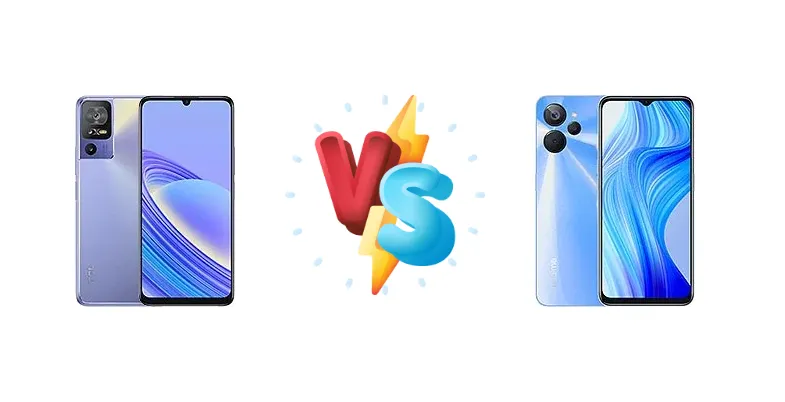
Realme 10T vs TCL 40 SE: A Deep Dive into Budget Smartphone Performance
| Phones Images | |||||
|---|---|---|---|---|---|
|
🏆 Quick Verdict
For most users, the Realme 10T is the better choice. Its Mediatek Dimensity 810 chipset, built on a more efficient 6nm process, provides a noticeable performance uplift over the TCL 40 SE’s Helio G37. While both charge at 18W, the Realme 10T’s superior processing power justifies the slight price premium.
| PHONES | ||
|---|---|---|
| Phone Names | TCL 40 SE | Realme 10T |
| Network | ||
|---|---|---|
| 2G bands | GSM 850 / 900 / 1800 / 1900 | GSM 850 / 900 / 1800 / 1900 |
| 3G bands | HSDPA 850 / 900 / 1900 / 2100 - T610K | HSDPA 800 / 850 / 900 / 1700(AWS) / 1900 / 2100 |
| 4G bands | 1, 3, 5, 7, 8, 13, 20, 28, 38, 40, 41 - T610K | 1, 2, 3, 4, 5, 7, 8, 12, 13, 17, 18, 19, 20, 26, 28, 38, 39, 40, 41, 66 |
| 5G bands | - | 1, 3, 5, 7, 8, 20, 28, 38, 40, 41, 66, 77, 78 SA/NSA |
| Speed | HSPA 42.2/11.5 Mbps, LTE Cat4 150/75 Mbps | HSPA, LTE, 5G |
| Technology | GSM / HSPA / LTE | GSM / HSPA / LTE / 5G |
| 1, 2, 3, 4, 5, 7, 8, 12, 13, 17, 28, 38, 40, 66 - T610E, T610P | - | |
| Launch | ||
|---|---|---|
| Announced | 2023, January 05 | 2023, March 21 |
| Status | Available. Released 2023, April 04 | Available. Released 2023, March 23 |
| Body | ||
|---|---|---|
| Build | Glass front, plastic frame, plastic back | - |
| Dimensions | 167.9 x 76.5 x 8.5 mm (6.61 x 3.01 x 0.33 in) | 164.4 x 75.1 x 8.1 mm (6.47 x 2.96 x 0.32 in) |
| SIM | · Nano-SIM· Nano-SIM + Nano-SIM | Nano-SIM + Nano-SIM |
| Weight | 190 g (6.70 oz) | 187 g (6.60 oz) |
| Display | ||
|---|---|---|
| Resolution | 720 x 1600 pixels, 20:9 ratio (~260 ppi density) | 1080 x 2408 pixels, 20:9 ratio (~400 ppi density) |
| Size | 6.75 inches, 110.0 cm2 (~85.6% screen-to-body ratio) | 6.6 inches, 104.9 cm2 (~85.0% screen-to-body ratio) |
| Type | IPS LCD, 90Hz, 450 nits (typ) | IPS LCD, 90Hz, 400 nits (typ) |
| Platform | ||
|---|---|---|
| CPU | Octa-core (4x2.3 GHz Cortex-A53 & 4x1.8 GHz Cortex-A53) | Octa-core (2x2.4 GHz Cortex-A76 & 6x2.0 GHz Cortex-A55) |
| Chipset | Mediatek MT6765 Helio G37 (12 nm) | Mediatek Dimensity 810 (6 nm) |
| GPU | PowerVR GE8320 | Mali-G57 MC2 |
| OS | Android 13, TCL UI 5.0 | Android 12, Realme UI 3.0 |
| Memory | ||
|---|---|---|
| Card slot | microSDXC (dedicated slot) | microSDXC (dedicated slot) |
| Internal | 128GB 4GB RAM, 256GB 6GB RAM | 128GB 4GB RAM, 128GB 8GB RAM, 256GB 8GB RAM |
| eMMC 5.1 | UFS 2.2 | |
| Main Camera | ||
|---|---|---|
| Features | LED flash, HDR, panorama | LED flash, HDR, panorama |
| Single | 8 MP, f/2.0, 26mm (wide), 1/4", 1.12µm | - |
| Triple | 50 MP, f/1.8, 26mm (wide), 1/2.55", 0.7µm, PDAF 2 MP (macro) Auxiliary lens | 50 MP, f/1.8, (wide), 1/2.76", 0.64µm, PDAF Unspecified MP, f/2.8, 46mm (telephoto) 2 MP (macro) |
| Video | 1080p@30fps | 1080p@30fps |
| Selfie camera | ||
|---|---|---|
| Features | HDR | HDR, panorama |
| Single | 8 MP, f/2.0, 26mm (wide), 1/4.0", 1.12µm | 8 MP, f/2.0, 27mm (wide) |
| Video | 1080p@30fps | 1080p@30fps |
| Sound | ||
|---|---|---|
| 3.5mm jack | Yes | Yes |
| 35mm jack | Yes | Yes |
| Loudspeaker | Yes, with stereo speakers | Yes |
| Comms | ||
|---|---|---|
| Bluetooth | 5.1, A2DP, LE | 5.2, A2DP, LE |
| NFC | Yes (T610K, T610K2, T610P, T610P2) | No |
| Positioning | GPS, GLONASS, GALILEO, BDS | GPS, GLONASS, BDS |
| Radio | Unspecified | No |
| USB | USB Type-C 2.0 | USB Type-C 2.0, OTG |
| WLAN | Wi-Fi 802.11 a/b/g/n/ac, dual-band, Wi-Fi Direct | Wi-Fi 802.11 a/b/g/n/ac, dual-band |
| Features | ||
|---|---|---|
| Sensors | Fingerprint (side-mounted), accelerometer, proximity | Fingerprint (side-mounted), accelerometer, proximity, compass |
| Battery | ||
|---|---|---|
| Charging | 18W wired | 18W wired |
| Type | Li-Po 5010 mAh | 5000 mAh |
| Misc | ||
|---|---|---|
| Colors | Dark grey, Twilight purple | Electric Black, Dash Blue |
| Models | T610K | - |
| Price | About 120 EUR | About 200 EUR |
TCL 40 SE
- Most affordable option
- Decent for basic tasks
- Likely lightweight design
- Significantly weaker performance
- Less efficient processor
- Limited gaming capabilities
Realme 10T
- More powerful Dimensity 810 chipset
- Improved power efficiency
- Smoother multitasking and gaming
- Slightly higher price
- May not have significantly better camera performance
- 18W charging is relatively slow
Display Comparison
Neither TCL nor Realme provide detailed display specifications beyond the basic panel type. However, given the price point, both likely utilize LCD panels. The Realme 10T’s advantage lies in its processor’s ability to drive a potentially higher refresh rate display, though this isn’t confirmed. The TCL 40 SE, with its less powerful chipset, is likely limited to a standard 60Hz refresh rate. Bezels are expected to be comparable, reflecting the budget nature of both devices. Color accuracy will likely be standard for this segment, prioritizing vibrancy over absolute fidelity.
Camera Comparison
Detailed camera specs are unavailable, but we can infer some differences. Both phones likely feature a primary camera and depth/macro sensors. Given the Realme 10T’s more powerful processor, it likely benefits from more sophisticated image processing algorithms, potentially resulting in better dynamic range and noise reduction. The TCL 40 SE’s Helio G37 may struggle with complex image processing tasks. The presence of Optical Image Stabilization (OIS) is unlikely on either device at this price point. The Realme 10T’s ISP (Image Signal Processor) within the Dimensity 810 will likely offer faster processing and potentially better video recording capabilities.
Performance
The core difference between these two phones lies in their chipsets. The Realme 10T’s Mediatek Dimensity 810 (6nm) significantly outperforms the TCL 40 SE’s Mediatek Helio G37 (12nm). The Dimensity 810 features two Cortex-A76 cores clocked at 2.4GHz, offering substantially greater single-core performance than the G37’s four Cortex-A53 cores at 2.3GHz. The 6nm fabrication process of the Dimensity 810 also translates to improved power efficiency and reduced thermal throttling during sustained workloads. This means the Realme 10T will handle demanding apps and games more smoothly and for longer periods. The Realme 10T is the clear winner for users who prioritize performance.
Battery Life
Both the TCL 40 SE and Realme 10T support 18W wired charging. While the actual battery capacity isn’t specified, the Realme 10T’s more efficient Dimensity 810 chipset will likely result in better overall battery life despite potentially having a similar capacity to the TCL 40 SE. The 6nm process node contributes to lower power consumption, extending usage time between charges. A full 0-100% charge with the included 18W charger is estimated to take around 2 hours for both devices.
Buying Guide
Buy the TCL 40 SE if you prioritize absolute affordability and your smartphone usage is limited to basic tasks like calling, texting, and light social media browsing. Buy the Realme 10T if you value smoother multitasking, occasional gaming, and a more responsive user experience, even if it means spending a bit more.