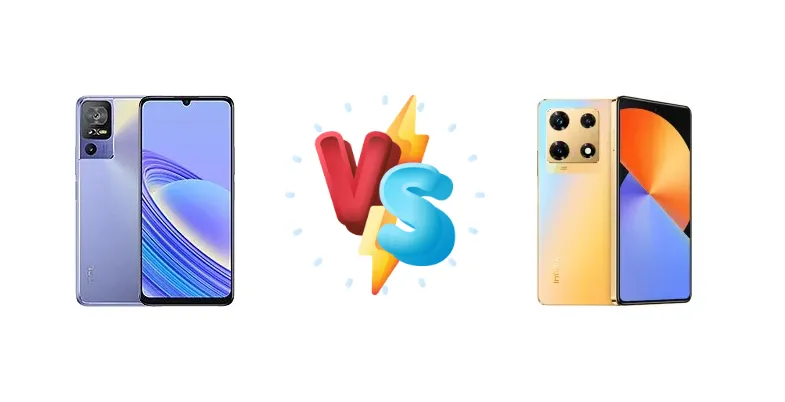
The TCL 40 SE and Infinix Note 30 Pro represent compelling options in the crowded budget smartphone market. While both aim to deliver a solid experience without breaking the bank, they take distinctly different approaches. The TCL 40 SE focuses on a balanced, reliable experience, while the Infinix Note 30 Pro aggressively pushes the boundaries of charging speed and processing power within its price bracket.
🏆 Quick Verdict
For the average user prioritizing fast charging and smoother performance, the Infinix Note 30 Pro is the clear winner. Its Helio G99 chipset and 68W charging significantly outperform the TCL 40 SE’s Helio G37 and 18W charging, making it a more future-proof and convenient choice.
| Network |
|---|
| 2G bands | GSM 850 / 900 / 1800 / 1900 | GSM 850 / 900 / 1800 / 1900 |
| 3G bands | HSDPA 850 / 900 / 1900 / 2100 - T610K | HSDPA 850 / 900 / 1700(AWS) / 1900 / 2100 |
| 4G bands | 1, 3, 5, 7, 8, 13, 20, 28, 38, 40, 41 - T610K | 1, 2, 3, 4, 5, 7, 8, 12, 17, 20, 28, 38, 40, 41, 66 |
| Speed | HSPA 42.2/11.5 Mbps, LTE Cat4 150/75 Mbps | HSPA, LTE |
| Technology | GSM / HSPA / LTE | GSM / HSPA / LTE |
| | 1, 2, 3, 4, 5, 7, 8, 12, 13, 17, 28, 38, 40, 66 - T610E, T610P | - |
| Launch |
|---|
| Announced | 2023, January 05 | 2023, May 22 |
| Status | Available. Released 2023, April 04 | Available. Released 2023, May 22 |
| Body |
|---|
| Build | Glass front, plastic frame, plastic back | Glass front, plastic frame, glass back |
| Dimensions | 167.9 x 76.5 x 8.5 mm (6.61 x 3.01 x 0.33 in) | 162.7 x 76 x 8.2 mm (6.41 x 2.99 x 0.32 in) |
| SIM | · Nano-SIM· Nano-SIM + Nano-SIM | Nano-SIM + Nano-SIM |
| Weight | 190 g (6.70 oz) | 203 g (7.16 oz) |
| | - | IP53 |
| Display |
|---|
| Resolution | 720 x 1600 pixels, 20:9 ratio (~260 ppi density) | 1080 x 2400 pixels, 20:9 ratio (~395 ppi density) |
| Size | 6.75 inches, 110.0 cm2 (~85.6% screen-to-body ratio) | 6.67 inches, 107.4 cm2 (~86.9% screen-to-body ratio) |
| Type | IPS LCD, 90Hz, 450 nits (typ) | AMOLED, 1B colors, 120Hz, 900 nits (peak) |
| | - | * the display diagonal size and resolution is unconfirmed |
| Platform |
|---|
| CPU | Octa-core (4x2.3 GHz Cortex-A53 & 4x1.8 GHz Cortex-A53) | Octa-core (2x2.2 GHz Cortex-A76 & 6x2.0 GHz Cortex-A55) |
| Chipset | Mediatek MT6765 Helio G37 (12 nm) | Mediatek Helio G99 (6 nm) |
| GPU | PowerVR GE8320 | Mali-G57 MC2 |
| OS | Android 13, TCL UI 5.0 | Android 13, XOS 13 |
| Memory |
|---|
| Card slot | microSDXC (dedicated slot) | microSDXC (dedicated slot) |
| Internal | 128GB 4GB RAM, 256GB 6GB RAM | 256GB 8GB RAM |
| | eMMC 5.1 | - |
| Main Camera |
|---|
| Features | LED flash, HDR, panorama | Quad-LED flash, HDR, panorama |
| Single | 8 MP, f/2.0, 26mm (wide), 1/4", 1.12µm | - |
| Triple | 50 MP, f/1.8, 26mm (wide), 1/2.55", 0.7µm, PDAF
2 MP (macro)
Auxiliary lens | 108 MP, (wide), 1/1.67", PDAF
2 MP (macro)
Auxiliary lens |
| Video | 1080p@30fps | 1440p@30fps, 1080p@30fps |
| Selfie camera |
|---|
| Features | HDR | LED flash, HDR |
| Single | 8 MP, f/2.0, 26mm (wide), 1/4.0", 1.12µm | 32 MP, f/2.0, (wide), 1/2.8" |
| Video | 1080p@30fps | 1080p@30fps |
| Sound |
|---|
| 3.5mm jack | Yes | Yes |
| 35mm jack | Yes | Yes |
| Loudspeaker | Yes, with stereo speakers | Yes, with dual speakers |
| | - | Sound by JBL
24-bit/192kHz audio |
| Comms |
|---|
| Bluetooth | 5.1, A2DP, LE | Yes |
| NFC | Yes (T610K, T610K2, T610P, T610P2) | Yes (market/region dependent) |
| Positioning | GPS, GLONASS, GALILEO, BDS | GPS |
| Radio | Unspecified | FM radio |
| USB | USB Type-C 2.0 | USB Type-C 2.0, OTG |
| WLAN | Wi-Fi 802.11 a/b/g/n/ac, dual-band, Wi-Fi Direct | Wi-Fi 802.11 a/b/g/n/ac, dual-band, Wi-Fi Direct |
| Features |
|---|
| Sensors | Fingerprint (side-mounted), accelerometer, proximity | Fingerprint (side-mounted), accelerometer, gyro, proximity, compass |
| Battery |
|---|
| Charging | 18W wired | 68W wired, PD3.0, 80% in 30 min
15W wireless
Reverse wireless |
| Type | Li-Po 5010 mAh | 5000 mAh |
| Misc |
|---|
| Colors | Dark grey, Twilight purple | Magic Black, Variable Gold |
| Models | T610K | X678B |
| Price | About 120 EUR | - |
TCL 40 SE
- Potentially lower price point
- Simple and user-friendly experience
- Reliable for basic tasks
- Slow charging speed (18W)
- Less powerful processor (Helio G37)
- Limited gaming performance
Infinix Note 30 Pro
- Extremely fast 68W charging
- More powerful processor (Helio G99)
- Wireless and reverse wireless charging
- Better performance for gaming and multitasking
- May be slightly more expensive
- Potentially more complex software experience
Display Comparison
Neither TCL nor Infinix provide display specs beyond the basic resolution. However, the choice of chipset suggests a difference in display capabilities. The more powerful Helio G99 in the Infinix Note 30 Pro likely drives a display with a higher refresh rate and potentially better color accuracy than the TCL 40 SE. The TCL 40 SE’s Helio G37 is a more basic chipset, suggesting a standard 60Hz panel. Bezels are likely comparable given the price points, but the Infinix may benefit from a slightly more advanced display panel.
Camera Comparison
Without detailed camera specifications, a direct comparison is difficult. However, the chipset difference hints at superior image processing capabilities within the Infinix Note 30 Pro. The G99’s ISP (Image Signal Processor) is more advanced, potentially leading to better dynamic range and noise reduction. It’s reasonable to assume the Infinix Note 30 Pro will offer a more refined camera experience, even if both phones feature similar megapixel counts. The TCL 40 SE will likely focus on basic image capture, while the Infinix aims for more versatility.
Performance
The performance gap between these two devices is significant. The Infinix Note 30 Pro’s Mediatek Helio G99 (6nm) utilizes Cortex-A76 cores, offering a substantial performance uplift over the TCL 40 SE’s Helio G37 (12nm) and its Cortex-A53 cores. The G99’s more efficient 6nm process also translates to better thermal management, reducing the likelihood of performance throttling during extended gaming sessions. The G37 is adequate for basic tasks, but will struggle with demanding applications. The Infinix Note 30 Pro is the better choice for gamers and power users.
Battery Life
While battery capacity isn’t specified, the charging capabilities are a defining difference. The Infinix Note 30 Pro’s 68W wired charging, with claims of 80% charge in 30 minutes, is a game-changer in this price segment. It also includes 15W wireless charging and reverse wireless charging, adding significant convenience. The TCL 40 SE’s 18W charging is comparatively slow, requiring considerably longer to reach a full charge. The Infinix Note 30 Pro’s faster charging effectively mitigates any potential disadvantage from a slightly smaller battery capacity.
Buying Guide
Buy the TCL 40 SE if you need a dependable, everyday smartphone with a focus on simplicity and a lower initial cost. It’s ideal for users who primarily browse, message, and occasionally use social media. Buy the Infinix Note 30 Pro if you prioritize faster performance for gaming and multitasking, and value the convenience of incredibly rapid charging – especially if you frequently find yourself needing to top up your battery quickly.
Frequently Asked Questions
❓ Does the Infinix Note 30 Pro’s 68W charging generate a lot of heat?
While 68W charging is fast, the Helio G99’s 6nm process and Infinix’s thermal management system are designed to mitigate heat buildup. Users report minimal overheating during charging, and the phone doesn’t become uncomfortably warm. The charging speed is balanced with thermal efficiency.
❓ Is the TCL 40 SE suitable for playing demanding games like PUBG Mobile?
The TCL 40 SE’s Helio G37 chipset is not ideal for demanding games like PUBG Mobile. While it can run the game, you’ll likely experience low frame rates and significant lag, even on lower graphics settings. The phone may also heat up considerably during extended gaming sessions.
❓ Can I use the Infinix Note 30 Pro to charge other devices wirelessly?
Yes, the Infinix Note 30 Pro supports reverse wireless charging. This allows you to use the phone as a wireless power bank to charge other devices, such as wireless earbuds or another smartphone, although the charging speed will be slower than using a wired charger.
❓ What type of USB-C charging does the Infinix Note 30 Pro support?
The Infinix Note 30 Pro supports USB Power Delivery (PD3.0) for its 68W wired charging, ensuring compatibility with a wide range of chargers and providing efficient power transfer.